The wearable robot design developed by a Korean research team has been recognized for its excellence on a global stage.
KAIST announced on August 8 that the Move Lab, led by Professor Hyunjun Park from the Department of Industrial Design, received the Best of the Best award in the Design Concept-Professional category at the 2025 Red Dot Design Award for its next-generation wearable robot design, the Angel Robotics WSF1 Vision Concept.
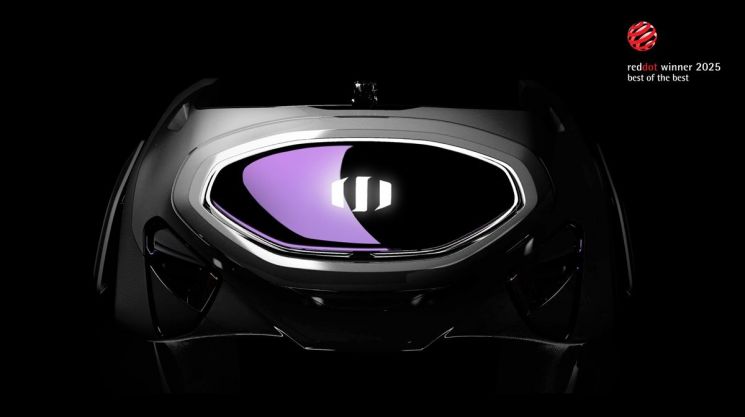
The Red Dot Design Award in Germany is considered one of the world's top three design awards, alongside the International Design Excellence Awards (IDEA) in the United States and the Industrie Forum Design Award (IF Design Award) in Germany.
In particular, the Red Dot Best of the Best award is given to the top design in each category and is reserved for only the top 1% of all winning entries.
The Angel Robotics WSF1 Vision Concept is a user-friendly follow-up to Move Lab's Walk On Suit F1 prototype. Previously, Move Lab demonstrated its capabilities by winning a gold medal at last year's Cybathlon with the Walk On Suit F1 prototype and receiving the IF Design Award this year.
The Angel Robotics WSF1 Vision Concept, which won the Best of the Best award at the Red Dot Design Award, is a concept design that proposes the form of a next-generation wearable robot (an ultra-personal mobility device) that can be used by people with lower limb paralysis in everyday environments. This design was realized through industry-academia collaboration with Angel Robotics, a company founded by Professor Kyungchul Kong from the Department of Mechanical Engineering at KAIST.
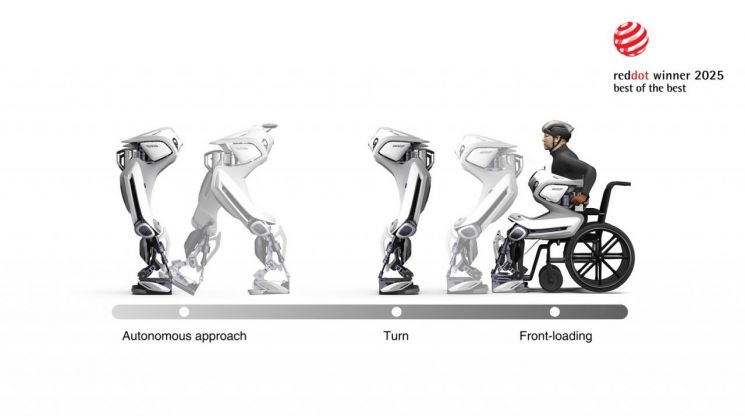
Move Lab focused on transforming Angel Robotics' advanced engineering platform into an intuitive and emotionally engaging user-centered experience, and has been recognized for implementing a design solution that simultaneously achieves functionality, aesthetics, and social inclusivity.
The Angel Robotics WSF1 Vision Concept incorporates several innovative features developed by Professor Kyungchul Kong's Exo Lab, including: an autonomous approach function that allows the robot to find the user on its own; a front-loading mechanism designed so the user can put it on independently while seated; multi-directional walking enabled by 12 powerful torque actuators and state-of-the-art control algorithms; and AI vision technology.
Above all, the multi-visual display system, which provides navigation and omnidirectional visibility, offers users a safer and more convenient mobility experience.
The robust yet elegant silhouette was achieved through a design process that pursued proportions, surfaces, and details not seen in conventional wearable robots.
 (From left) Professor Hyunjun Park, Master’s student Eunju Kang, Master’s student Jaesung Kim (admitted), Bachelor’s student Minsu Kim. Provided by KAIST
The fabric cover, which wraps from the robot's hip joint to the entire thigh, serves as a stylish element that respects the wearer's self-esteem and individuality, much like fashionable sportswear. It also functions as a device that enables the wearer to interact with the robot in a psychologically safe manner and blend in with the general public, presenting a new aesthetic for wearable robots where form and function are harmoniously integrated.
Professor Hyunjun Park stated, "The Angel Robotics WSF1 Vision Concept enables advanced technological solutions to reach users as easy, enjoyable, and stylish experiences through innovation centered on technology, aesthetics, and humanity. The core of the Angel Robotics WSF1 Vision Concept is to deliver a design experience that breaks away from the conventional framework of wearable robots, adding dignity, independence, and a new sense of style to users' lives."
Meanwhile, a physical model of the Angel Robotics WSF1 Vision Concept will be exhibited at the Gwangju Design Biennale Future Pavilion under the theme of "The Virtue of Inclusion" from August 30 to November 2.
© The Asia Business Daily(www.asiae.co.kr). All rights reserved.
![Clutching a Stolen Dior Bag, Saying "I Hate Being Poor but Real"... The Grotesque Con of a "Human Knockoff" [Slate]](https://cwcontent.asiae.co.kr/asiaresize/183/2026021902243444107_1771435474.jpg)

















