After the 2 Million Won Admission Ticket, Public Interest Is Lost
A Sports Event Focused Only on Appearances, Missing Its True Purpose
Jeju Development Corporation Remains Silent Amid Controversy
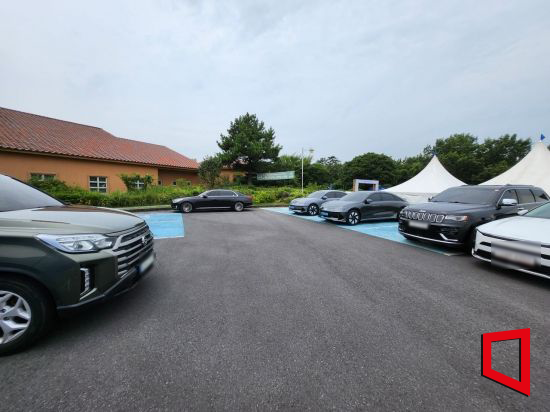 On the 6th, during the 2025 KLPGA Jeju Samdasoo Masters Golf Tournament, luxury and VIP cars are parked in the disabled parking spaces at Jeju Cypress Golf Course instead of vehicles for the disabled. Photo by Park Changwon
At the 2025 KLPGA Jeju Samdasoo Masters Golf Tournament, vehicles for the disabled were denied access to parking spaces they were rightfully entitled to use. At the Jeju Cypress Golf Course, where the tournament was held, luxury and VIP cars were parked in the disabled-only parking areas, and when a vehicle for the disabled arrived, it was blocked from entering on the grounds that it was a "VIP-only area."
A part-time staff member in charge of on-site guidance told the disabled driver, "Only VIPs are allowed," and prevented them from parking. When the disabled driver protested and asked the operations manager for confirmation, the same answer was repeated. In the verified photos, many regular vehicles without disabled markings were parked in the disabled parking spaces, and several spectators who witnessed the scene also reportedly lodged complaints.
In response, a representative from the tournament operations agency explained, "It appears there was an error in the on-site guidance," adding, "This has never happened in years of running the tournament, and we will take immediate action."
Even before the tournament began, controversy arose over the sale of "Rope Inside Tickets." These tickets were designed to allow general spectators to accompany players inside the ropes and watch the entire game up close, selling for 2 million won for the championship group and 1.5 million won for the regular group. Such ultra-high-priced spectator products are virtually unprecedented in domestic golf tournaments.
The agency claims that "all proceeds will be donated and the aim is to provide fans with a special experience," but criticism persists that the very structure of "paying to get closer" runs counter to the principle of fair sports viewing.
The problem is that the main organizer, Jeju Development Corporation, has not issued any statement regarding these operational issues.
Jeju Development Corporation is a leading public enterprise in Jeju, and this tournament was expected to be a public sports event for both residents and tourists. However, the controversy over disabled parking, high-priced admission tickets and lesson packages costing several hundred thousand won, and fan meeting packages in the 100,000-won range, all contribute to the impression that the event is focused on VIPs and is more of a "showcase" than a truly public event.
Local tourism expert Mr. A commented, "The disabled parking issue may be seen as a simple mistake, but there are structural limitations in the overall direction of the tournament's operation," and added, "If a local public enterprise is hosting a sports event using Jeju's resources, the purpose and scope of its benefits should be clear."
He emphasized, "Sports events hosted by local public enterprises should not be mere promotional tools, but should lead to resident participation, community engagement, and positive tourism impact," and continued, "Public interest and equity, based on the fundamentals, should take precedence over flashy events."
So far, Jeju Development Corporation has not made any official statement regarding this controversy. Passing responsibility solely to the outsourced agency when problems arise cannot be considered a responsible attitude for a public institution.
If there was confusion or error in tournament operations, clearly recognizing and immediately correcting the issue is the first step to earning the trust of local residents. Explanations such as "there is no problem because all proceeds are donated" or "it was a communication error on site" are not enough to resolve recurring issues.
The essence of a sports event is to guarantee equal rights and experiences for all participants. Emphasizing only a "special experience" without upholding the basics is ultimately a shortcut to losing trust.
Now is the time for the principle of "an event together with the local community" to become the starting point of event planning. It is time to prioritize the values that must be upheld over mere appearances.
© The Asia Business Daily(www.asiae.co.kr). All rights reserved.
![Clutching a Stolen Dior Bag, Saying "I Hate Being Poor but Real"... The Grotesque Con of a "Human Knockoff" [Slate]](https://cwcontent.asiae.co.kr/asiaresize/183/2026021902243444107_1771435474.jpg)















