Acceptance of Additional Quotas and Military Service Deferral...
Ongoing Discussions on Improving Training Environment
"Public Participation Medical Innovation Committee" to Launch Next Month
As the government and the medical community have reached an agreement on the detailed conditions for the reinstatement of resigned residents, a significant number of these residents are expected to resume their training in the second half of the year, starting next month. With medical students already returning to classes, the return of residents to training sites is set to finally bring an end to the medical-government conflict that has persisted for nearly a year and a half.
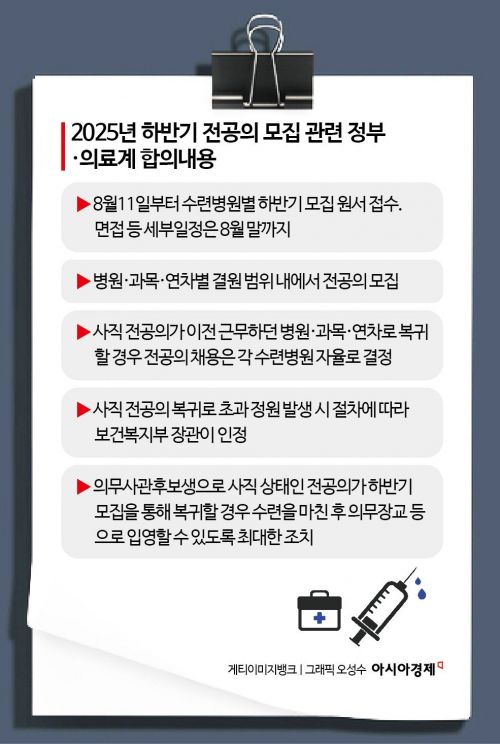
Agreement Reached on Residents' Return... Steps Toward Normalization of Medical Field
On the morning of the 7th, the Ministry of Health and Welfare, the Korean Intern Resident Association (KIRA), the Korean Academy of Medical Sciences, and the Association of Training Hospitals held the 3rd Resident Training Council meeting and finalized the recruitment plan for residents for the second half of the year, with applications opening on the 11th.
In this recruitment, the government will ensure that resigned residents can return to their original training hospitals by preserving their positions. For residents who have not yet completed military service but are in enlistment standby, the government will take all possible measures to allow them to complete their training first and then serve in the military, provided they return. Since the government has accepted most of the residents' demands for "guaranteeing continuity of training," it is expected that, except for a small number of resigned residents who have given up on training, the majority will return to their previous hospitals.
Kim Kukil, Director of Healthcare Policy at the Ministry of Health and Welfare, who attended the meeting, commented, "I believe the government has done everything it possibly can at this point."
Previously, residents collectively submitted resignations and stopped working from February 20 last year, in protest after the Yoon Suk-yeol administration announced an increase of 2,000 in the medical school quota. Although the government tried to encourage their return by applying special training and enlistment exemptions several times in the latter half of last year and the first half of this year, only a small number returned. Currently, there are 2,532 residents working at training hospitals nationwide, which is only 18.7% of the pre-conflict level.
The situation, which had been deadlocked for over a year, began to change after the impeachment of the Yoon Suk-yeol administration and the inauguration of the new government, which expressed a commitment to correct previous policy mistakes. Additionally, public opinion turned against the hardline stance of medical students and residents. Even after the inauguration of the Lee Jaemyung administration, no clear solution was presented for some time. However, growing internal dissatisfaction within the residents' association over continued protests without alternatives led to increasing calls for a return to work.
Subsequently, the departure of hardline leaders and the appointment of physician-turned-Minister of Health and Welfare Chung Eun-kyung helped open channels for dialogue between the government and the medical community. Prime Minister Kim Minseok actively engaged with residents and medical students from his first day in office, and the new leadership of KIRA, led by acting chair Han Sungjon, met broadly with the government, political circles, and patient organizations to facilitate the return of residents. Medical students who had refused to attend classes through collective leave declared an "unconditional return" last month and have since returned to school as the government allowed reinstatement.
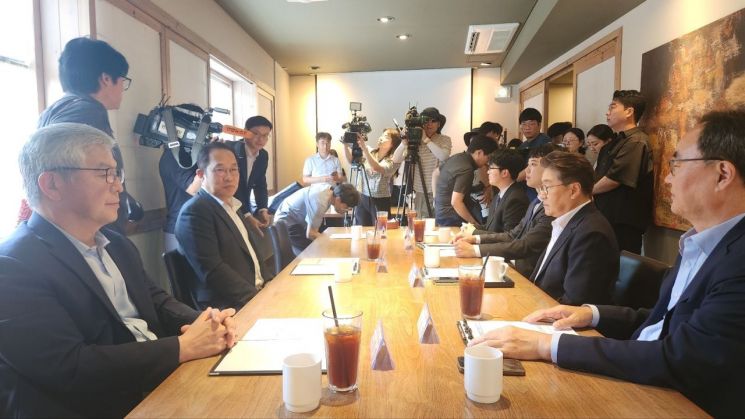 On the 7th, the 3rd Resident Training Council meeting is being held at Dalgaebi in Jung-gu, Seoul. Photo by Yonhap News
Ongoing Discussions to Improve Training Environment... Medical School Quota Projections Begin
Although discussions on the residents' return were concluded at the 3rd Resident Training Council meeting, the government, residents' associations, and training hospitals plan to continue talks on improving the training environment for residents. Efforts will first focus on reducing excessive working hours and enhancing the quality of training, while residents are also calling for the establishment of leave systems for unavoidable interruptions to training due to pregnancy, childbirth, childcare, illness, or military service.
The issue of medical school quotas, which triggered the conflict, will be discussed by the Physician Workforce Supply and Demand Estimation Committee, which was formed at the end of last month. This committee, composed of representatives recommended by the medical community, civic and patient organizations, and academia, will soon hold its first meeting to estimate the medical school quota for 2027 and beyond, and will finalize the numbers by April next year based on the results.
The "Public Participation Medical Innovation Committee" (tentative name), which will spearhead Lee Jaemyung's medical reform, is also set to launch next month. Through this initiative, the government plans to continue increasing reimbursement rates for undervalued essential medical services such as high-difficulty surgeries and procedures, establish a public compensation system for medical accidents to address the avoidance of high-risk essential care, and discuss building a legal protection system for physicians who have done their best in essential medical fields, thereby strengthening the safety net for medical incidents.
The Ministry of Health and Welfare emphasized, "With the recruitment of residents in the second half of the year, we will accelerate key policies to create an environment that favors doctors working in essential medical fields," and added, "During the discussions of the innovation committee, we will also ensure that residents and young doctors who will lead the future of Korean healthcare can participate fully so that the voices from the field are reflected."
© The Asia Business Daily(www.asiae.co.kr). All rights reserved.
![Clutching a Stolen Dior Bag, Saying "I Hate Being Poor but Real"... The Grotesque Con of a "Human Knockoff" [Slate]](https://cwcontent.asiae.co.kr/asiaresize/183/2026021902243444107_1771435474.jpg)

















