Venture investment reaches 800 billion KRW in July...
Rebellions and FuriosaAI become unicorns
Government supports 'Korean-style AI ecosystem'...
537.8 billion KRW invested in five elite teams
The domestic venture investment market has entered a rebound phase, with artificial intelligence (AI) at its core. As the government ramps up policy support to foster a Korean-style large-scale AI ecosystem, investor interest in AI-related companies is growing.
Venture investment reaches 800 billion KRW in July... Rebellions and FuriosaAI become unicorns
According to an analysis by Hanwha Investment & Securities on August 7, domestic venture investment in July totaled approximately 800 billion KRW. This figure is nearly double the monthly average investment of 440 billion KRW recorded in the first half of the year. Kim Suyeon, a researcher at Hanwha Investment & Securities, stated, "AI led the investment trend," and added, "As investment amounts increased, the range of industries expanded. In addition to AI, robotics, and medical devices, there has also been a rise in investments in sectors such as gaming and agriculture, which had seen little activity for some time."
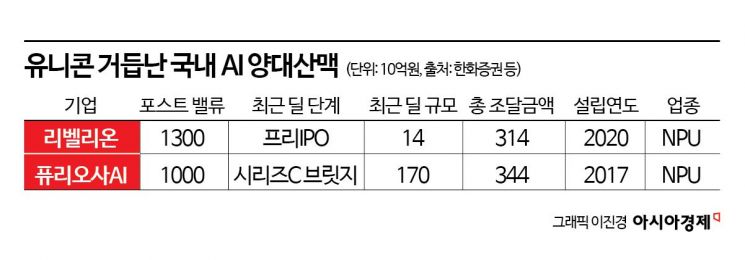
Riding this investment momentum, Korea's two major AI semiconductor (NPU) companies, FuriosaAI and Rebellions, have both joined the ranks of unicorns (unlisted companies valued at over 1 trillion KRW). The two companies attracted investment by achieving corporate valuations of 1 trillion to 1.3 trillion KRW through their respective Series C bridge rounds and pre-IPO (pre-listing investment) fundraising.
In addition, Web 3.0 gaming company Delabs Games, Law&Company, which operates the AI legal platform 'Lawtalk', and Rovers, a company specializing in agricultural genetic intellectual property (IP)-based breeding solutions, have all secured investments in succession. Kim noted, "What has changed compared to the past is that companies now need to incorporate either AI or blockchain in their business to attract investment," adding, "Delabs Games has combined large language models (LLMs) with blockchain, while Rovers is also developing breeding solutions by adopting AI."
Government supports 'Korean-style AI ecosystem'... 537.8 billion KRW invested in five elite teams
The government is also strengthening policy support in line with these market trends. The Ministry of Science and ICT recently selected five elite teams for the development of a 'domestic AI LLM' and officially launched the 'K-AI (Korean-style AI)' project, with a total budget of 537.8 billion KRW. The project includes tailored support for each team, such as GPU infrastructure essential for AI development (450 billion KRW), data construction (62.8 billion KRW), and the recruitment of overseas AI talent (25 billion KRW). Teams will be evaluated every six months, with eliminations at each stage, and only two teams will remain by the final round in 2027 in a tournament-style process.
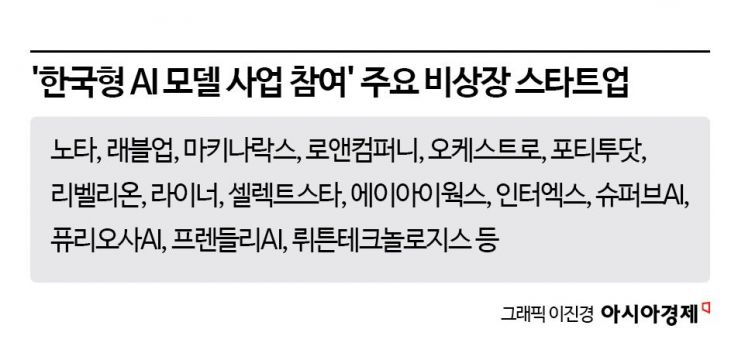
The elite teams are led by Naver Cloud, Upstage, SK Telecom, NC AI, and LG Management Development Institute, with numerous unlisted AI startups participating in each team. Notably, the Upstage team, which is headed by a startup, includes MakinaRocks, Nota, Law&Company, and Orchestra, among others, as collaborators. The SK Telecom team includes Rebellions, FortyTwoDot, and SelectStar, while the NC AI team features InterX, SuperbAI, and AIWorks.
Choi Jongkyung, a researcher at Heungkuk Securities, emphasized, "The implementation of this project marks the starting point for the expansion of Korea's AI ecosystem," adding, "It is particularly noteworthy that many unlisted startups are participating, much like the early days of the AI industry, providing an opportunity to observe companies that may become the foundation of the Korean AI industry in the future."
With such policy support, there is growing interest in the possibility that the K-AI model may be adopted for B2G (business-to-government) services in the future. Choi Seungho, a researcher at DS Investment & Securities, commented, "The significance of this project lies in the formation of consortiums that can participate in future government-led initiatives," and added, "There is a very high possibility that K-AI will be adopted in the most security-sensitive fields, such as defense and the public sector, and it is likely that the final selected teams will become the main suppliers."
A representative from a domestic venture capital (VC) firm remarked, "Even with technological capabilities, it has been difficult for startups to survive due to challenges in securing use cases and market size," and continued, "With both policy and funding support now being provided, both startups and investors are finally able to breathe a little easier."
© The Asia Business Daily(www.asiae.co.kr). All rights reserved.
![Clutching a Stolen Dior Bag, Saying "I Hate Being Poor but Real"... The Grotesque Con of a "Human Knockoff" [Slate]](https://cwcontent.asiae.co.kr/asiaresize/183/2026021902243444107_1771435474.jpg)

















