'Generational Reversal' in Major Companies
Share of Employees Under 30 Falls Below Those Aged 50 and Above for the First Time
For the first time, the proportion of employees under the age of 30 at major domestic companies has fallen below that of employees aged 50 and above. This "generational reversal" has occurred as new hiring has decreased while the retirement age has risen.
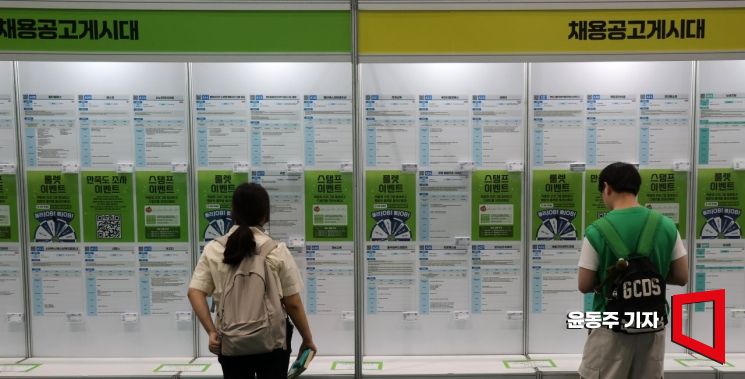
According to an analysis released on the 5th by Leaders Index, a corporate analysis research institute, which examined 124 major companies where workforce composition by age group can be compared, the proportion of employees under 30 at these companies last year was 19.8%, a decrease of 1.2 percentage points compared to the previous year. In contrast, the proportion of employees aged 50 and above increased by 0.6 percentage points to 20.1% over the same period. This is the first time since the survey began in 2015 that the proportions of these two age groups have reversed. It is also the first time that the share of employees under 30 has fallen below 20%.
Looking at the trend over the past three years, the number of employees under 30 was 235,923 (21.9%) in 2022, 230,888 (21.0%) in 2023, and 221,369 (19.8%) in 2024, showing a steady decline each year. In contrast, the number of employees aged 50 and above has steadily increased, from 206,040 (19.1%) in 2022, to 214,098 (19.5%) in 2023, and to 224,438 (20.1%) in 2024.
The industry with the largest gap between age groups was the secondary battery sector. In this sector, over the past three years, the proportion of employees under 30 dropped by 9.7 percentage points (7,789 people), while the proportion of those aged 50 and above increased by 1.2 percentage points (496 people), resulting in a gap of 10.9 percentage points. In the information technology (IT) and electrical and electronics industries, the proportion of employees under 30 decreased by 5.4 percentage points (15,300 people), while the proportion of those aged 50 and above increased by 3.1 percentage points (6,933 people), resulting in a difference of 8.5 percentage points.

Park Jugun, CEO of Leaders Index, said, "Due to the economic slowdown, most industries, including secondary batteries and IT, are taking a passive stance on hiring new employees. In addition, the retirement of senior employees is being delayed, accelerating the aging of the workforce within companies," adding, "We have reached a turning point where the proportions between generations have been reversed."
© The Asia Business Daily(www.asiae.co.kr). All rights reserved.
![Clutching a Stolen Dior Bag, Saying "I Hate Being Poor but Real"... The Grotesque Con of a "Human Knockoff" [Slate]](https://cwcontent.asiae.co.kr/asiaresize/183/2026021902243444107_1771435474.jpg)
















