Discovery of a New Giant Stick Insect Species
Acrophylla alta Found in the Highlands of Queensland, Australia
A newly discovered species of giant stick insect, as long as a human forearm, has been found in Australia, drawing attention from the academic community.
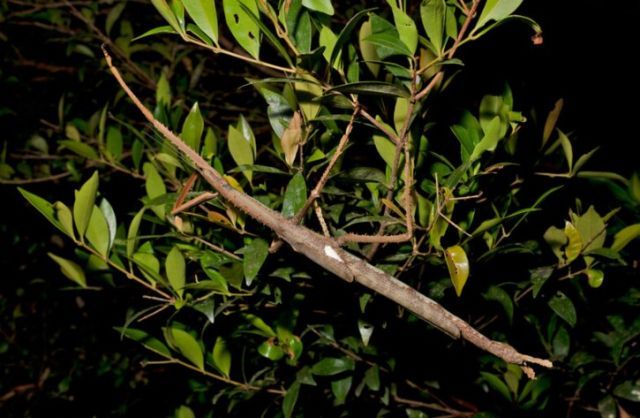 New species of giant stick insect discovered by researchers at James Cook University, Australia. James Cook University website
On July 31 (local time), The Guardian reported that a research team led by Professor Angus Emmott of James Cook University recently discovered a new insect species named Acrophylla alta in the highlands of Queensland, Australia. The researchers raised the new stick insect at Professor Emmott's home, analyzed the eggs it laid, and confirmed it as a new species through this process.
This insect measures about 40 centimeters in length and weighs 44 grams, making it slightly lighter than a golf ball. It is heavier than the giant burrowing cockroach, previously known as the heaviest insect in Australia. Due to Australia’s long isolation from other continents and its warm, humid environment, large insects are often discovered there.
The research team explained, "The high altitude and cool, humid environment of this region likely contributed to the giant growth of the stick insect." Additionally, because it lives in the canopy (the uppermost part) of plants in the highlands, it is difficult for people to spot it unless it falls due to typhoons or birds. In fact, when the researchers captured this stick insect, it was so high up that they had to use a long pole.
The specimen discovered this time is female, and no male has been found yet. Generally, female stick insects, which produce more eggs, are known to be two to three times larger than males. Therefore, if a male of this new species is found, it is expected to be smaller and have a different appearance compared to the female. Furthermore, even if a male is found, additional investigation will be required to confirm whether it is the same species as the one discovered this time.
Nicole Gunter of the Queensland Museum stated, "This discovery fills a gap in the study of Australia’s biodiversity," adding, "Seventy percent of Australian insects have not yet been scientifically reported. Since undiscovered species cannot be preserved, research like this is crucial."
Australia’s ecosystem has developed independently due to its long-term isolation, resulting in little influx of outside species. The scarcity of large predators has created an environment favorable for the survival of giant organisms, and extreme environments such as intense sunlight and arid deserts exert evolutionary pressure that favors larger and stronger individuals. Previously, Australia has also seen the discovery of giant species, such as the world’s largest butterfly with a wingspan of 18 centimeters and the largest cicada with a wingspan of 13 centimeters.
© The Asia Business Daily(www.asiae.co.kr). All rights reserved.
![Clutching a Stolen Dior Bag, Saying "I Hate Being Poor but Real"... The Grotesque Con of a "Human Knockoff" [Slate]](https://cwcontent.asiae.co.kr/asiaresize/183/2026021902243444107_1771435474.jpg)
















