Nuclear Weapons Materials Produced for Decades Since the 1950s
Department of Energy: "Soil and Surrounding Areas Not Contaminated"
Concerns about environmental contamination have been raised in the vicinity of a nuclear facility in South Carolina, United States, after wasp nests contaminated with radiation were discovered.
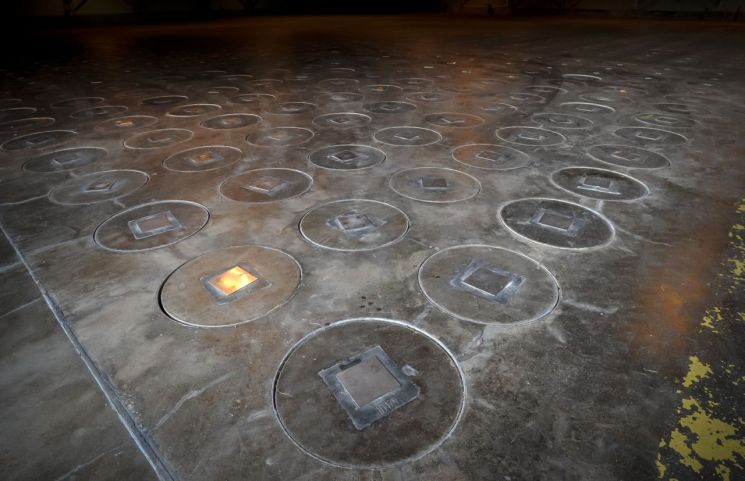 Radioactive waste stored beneath 5-foot-thick concrete inside a building at the Savannah River Plant in Aiken, South Carolina, USA, November 2013. Photo by AP
According to reports from The New York Times (NYT), AP, and others on August 1 (local time), workers found four wasp nests last month at the Savannah River Site in Aiken, South Carolina. The workers regularly monitor the site to check radiation levels, and on July 3, they discovered the first wasp nest on a pillar near a nuclear waste storage tank.
The U.S. Department of Energy, which manages the facility, stated in a recently released report, "After spraying insecticide to kill the wasps in the nest, the nest was sealed in a bag as radioactive waste," adding, "The soil and surrounding areas were not contaminated." Authorities further reported that three additional wasp nests were subsequently found at the site. The Department of Energy explained that the level of radioactive contamination in these four nests is extremely low and that the nests do not pose a health risk to workers, the local community, or the environment.
However, experts hold a different view. Timothy Mousseau, a professor of biological sciences at the University of South Carolina who studies wildlife and ecosystems in radioactive contamination zones such as Chernobyl and Fukushima, stated, "This discovery raises questions about the extent of environmental contamination in the area," and argued, "It is an indicator that contaminants are spread throughout the region and that these contaminants have not been fully contained or buried."
Professor Mousseau added, "However, wasps generally do not travel far from their nests, so these wasps likely posed little direct risk to the public." He continued, "The fact that additional radioactive wasp nests have been found demonstrates that much greater efforts are needed to assess the potential risks and hazards associated with what appears to be a major source of radioactive contamination."
The Savannah River Site, formerly known as the Savannah River Plant, covers an area of approximately 896 square kilometers and is located on the sand hills of South Carolina near the Georgia border. The facility was constructed in the 1950s for the production of nuclear weapons materials, and for decades, it produced plutonium and tritium, which are key components of hydrogen bombs.
After the end of the Cold War, the production of nuclear weapons materials decreased, and the Department of Energy began cleanup operations at the site in 1996. However, this work has been delayed far beyond the originally projected completion date, and officials now estimate that the cleanup will not be finished until 2065.
© The Asia Business Daily(www.asiae.co.kr). All rights reserved.
![Clutching a Stolen Dior Bag, Saying "I Hate Being Poor but Real"... The Grotesque Con of a "Human Knockoff" [Slate]](https://cwcontent.asiae.co.kr/asiaresize/183/2026021902243444107_1771435474.jpg)















