Citigroup Report
Investments Focused on South Korea's Competitive Sectors
Fund Management with Low Private Sector Burden through 'Capital Call'
"Energy Imports Will Not Impose Additional Burden"
Non-Tariff Barriers Maintained for Rice, Beef, and Digital Sectors
"Effective Tariff Rate Estimated at 14.3%"
As trade negotiations between South Korea and the United States have concluded, there are opinions that the agreement was reached under conditions somewhat favorable to South Korea. As a result of this negotiation, the effective tariff rate on South Korean products is estimated to be approximately 14.3%.
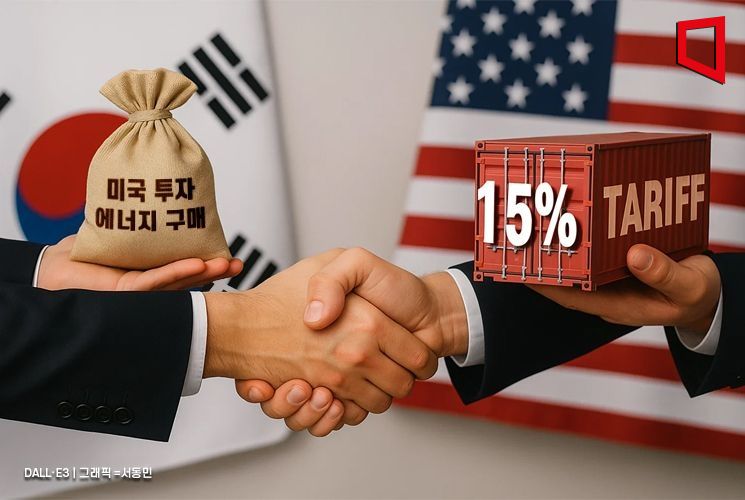
On July 31, Kim Jinwook, a Citi economist, released a report titled "Details of Korea-US Trade Negotiations Favor South Korea." South Korea and the United States have signed a trade agreement that applies a unified 15% tariff on South Korean products, including automobiles. South Korea has agreed to invest $350 billion (approximately 487.55 trillion won) in the United States, and a summit meeting will also be held within two weeks. Kim pointed out, "While the scale of investment may appear advantageous to the United States, when considering the details related to investment, energy purchases, and non-tariff barriers, there are aspects that are favorable to South Korea."
He predicted that the $350 billion investment and the method of fund management would be mutually profitable for both countries. He explained, "Of the $350 billion investment, $150 billion will be allocated to the shipbuilding industry, and the remaining $200 billion will be invested in the semiconductor, nuclear power, and secondary battery sectors, all of which are areas where South Korean companies have competitive strength." Regarding the operation of the investment fund, he emphasized that the capital call method (where a portion of capital is raised and invested, with additional capital provided as needed) is likely to be adopted, and that most of the funds will be composed of loans and guarantees from public financial institutions, with direct investment accounting for only a small portion.
Regarding the $100 billion import of liquefied natural gas (LNG), he stated, "The Presidential Office explained that energy imports will not impose an additional import burden on South Korea," and added, "There is a possibility that some of South Korea's energy imports will shift from the Middle East to the United States. As of last year, South Korea imported $14.2 billion worth of crude oil and $3.1 billion worth of LNG from the United States." Concerning non-tariff barriers, he explained, "There will be no additional market opening for rice, beef, or the digital sector," and clarified, "Although there were discussions on a duty-free import quota for US rice, imports of beef over 30 months old, and the withdrawal of regulations on US big tech companies, no such additional market opening was included."
As a result of this negotiation, the effective tariff rate on South Korean products in the United States is estimated to be about 14.3%. This estimate is based on the assumption that the automobile tariff will be reduced from 25% to 15%, and that there will be no additional increases in other sectors such as steel, aluminum, copper (50%), technology and semiconductors (0%), and pharmaceuticals (0%). However, if tariffs on semiconductors and pharmaceuticals are each raised to 15% in the future, the effective tariff rate is expected to rise to about 16.8%.
Regarding semiconductors, Kim assumed a 15% tariff would be imposed by sector, but noted that key semiconductors related to artificial intelligence (AI) could be exempt from tariffs. He cited the example of the European Union (EU), where a 15% tariff was applied to semiconductors and pharmaceuticals, but some pharmaceutical products and semiconductor equipment were exempt. He also referred to US Secretary of Commerce Howard Lutnick's statement that South Korean semiconductors and pharmaceuticals would not face discriminatory treatment.
For South Korean automobiles subject to the 15% tariff, he predicted that automakers would mitigate the impact of tariffs through price increases. He stated, "As of July this year, the export price of South Korean passenger cars to the United States fell by 11% compared to January, which contrasts with the export price trends of other countries," and added, "It is expected that automakers will raise vehicle prices in the US starting from the fourth quarter to absorb some of the tariff impact."
© The Asia Business Daily(www.asiae.co.kr). All rights reserved.
![Clutching a Stolen Dior Bag, Saying "I Hate Being Poor but Real"... The Grotesque Con of a "Human Knockoff" [Slate]](https://cwcontent.asiae.co.kr/asiaresize/183/2026021902243444107_1771435474.jpg)















