U.S. Focuses on Shipbuilding Cooperation in Korea-U.S. Talks
Government to Pursue $150 Billion Cooperation Project
Deputy Prime Minister: "The Cooperation Project Is Essentially a Korean-Led Initiative"
No Further Opening of Agricultural and Livestock Markets, Considering Korean Sensitivities
Future Consultations Expected on Non-Tariff Barriers, Including Quarantine Procedures
"U.S. Energy Purchases to Be Expanded by $100 Billion Over Four Years"
The government cited cooperation in the shipbuilding industry as the most significant factor enabling it to reach a customs agreement with the United States. It also indicated that Korea would take the lead in the shipbuilding cooperation project to be pursued with the U.S. In the process of blocking further opening of agricultural and livestock products such as rice and beef, the government took into account the highly sensitive domestic situation. President Donald Trump reportedly emphasized Korea's importance during the negotiations and highly praised the process by which the new administration was established in Korea.
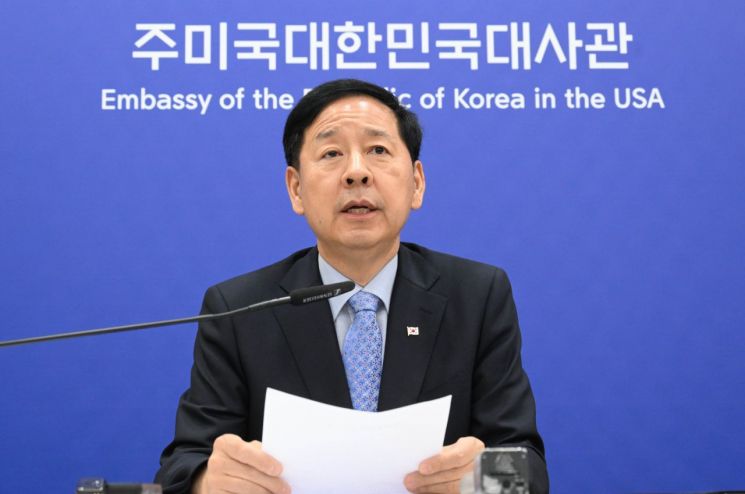 Economic Deputy Prime Minister and Minister of Strategy and Finance Koo Yoonchul is speaking at the "Korea-US Trade Consultation Results Briefing" held at the Embassy of the Republic of Korea in Washington D.C., USA, on the 30th (local time). Photo by Yonhap News
"Shipbuilding Cooperation to Be Effectively Led by Korea"
On the 30th (local time), Deputy Prime Minister and Minister of Economy and Finance Koo Yooncheol stated at a briefing on the Korea-U.S. customs negotiations held at the Korean Embassy in Washington, D.C., "The most significant contributor to today's agreement was the Make American Shipbuilding Great Again (MASGA) project." The MASGA project refers to a Korea-U.S. shipbuilding cooperation package worth $150 billion.
Deputy Prime Minister Koo explained, "This project includes the construction of new shipyards in the U.S., training of shipbuilding personnel, rebuilding of shipbuilding-related supply chains, and maintenance, repair, and overhaul (MRO). It will essentially proceed as a Korean-led business based on the needs of our companies across the shipbuilding sector." He added, "President Trump highly praised Korea's shipbuilding capabilities and requested that the project be pushed forward so that shipbuilding in the U.S. can proceed as quickly as possible."
The government agreed in this negotiation to lower reciprocal tariffs and automobile tariffs to 15% each. Additional tariffs on items such as semiconductors and pharmaceuticals will be granted 'most-favored-nation' status in future implementation. Through this negotiation, Korea pledged a total investment of $350 billion in the U.S., of which $150 billion will be allocated to shipbuilding cooperation. The remaining $200 billion will be provided as a financial package for economic security support, including for critical minerals.
Deputy Prime Minister Koo noted, "The financial package for the U.S. will be structured similarly to the $550 billion investment fund agreed upon by Japan and the U.S. Considering the size of our economy compared to Japan, the agreement at 36% of Japan's level is significant." He continued, "Given that Korea's and Japan's trade surpluses with the U.S. were similar last year, the result reflects our circumstances and position."
Kim Jeonggwan, Minister of Trade, Industry and Energy and a member of the negotiation team, explained, "The financial package for the U.S. is structured so that both large and small support will inevitably go to Korean companies." He added, "For example, there is very high demand in fields such as semiconductors and U.S. nuclear power plants, and if funds are used in those areas, we expect it could help our companies when building U.S. power plants or pharmaceutical factories."
Tariffs on items such as steel and aluminum were not reduced. Minister Kim explained, "After the results for Japan and the European Union (EU) were announced, there was strong opposition from the U.S. automobile industry, so even achieving 15% was not easy. We secured the 15% rate through persistent requests." He added, "Japan and the EU were also not granted exemptions for steel. Maintaining a 50% tariff on steel is the U.S. government's policy."
The government blocked U.S. demands to further open the market for agricultural and marine products such as rice and beef. The negotiation team explained that the U.S. understood Korea's sensitivity on the agricultural market issue, having observed the controversy in Korea, and as a result, did not push for further opening. During the negotiations, the team even showed photos of large-scale protests in Korea during the past mad cow disease incident to illustrate the domestic situation.
However, additional consultations regarding non-tariff barriers are expected to continue. Deputy Prime Minister Koo stated, "We will continue discussions on technical issues related to non-tariff barriers, including improvements to quarantine procedures and the removal of the cap on mutual recognition of automobile safety standards."
The government also included an agreement to expand purchases of U.S. energy, such as liquefied natural gas (LNG), by $100 billion over the next four years. Deputy Prime Minister Koo said, "We will expand and shift our energy procurement to the U.S. as needed. We do not expect this to impose additional burdens on our economy."
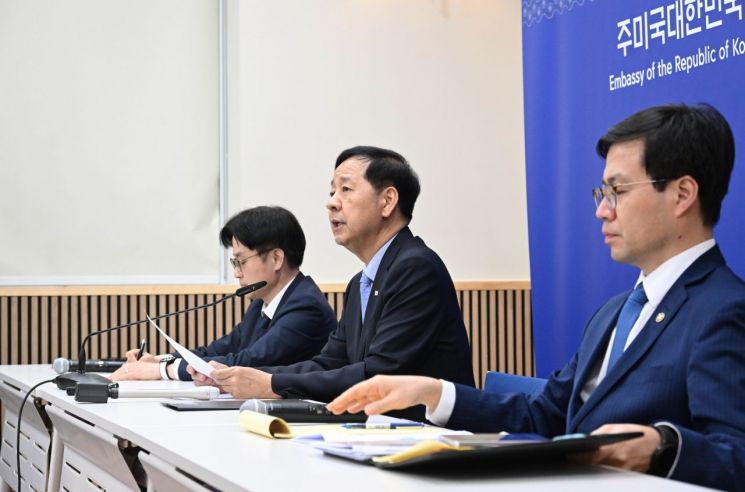 Deputy Prime Minister and Minister of Economy and Finance Koo Yooncheol is speaking at the "Korea-US Trade Consultation Results Briefing" held at the Embassy of the Republic of Korea in Washington D.C., USA, on the 30th (local time). From left, Minister of Trade, Industry and Energy Kim Jungkwan, Deputy Prime Minister Koo, and Chief Trade Negotiator Yeo Hangoo. Photo by Yonhap News.
U.S. President Emphasizes Importance of Korea in Negotiations..."Exchange Rate Discussed Separately"
According to the negotiation team, President Trump took a leading role in these negotiations. Unlike with other countries, he directly participated in the Korean negotiation process, stating that he "respects and values Korea highly." Minister Kim explained, "President Trump is very eager to meet President Lee Jaemyung and also highly praised the process by which a new government was established in Korea."
The government anticipates that additional tariff negotiations and pressure to remove non-tariff barriers in line with U.S. demands will continue in the future. While this negotiation has resolved some uncertainty, the negotiation team noted that mid- to long-term efforts will be required to improve the structure of domestic industries, enhance competitiveness, and diversify markets.
Deputy Prime Minister Koo stated, "As a result of this negotiation, we expect that the burden of exports to the U.S.?which account for 19% of our companies' total global exports?will be significantly eased." He continued, "A 15% tariff could be challenging for us, given that we have a Korea-U.S. Free Trade Agreement (FTA), but if our companies demonstrate creativity and competitiveness, this could become a new opportunity for us."
Meanwhile, the exchange rate was not discussed at the negotiation table. The Ministry of Economy and Finance explained after the negotiation team briefing, "There was no direct discussion of the exchange rate in today's negotiations. Exchange rate matters are being discussed separately between the two countries' financial authorities."
© The Asia Business Daily(www.asiae.co.kr). All rights reserved.
![Clutching a Stolen Dior Bag, Saying "I Hate Being Poor but Real"... The Grotesque Con of a "Human Knockoff" [Slate]](https://cwcontent.asiae.co.kr/asiaresize/183/2026021902243444107_1771435474.jpg)
















