Transition to Semi-Public Operation
65% of Operating Costs to Be Shared by Central and Provincial Governments
Starting from August 1, the number of seats and the frequency of operations for the "8507" metropolitan bus, which runs between Gwangmyeong in Gyeonggi Province and Sadang Station in Seoul, will increase.
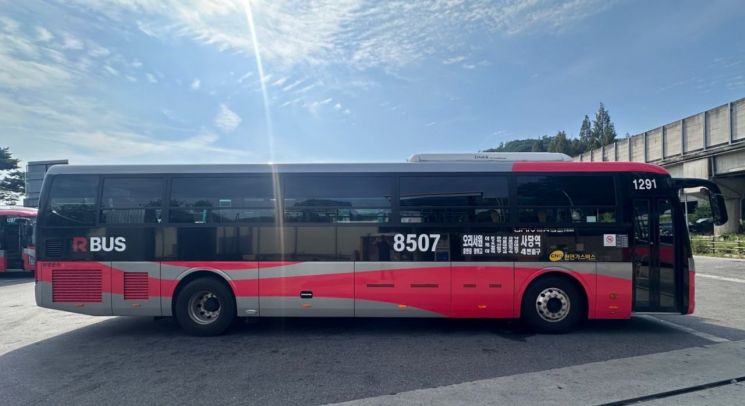 The 8507 intercity bus running between Gwangmyeong and Sadang Station will switch to a quasi-public operation system starting August 1. With increased seating, more buses in operation, and higher frequency, commuting conditions to the Gangnam area for Gwangmyeong residents are expected to improve. Provided by Gwangmyeong City
On July 31, Gwangmyeong City announced that the operation of the 8507 bus would be converted to a semi-public system managed by the Metropolitan Transport Commission (Daegwangwi).
With the transition to the semi-public system, 44-seat buses will replace the previous 36-seat buses on this route, and the number of operating buses will increase from 10 to 11. The number of daily trips will also rise from 99 to 112, reducing the interval between buses from 10-15 minutes to 10-12 minutes.
This route is a metropolitan line connecting Soha-dong and Gwangmyeong Station area in Gwangmyeong with the Gangnam area of Seoul. Starting from Soha-dong in Gwangmyeong, it passes through KTX Gwangmyeong Station, Seoul National University Station, Nakseongdae Station, and makes a round trip to Exit 4 of Sadang Station.
The city expects that the operation under the semi-public system will resolve the commuting inconveniences for Gwangmyeong residents, such as delays and congestion that have persisted until now.
Previously, the city applied for the new semi-public system project to Daegwangwi in November 2023, and after being selected for the project in June last year and completing the preparation process, the operation has now begun under the semi-public system.
The transition to the semi-public system will also significantly reduce the city's financial burden. Previously, the city covered all operating costs for this route, but from now on, the costs will be shared as follows: 50% from the national government, 15% from the provincial government, and 35% from the city government.
Park Seungwon, Mayor of Gwangmyeong, said, "We will continue to improve and expand metropolitan bus routes to guarantee citizens' right to mobility and enhance access to metropolitan transportation."
Currently, Gwangmyeong City operates a total of nine routes under the semi-public system: six routes (No. 1, 2, 11, 11-1, 11-2, and 22) under the Gyeonggi Province public management system, and three metropolitan routes (No. 3001, 3002, and G9633) under Daegwangwi.
© The Asia Business Daily(www.asiae.co.kr). All rights reserved.
![Clutching a Stolen Dior Bag, Saying "I Hate Being Poor but Real"... The Grotesque Con of a "Human Knockoff" [Slate]](https://cwcontent.asiae.co.kr/asiaresize/183/2026021902243444107_1771435474.jpg)















