15% Mutual Tariff, Similar to May Outlook... Reduced Uncertainty
US Rate Freeze and Hawkish Press Conference... Rate Gap Remains a Burden
Despite Improved Domestic Demand, Growth Rate Above 1% Still Uncertain
Real Estate Market: Variables Remain Despite Lull
Four weeks ahead of the Bank of Korea's Monetary Policy Board decision on the base interest rate, a tariff agreement was reached between South Korea and the United States. Overnight, the US Federal Reserve (Fed) also decided to keep its policy rate unchanged, clearing some of the uncertainty surrounding the August Monetary Policy Board meeting. Attention is now expected to focus on the August economic outlook and trends in the real estate market. The key point to watch is how much the economic outlook, which incorporates the 15% Korea-US mutual tariff, the previously concluded tariff agreements with major countries, improvements in private consumption, and the impact of the supplementary budget on domestic demand, will surpass the previous annual growth forecast of 0.8%. Until the next month's rate decision, the Bank of Korea is also expected to closely monitor the real estate market's response to the government's June 27 measures and developments in household debt.
15% Mutual Tariff, Similar to May Assumptions... Reduced Uncertainty
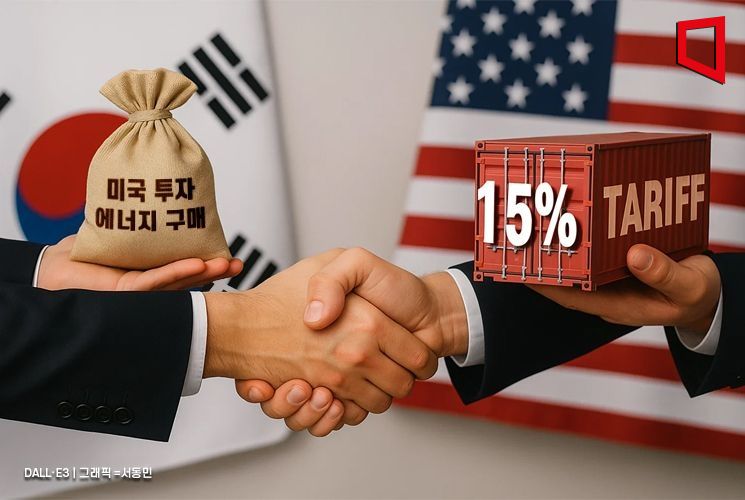
On July 30 (local time), US President Donald Trump announced that South Korea had agreed to lower the mutual tariff on South Korean goods from the previous 25% to 15%, in exchange for conditions such as South Korea investing $350 billion (about 487 trillion won) in the United States. At a briefing on July 24, the Bank of Korea stated that if the Korea-US mutual tariff rate is set at 15%, the same as Japan, it would not significantly deviate from the tariff assumptions made in the May economic outlook and would be "only slightly negative." The US side also said that tariffs on semiconductors, a key South Korean export, would "not be less favorable than those for other countries." The tariff on South Korean automobiles was confirmed to be 15%.
However, the impact is not limited to the Korea-US tariff agreement; the outcomes of tariff negotiations with other major countries are also significant. The European Union and Japan have agreed to a 15% mutual tariff, while China has extended the grace period for ultra-high mutual tariffs by 90 days, effectively buying time. Bank of Korea Deputy Governor Yoo Sangdae said at a market monitoring meeting on the morning of July 31, "With the Korea-US trade negotiations concluded at a similar tariff rate (15%) as other major countries, related uncertainties are expected to decrease. However, since trade negotiations among major countries such as the US and China are ongoing, we will continue to monitor how changes in global trade conditions affect various sectors of the domestic economy and the financial and foreign exchange markets."
US Rate Freeze and Hawkish Press Conference... Korea-US Rate Gap Remains a Burden
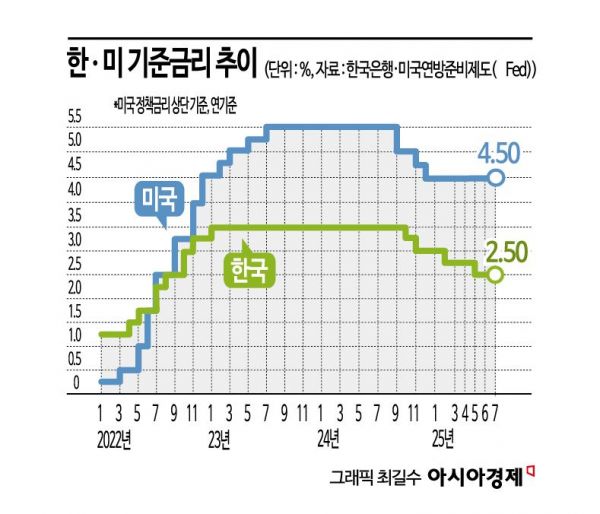
On the same day, the Fed kept its policy rate target range at 4.25-4.50% per annum at its regular Federal Open Market Committee (FOMC) meeting. This marks the fifth consecutive rate freeze this year. The Korea-US interest rate gap also remained at a record-high level of 2 percentage points. In terms of the Korea-US rate gap, an additional rate cut by the Bank of Korea in August is a burden. This is due to concerns that foreign capital may flow out and exchange rate volatility may increase. These points were also raised at the Bank of Korea's Monetary Policy Board meeting on the direction of monetary policy in July. One board member emphasized, "It is also important to maintain the domestic-foreign interest rate gap at a level that can be tolerated, so as not to create difficulties in foreign exchange supply and demand, such as capital outflows."
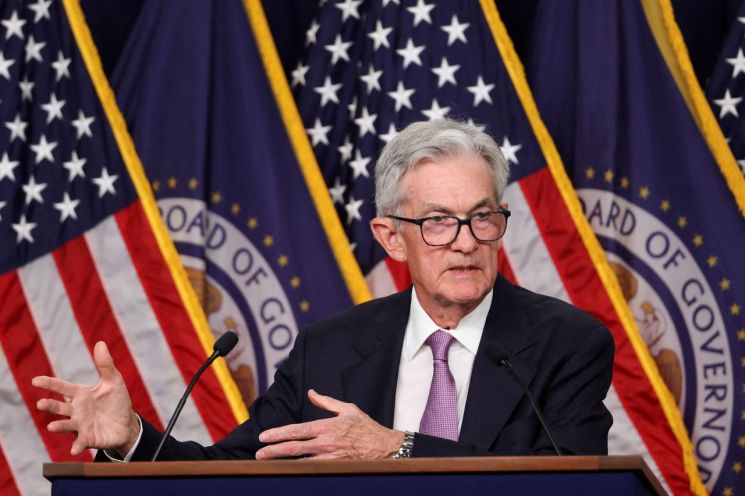
Fed Chair Jerome Powell, at a press conference, emphasized the uncertainty regarding the impact of tariff policy on inflation and maintained a basic stance that future monetary policy decisions will be based on incoming data. In international financial markets, Powell's press conference was evaluated as hawkish (favoring monetary tightening). Deputy Governor Yoo pointed out, "Although the Fed's economic outlook was downgraded at last night's FOMC and two members expressed dissenting opinions, Chair Powell remains cautious about additional rate cuts, so uncertainty regarding the Fed's rate cut path remains."
Despite Improved Domestic Demand, Growth Rate Above 1% Still Uncertain vs. Real Estate Market: Variables Remain Despite Lull
The August economic outlook suggests that domestic demand this year will improve compared to previous forecasts. This is the result of improved private consumption due to recovering consumer sentiment and the implementation of a large-scale supplementary budget aimed at stimulating the economy. However, the conditions that make it difficult to guarantee an economic growth rate in the 1% range this year continue to support further monetary easing.
The trend in the real estate market, which was a key factor holding back an additional rate cut in July, will also be a major monitoring target over the remaining four weeks. Due to the government's strict lending regulations, overheating in the Seoul metropolitan area real estate market has somewhat subsided. According to the Korea Real Estate Board's weekly apartment price trends, as of July 23, just before the government's June 27 measures were announced, apartment prices in Seoul rose by 0.43% compared to the previous week. However, after the announcement, the weekly increase slowed to 0.4%, 0.29%, 0.19%, and 0.16%. After the June 27 lending regulations, the amount of new household loan applications at banks reportedly plummeted by nearly 60%.
However, since household loans, which lag behind transactions by two to three months, are expected to remain high through August, and record-high prices are still being set in some metropolitan area apartments, there remains a variable: whether the lull in the real estate market caused by the government's strict lending regulations will prove to be only a temporary effect. This will require observation over a 'considerable period.'
© The Asia Business Daily(www.asiae.co.kr). All rights reserved.
![Clutching a Stolen Dior Bag, Saying "I Hate Being Poor but Real"... The Grotesque Con of a "Human Knockoff" [Slate]](https://cwcontent.asiae.co.kr/asiaresize/183/2026021902243444107_1771435474.jpg)

















