The current affairs seminar hosted by the Seoul National University Center for Financial Law, focusing on the interpretation and practical issues of the recently revised Commercial Act's "director's duty of loyalty" provision, concluded successfully.
On the 29th, the seminar titled "Practical Issues Following the Introduction of the Director's Duty of Loyalty" was held at the Centennial Memorial Hall of Seoul National University School of Law. Hundreds of participants, including in-house corporate lawyers and law firm representatives, attended, demonstrating high interest in the revised Commercial Act.
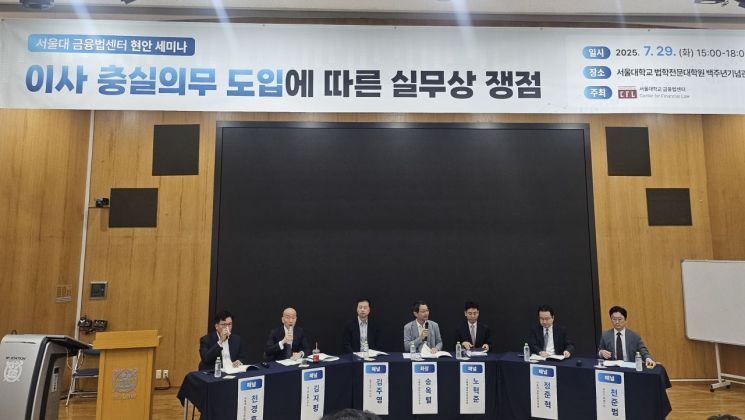 On the afternoon of the 29th, at the Centennial Memorial Hall of Seoul National University Law School, Kim Jipyeong, a lawyer from Kim & Chang Law Office (second from the left), who participated as a panelist in the seminar on the revised Commercial Act, is giving a presentation. Photo by Choi Seokjin
In his congratulatory remarks, Lee Jaemin, Dean of Seoul National University School of Law, said, "It is the first time in recent years that so many people have attended a seminar held at the end of July during the vacation period," adding, "I believe this is a culmination of the interest from experts, various institutions, and many individuals in this topic."
Dean Lee continued, "The practical issues of the director's duty of loyalty are extremely important," and added, "Looking at the seminar materials, they are so thorough and detailed that they are almost comparable to an academic journal. The presenters today are the top experts in each field. I believe that through various discussions and questions, we will be able to sketch out the general direction and framework."
He further noted, "Professor Noh Hyukjoon, Director of the Seoul National University Center for Financial Law, mentioned that 'despite the recent emergence of the director's duty of loyalty as a major topic, there is a lack of precise understanding, review, and legal assessment.' I hope that this seminar will lead to more systematic and legally organized discussions and outcomes."
The seminar was conducted in a roundtable format, with Song Okryul, professor at Seoul National University School of Law, serving as the moderator. Multiple panelists shared their views on each topic.
The panel included Professors Noh Hyukjoon, Jung Junhyuk, and Chun Kyunghoon from Seoul National University School of Law; Kim Jooyoung, attorney at Hannuri Law Firm; Kim Jipyung, attorney at Kim & Chang; and Chun Junbeom, CEO of Wiseforest (attorney).
Before the main discussion, each panelist shared their thoughts. Attorney Kim Jooyoung said, "After the Commercial Act was amended, I attended other academic seminars and appeared in court, and I realized that legal disputes regarding the meaning of the amendment have already begun. I am currently handling an injunction lawsuit, and through that experience, I felt, 'Now the real battle begins. The amendment itself is not the end, but the beginning.'"
He added, "The director's duty of loyalty was introduced in 1998, nearly 30 years ago. Although the original intent and various legal systems to improve corporate governance have been continuously revised, implementing these changes in practice and in court has required a very challenging process."
Attorney Kim continued, "Having experienced various cases in the capital market, I reviewed precedents that have hindered the development of the capital market. Most of the precedents that restricted standing on the grounds that shareholders' interests are factual or economic rather than legal, or those that applied the business judgment rule too broadly, were not capital market law precedents but Commercial Act precedents related to corporate governance, which were difficult for investors to understand and hindered the development of the capital market."
He further stated, "I believe this amendment to the Commercial Act should serve as a catalyst for changing such corporate governance-related precedents, which are a major cause of the so-called Korean Discount in the capital market. However, this will not happen easily; it will require intense debate, real cases where investors raise issues, and the creation of precedents in court?a long and arduous process."
Attorney Kim Jipyung said, "Looking at the overall sentiment toward the market, since the law has already passed, debating that point is a thing of the past. It is actually difficult to deny the validity or rationality of the legislation."
He continued, "However, from the perspective of those actually operating companies, the main concern is the issue of uncertainty. If risks arise regarding the scope and application of interpretation, these inevitably translate into costs for companies, which can weaken their competitiveness. Therefore, I believe it is crucial for everyone gathered here today to pool their wisdom and reach a consensus to quickly establish appropriate market guidelines, which is essential for the successful implementation of this law."
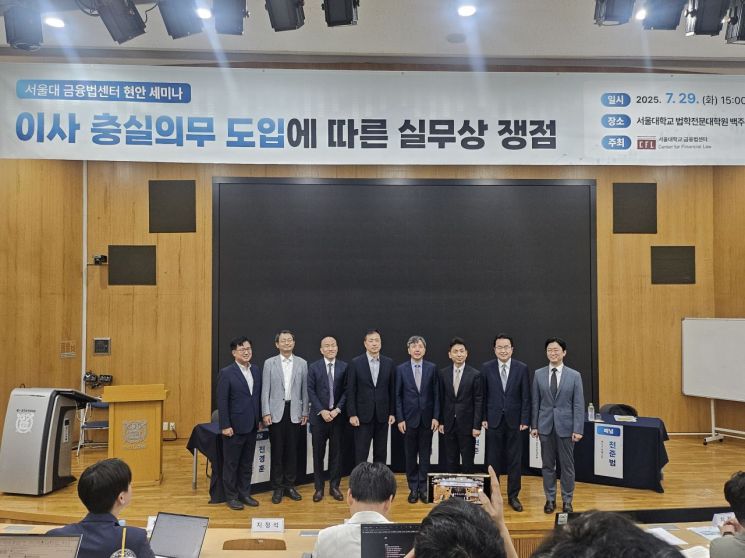 On the afternoon of the 29th, before the main discussion at the seminar on the amended Commercial Act held at the Centennial Memorial Hall of Seoul National University Law School, Song Okryul, professor at Seoul National University Law School (second from the left) and the panelists are taking a commemorative photo. Photo by Choi Seokjin
In the first session, the following topics were covered: an overview of the revised provisions, including the meaning of "all shareholders" and its relationship with the duty of care; the scope of criminal breach of trust after the amendment; shareholder claims for damages; and an overall review of the revised director's duty of loyalty in relation to compliance with capital market laws.
Attorney Chun Kyunghoon commented on the intent of the amendment, stating, "Even before this amendment, I interpreted the Commercial Act as imposing a duty on directors to protect and promote the interests of all shareholders. Therefore, I see the revised Commercial Act not as creating a new duty, but as clearly confirming the existing duty."
He continued, "The intent of this amendment is to impose a duty on directors to protect and promote the interests of all shareholders, even in cases where it is difficult to establish company damages, and to prevent unfair transfers of wealth among shareholders that do not correspond to their share ratios."
However, Attorney Chun also addressed whether the scope of criminal breach of trust has been expanded by the amendment, stating, "Even though the phrase 'for the shareholders' has been added to the director's duty of loyalty provision, since there is no contractual relationship of delegation between the company and the shareholders, directors still have the status of company administrators. Inferring that they are administrators for shareholders goes beyond the limits of the principle of legality in criminal law."
There was also discussion on how much the actual liability of directors would be expanded as a result of the amendment.
Attorney Kim Jipyung said, "For companies and management to prepare for this and improve governance to comply with and defend against such duties, it is essential to clarify which transactions this law will substantively apply to. This must be considered alongside the legal principles of liability for damages and criminal breach of trust."
He added, "Basically, this law aims to clearly recognize directors' liability in situations where company damages are not clear, but where there is a conflict of interest among shareholders or harm to shareholders, such as the issue of dividing the 'pie.'"
He further noted, "The reason for the partial amendment bill to the Commercial Act proposed by Representative Lee Jungmoon in June clearly specifies various governance restructuring transactions such as mergers and splits as major targets of the bill, which I interpret as evidence of the intention behind this part."
Attorney Kim explained specific practical examples where directors' civil and criminal liability could be at issue, categorizing them as follows: cases where controlling shareholders acquire company shares at a low price in Stock for Cash transactions; cases where controlling shareholders sell their shares at a high price by monopolizing management control premiums in Stock for Cash transactions; cases where controlling shareholders or other affiliates gain benefits and minority shareholders suffer losses in Stock for Stock transactions during mergers, splits, split-mergers, or comprehensive share exchanges; and cases where controlling shareholders indirectly expand their corporate control by allowing friendly shareholders to preferentially acquire shares over adversarial shareholders.
In the second session, discussions continued on specific practical issues, including: physical spin-offs followed by split-off listings; conversion to a holding company through exchange tender offers after a spin-off; defending management control through public offerings or treasury share utilization; tender offers and minority shareholder squeeze-out transactions for voluntary delisting; and old share IPOs and management control premium transactions.
At the end of the seminar, a Q&A session was held in which panelists answered questions submitted in writing by attendees.
The Seoul National University Center for Financial Law (CFL) was established in 2003 with the aim of contributing to the advancement of the legal infrastructure supporting the financial market by conducting objective, continuous, systematic, and in-depth research on major legal issues facing Korea's financial market.
Director Noh Hyukjoon stated, "Over the past 20 years, the Seoul National University Center for Financial Law has served as a bridge between academia and practice, as well as the economic, financial, and legal sectors, through the publication of the practical academic journal BFL and about 20 volumes of monographs. In particular, we have led the trends in practice and academia by organizing current affairs seminars on major contemporary issues and facilitating the exchange of expert opinions from various fields."
© The Asia Business Daily(www.asiae.co.kr). All rights reserved.
![Clutching a Stolen Dior Bag, Saying "I Hate Being Poor but Real"... The Grotesque Con of a "Human Knockoff" [Slate]](https://cwcontent.asiae.co.kr/asiaresize/183/2026021902243444107_1771435474.jpg)
















