Trump Signs Executive Order to Support Commercialization and Demonstration Projects
Market Expected to Grow to $100 Billion by 2040
U.S. Joby and Korea Hyundai Motor Among Related Stocks in the Spotlight
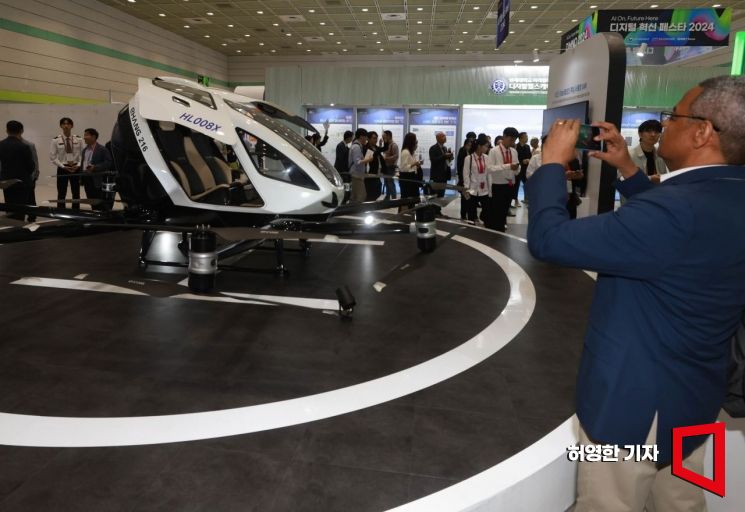
Last month, following an executive order by U.S. President Donald Trump, stocks related to UAM (Urban Air Mobility) became a hot topic in the U.S. stock market. This is due to expectations that the executive order, which establishes an institutional foundation for the drone and UAM industries, will become a critical turning point for the growth of the global industry.
'Flying Cars' Become Reality Over Los Angeles
On July 30, KB Securities analyzed in its report, "Rising Expectations for UAM Commercialization, 'Joby Aviation' as a Leading Company," that the UAM industry is experiencing positive momentum due to U.S. policy support and other factors.
The main points of the executive order signed by President Trump on June 6 include: ▲Active support for the development and commercialization of advanced aviation technologies such as drones and eVTOLs (Electric Vertical Take-Off and Landing, aircraft capable of vertical takeoff and landing powered by electricity) in the United States; ▲Full-scale promotion of demonstration projects in various application fields such as cargo transportation and emergency medical services. This can be interpreted as a signal that UAM has been firmly established as a government-led initiative.
UAM, also known as 'flying cars,' 'air taxis,' or 'drone taxis,' is a mobility solution that transports people and cargo through the air rather than on ground roads in urban environments. The core of UAM is the aircraft, which is basically a drone. Drones use eVTOL instead of internal combustion engines. UAM flies at a lower altitude of 300 to 600 meters compared to conventional aircraft and, by using electric power, is an eco-friendly transportation method with zero carbon emissions. It uses electric motors instead of engines, and the propellers are much smaller than those of conventional airplanes, resulting in noise levels of no more than 63 to 65dB. When flying overhead, the noise heard on the ground can be as low as 40dB. In addition, most UAM vehicles use six or more rotors, which increases safety. Major institutions forecast that the market size will grow from about $4 billion in 2023 to $23 to $30 billion in 2035, and up to $100 billion by 2040.
U.S.-Listed Stocks Such as Joby and Archer Draw Attention
The main value chain of the UAM industry consists of: ▲airframe and parts ▲core technologies such as autonomous flight ▲navigation and traffic management ▲infrastructure ▲services. In particular, eVTOLs, as aircraft carrying people, require extremely high levels of safety. Therefore, various certifications from aviation safety authorities (such as the U.S. Federal Aviation Administration [FAA] and the European Union Aviation Safety Agency [EASA]) are required in terms of aircraft design, manufacturing, and operation. As a result, it is estimated that obtaining full certification for new eVTOLs will require significant time and cost. For reference, Joby Aviation, a listed company known to be leading UAM commercialization in the United States, is currently undergoing the fourth stage of the FAA type certification (TC) process, having completed stage three of the five-stage process.
Recently, with increased policy support in the United States and growing expectations for business in the Middle East, the UAM industry is experiencing positive momentum. KB Securities cited Joby Aviation (JOBY) and Archer Aviation (ACHR) in the U.S. as leading companies, and also listed Eve Air Mobility in the U.S., as well as Hyundai Motor (U.S. subsidiary, Supernal), Hanwha Systems, and Korea Aerospace Industries from Korea as related stocks. Lim Sangkuk, an analyst at KB Securities, stated, "In May, Joby Aviation secured an additional $250 million investment from Toyota, accelerating expectations for FAA certification and commercialization. However, Korea is currently falling short of the KUAM roadmap presented in 2020."
© The Asia Business Daily(www.asiae.co.kr). All rights reserved.
![Clutching a Stolen Dior Bag, Saying "I Hate Being Poor but Real"... The Grotesque Con of a "Human Knockoff" [Slate]](https://cwcontent.asiae.co.kr/asiaresize/183/2026021902243444107_1771435474.jpg)















