ICAO Amendment to Take Effect Next Month on the 4th
Altitude Restrictions Within 11?13 km Radius of Gimpo Airport
Potential Application of Regulations to Mokdong Reconstruction Complexes
Concerns Over Disruption to Redevelopment Projects if Height Limits Are Imposed
The Mokdong reconstruction complexes in Yangcheon-gu, Seoul, have launched collective action as the International Civil Aviation Organization (ICAO) plans to completely revise its altitude restriction standards for the first time in about 70 years. There are concerns that if the revised standards are applied as proposed, height restrictions could disrupt redevelopment projects.
The Mokdong Reconstruction Alliance (Mokjaeryeon) held a meeting with Democratic Party lawmaker Hwang Hee on the 28th and issued a statement opposing ICAO's proposed revision of altitude restriction standards. Along with this, they also submitted a petition signed by local residents opposing the revision. Mokjaeryeon is an organization composed of the reconstruction associations and preparation committees for the 14 Mokdong New Town complexes.
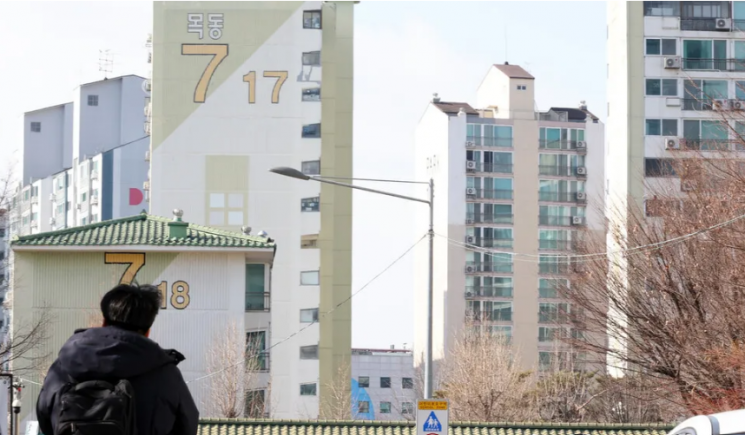
Mokjaeryeon criticized the regulation that designates the area within approximately 11 to 13 kilometers of Gimpo Airport as a "horizontal surface" and restricts building heights in the area, stating, "This revision imposes excessive regulations unrelated to aviation safety," and lamented, "The Mokdong New Town reconstruction project, which has been in preparation for years, is now facing a serious crisis." They further urged a reconsideration of the standards, warning that "it could hinder the overall development of the western metropolitan area."
Lee Sangyong, president of Mokjaeryeon, said, "We had expected the altitude standards to be eased in line with advances in aviation technology and the reality of urban densification, but the revision is actually a regressive measure that strengthens regulations." He pointed out, "This essentially blocks residents' opportunities to improve their living environment and infringes on their property rights."
Mokjaeryeon also demanded that the Ministry of Land, Infrastructure and Transport officially submit an opposing opinion during the public consultation process for the revision. In addition, they called for adjustments to ensure that, when enacting related domestic laws, the altitude restriction standards are not further strengthened, taking into account city shape, urban density, and property rights. They also emphasized that the 14 Mokdong New Town complexes currently undergoing redevelopment should be excluded from the impact of the regulations, and that the Seoul Metropolitan Government and relevant local governments should establish a joint response system. The need to consider relocating Gimpo Airport was also raised.
Mokjaeryeon stated, "This is not just an issue for a specific area, but a critical matter directly related to urban planning and housing rights for the entire metropolitan region," and declared, "We will remain united and respond until the end." In response, lawmaker Hwang promised, "I will actively convey residents' concerns to the National Assembly and the government and prepare institutional countermeasures."
The core of the ICAO international standard revision is to relax the "Obstacle Limitation Surface (OLS)" regulations, which have strictly and uniformly restricted obstacles such as buildings for aircraft safety, by dividing them into "Obstacle Free Surface (OFS)" and "Obstacle Evaluation Surface (OES)." The Obstacle Free Surface is an absolute no-go zone that directly affects aviation safety, while the Obstacle Evaluation Surface is an area where development may be conditionally permitted after assessment.
According to the revision, the area within approximately 11 to 13 kilometers of Gimpo Airport will be designated as a "horizontal surface," and the heights of buildings in the area will be limited to 45, 60, or 90 meters. Previously, only the area within a 5.1-kilometer radius of the airport runway was uniformly regulated. The revised standards will take effect on August 4, and will be fully implemented from November 2030. If the revision is enforced, Mokdong in Yangcheon-gu, Yeongdeungpo-gu, Mapo-gu, Bucheon-si, and Gimpo-si in Gyeonggi Province may be included in the altitude restriction zones.
As a result, the 14 Mokdong New Town reconstruction complexes are collectively protesting. This is because, if the revision is enforced, it may become difficult to build apartments taller than 90 meters (25 to 30 floors). For example, Mokdong New Town Complex 7 is planning to rebuild up to 60 floors, and Complex 6 up to 49 floors, raising concerns that the redevelopment projects could be derailed.
On the other hand, Gangseo-gu, where the possibility of altitude restriction relaxation has increased, is demanding early implementation of the revision. In Gangseo-gu, 97.3% of the total area has been designated as an altitude restriction zone. If the revision reduces the Obstacle Free Surface and increases the Obstacle Evaluation Surface, it is expected that redevelopment and reconstruction with higher building heights will become possible compared to the current situation.
© The Asia Business Daily(www.asiae.co.kr). All rights reserved.
![Clutching a Stolen Dior Bag, Saying "I Hate Being Poor but Real"... The Grotesque Con of a "Human Knockoff" [Slate]](https://cwcontent.asiae.co.kr/asiaresize/183/2026021902243444107_1771435474.jpg)















