Customary 'Mobile Phone Verification' by Domestic E-Commerce Platforms
Makes Registration Difficult for Overseas Consumers
Global Cards and Simple Payment Services Like PayPal Not Accepted
Government Should Play a Role in Enhancing Payment Convenience
The main reasons why 'reverse direct purchase,' where overseas consumers buy Korean products online directly, has not experienced significant growth are the complicated membership registration process and the limited payment methods offered by domestic e-commerce platforms. Amid rising global interest in Korean culture and products driven by the K-wave through content such as 'Squid Game' and 'K-pop Demon Hunters,' there is a growing consensus that the government must play a more active role in encouraging and supporting innovation in the private sector. In addition to introducing more open membership registration processes for domestic e-commerce platforms, the industry should be continuously informed about the acceptance of overseas-issued payment methods and fraud prevention technologies, and be encouraged to implement these changes.

The Bank of Korea emphasized these points on July 28 in its 'BOK Issue Note ? Measures to Promote Foreigners’ Direct Online Purchase of Korean Products (Reverse Direct Purchase)' (by Kim Cheol, Kim Wonik, Chu Seungwoo, Lee Sanga).
While 'direct purchase,' where Korean consumers buy foreign products directly from overseas online shopping malls and e-commerce platforms, has grown significantly in recent years to reach a scale of about 8.1 trillion won, the size of reverse direct purchase remains at only about 1.6 trillion won. Chu Seungwoo, Deputy Head of the Electronic Finance Team at the Bank of Korea’s Financial Settlement Bureau, analyzed that "the high popularity of Korean products driven by the Korean Wave, such as K-pop and K-beauty, has not been fully reflected in the reverse direct purchase market."
Reverse direct purchase can serve as an opportunity for small and medium-sized enterprises and small business owners who have difficulty developing overseas sales channels on their own. Sales channels include selling through domestic e-commerce platforms or by joining overseas e-commerce platforms. Although both methods involve selling Korean products to overseas markets, there are concerns that excessive reliance on large overseas e-commerce platforms with high global recognition could make sellers vulnerable in the mid- to long-term to policy changes such as commission fee increases.
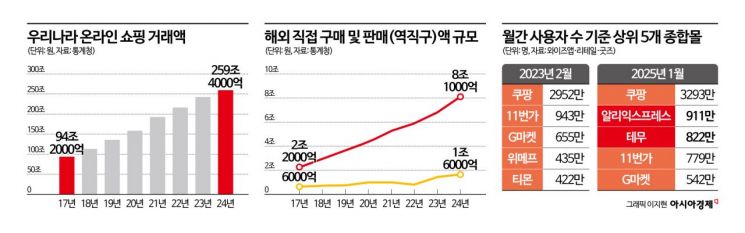
Customary 'Mobile Phone Verification' Makes Registration Difficult for Overseas Consumers... Accessibility Decreases
Most domestic e-commerce platforms customarily require identity verification through a mobile phone registered in Korea during membership registration. This practice makes it difficult for overseas consumers to register. Furthermore, global cards such as Visa and Mastercard issued overseas, as well as widely used international payment services like PayPal·and Alipay, are not accepted as payment methods. Chu explained, "Since the main customers have traditionally been domestic consumers, and because of difficulties in dealing with fraudulent use of payment methods and disputes related to delivery in overseas transactions, there has been little incentive to actively improve these practices."
To encourage more foreigners to use Korean e-commerce platforms, the registration barrier must be lowered. Chu noted, "Major overseas e-commerce platforms allow membership registration as long as the applicant's email or phone number is verified, adopting a more open approach." He added, "By actively accepting global cards issued overseas and international simple payment services as payment methods, and by building interlinked systems between domestic and international simple payment services targeting overseas consumers, the convenience of payment for reverse direct purchase can be greatly enhanced."
For example, if it becomes possible to recharge prepaid balances for domestic simple payment services via DanaPay, which is widely used in Indonesia, then global brand payment cards issued overseas, local cash, bank accounts, and payment cards linked to DanaPay in Indonesia could all be used as payment methods for reverse direct purchase. Chu added, "Any potential increase in fraudulent use of payment methods during the process of improving registration and payment convenience should be prevented through the appropriate use of various security technologies."
He also emphasized, "If integrated logistics agency services (fulfillment), which handle not only overseas shipping but also exchange, return, and customer support for overseas customers, are actively utilized to reduce the burden of handling overseas shipping-related disputes, and if logistics infrastructure is expanded to enable fast delivery at low cost, the conditions for foreigners to use Korean e-commerce platforms will be greatly improved."

The Government Should Promote 'Open Registration' and Inform About Fraud Prevention Technologies for Overseas-Issued Payment Methods
Recently, several domestic e-commerce platforms have begun allowing membership registration via email or phone number and are moving to accept payment methods available to overseas consumers. This trend is evident in some foreigner-only online malls (such as Gmarket Global, Coupang Taiwan, YES24 Global, Weverse, Olive Young Global, Silicontwo, etc.), as well as in duty-free shops, taxi-hailing services, and delivery services. There is a growing view that government support is needed to ensure that such changes spread further and lead to concrete results in expanding the overseas sales of products from Korean companies and small business owners.
Chu stated, "Through ongoing communication with the industry, it is necessary to inform and encourage change by clarifying that there are no legal restrictions on registering without a Korean mobile phone and that fraudulent use of overseas-issued payment methods can be prevented through various means." He added, "This will help create an environment where it is easier for foreigners to register and make payments."
He also suggested that small e-commerce platforms should be able to use integrated logistics agency services at lower costs to reduce the burden of serving overseas customers, and that projects should be promoted to expand related infrastructure such as global logistics centers through public-private cooperation. Chu pointed out, "If necessary, part of this could be supported through policy budgets."
He concluded, "Innovating domestic e-commerce platforms to meet global standards is important because it builds the infrastructure for a stable global consumer base and a sustainable growth structure." He emphasized, "A more active government role is needed to encourage and support the private sector, which is the main driver of innovation."
© The Asia Business Daily(www.asiae.co.kr). All rights reserved.
![Clutching a Stolen Dior Bag, Saying "I Hate Being Poor but Real"... The Grotesque Con of a "Human Knockoff" [Slate]](https://cwcontent.asiae.co.kr/asiaresize/183/2026021902243444107_1771435474.jpg)

















