Seoul National University Report Predicts Premium Rates for 2072
Health Insurance Could Rise 3.5 Times, Long-Term Care Insurance Up to 15 Times
An analysis has found that by 2072, the health insurance premium rate could rise to approximately 3.5 times the current level, while the long-term care insurance premium rate could soar up to 15 times higher. This projection is based on the expectation that the rapid aging of the population will significantly increase the financial burden on the National Health Insurance and the Long-Term Care Insurance for the Elderly.
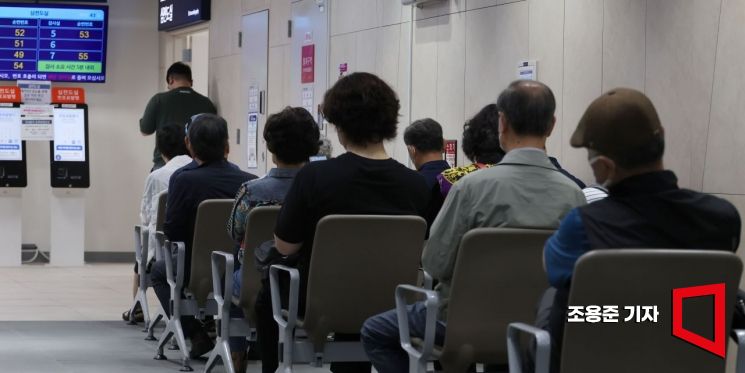 Patients visiting the outpatient clinic at Seoul National University Hospital are waiting for their medical appointments.
On the 27th, the Seoul National University Industry-Academic Cooperation Foundation presented this outlook in a report titled "Basic Research for Policy Development in Response to a Super-Aged Society," commissioned by the Presidential Committee on Ageing Society and Population Policy. The report is a long-term forecast of the impact of demographic changes on health insurance medical expenses and related factors.
According to the report, due to the increase in the elderly population aged 65 and older, their share of health insurance medical expenses is estimated to rise from 44.1% in 2023 to 53.1% in 2030, 63.9% in 2040, and an astonishing 70.2% in 2050. This indicates that the elderly will soon account for the majority of medical expense expenditures.
To predict the sustainability of health insurance finances, the research team established three scenarios and analyzed the trend of premium rate increases under each scenario. Among these, the scenario that most realistically reflected the increase rate of per capita care benefits, changes in the economically active population, and income growth rate projected the highest possibility of premium increases.
According to this scenario, the current health insurance premium rate of 7.09% is expected to rise to 10.04% by 2035, when the elderly population exceeds 30% of the total, and to reach 15.81% by 2050. By 2072, the premium rate could increase to 25.09%, meaning that employee subscribers may have to pay a quarter of their monthly income as insurance premiums. This figure greatly exceeds the statutory ceiling of 8%.
This sharp increase is not only due to rising medical costs but also reflects the impact of policies to strengthen health insurance coverage and the possibility of a slowdown in income growth due to a low-growth economic environment. The report stated that, considering all these factors, "the actual premium rate could end up even higher than projected."
In fact, the amount paid by the National Health Insurance Service for care benefits, excluding out-of-pocket payments, is also expected to increase significantly. It is predicted to rise from 83 trillion won in 2023 to 167 trillion won in 2035, and to reach 352 trillion won by 2050.
The growing demand for long-term care, comparable to that for medical services, is also expected to place a serious burden on insurance finances. In particular, the premium rate for long-term care insurance is projected to rise even more steeply than that for health insurance. It could surge to 1.95% in 2035, 5.84% in 2050, and 13.97% in 2072. This is because the structure of long-term care insurance is even more affected by aging than health insurance. Currently, the long-term care insurance premium rate is 0.91%, which is 12.95% of the health insurance premium rate.
According to the report, the number of people eligible for long-term care insurance was about 1 million in 2023, accounting for 7.14% of the population aged 65 and older. This is expected to increase to 1.71 million (8.8%) in 2035, 3.04 million (13.7%) in 2050, and 3.26 million (16.4%) in 2072. As a result, the cost of long-term care insurance benefits is also expected to surge.
The research team pointed out that if the exponentially increasing expenditures for medical and care services are not addressed, the sustainability of the insurance system could be threatened. They also warned that "if health insurance and long-term care insurance collapse, the social security system will be weakened, which will directly lead to a decline in the quality of life for the elderly in a super-aged society."
© The Asia Business Daily(www.asiae.co.kr). All rights reserved.
![Clutching a Stolen Dior Bag, Saying "I Hate Being Poor but Real"... The Grotesque Con of a "Human Knockoff" [Slate]](https://cwcontent.asiae.co.kr/asiaresize/183/2026021902243444107_1771435474.jpg)















