Kim Whanki's "Jar" Sells for 900 Million Won at K Auction
Seoul Auction Achieves 71% Success Rate, Highest This Year
Nevertheless, Outlook for Second Half Remains Uncertain
Market Typically Slows After Kiaf and Frieze
Seven-Year Boom Theory Now Hard to Predict
"We Believe the Market Has Hit Bottom... But No One Knows When It Will Recover"
The painting "Jar" (1958) by artist Kim Whanki, who is credited with broadening the horizons of Korean abstract art, was sold for 900 million won. When the piece, which was featured in the K Auction July auction in Sinsa-dong on the afternoon of the 23rd, was finally sold after several bids, the room erupted in applause. The audience expressed delight at the rare good news of a successful sale in the otherwise sluggish auction market. During the auction, high-priced works by Park Seobo (410 million won) and Yun Hyongkeun (230 million won), among others, also found new owners, and there was fierce bidding competition for works in the tens of millions of won range.
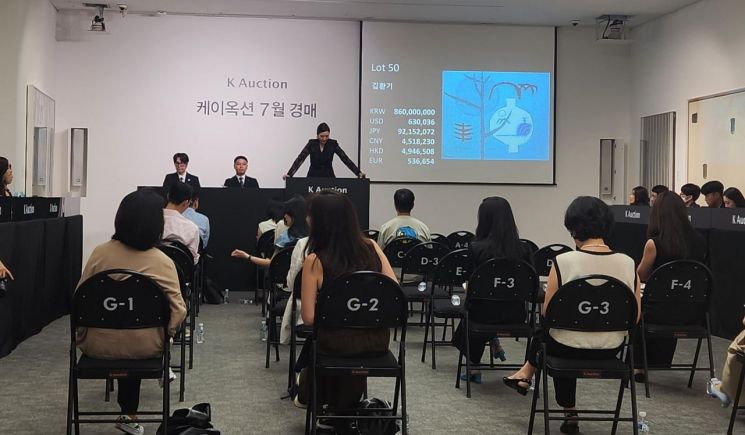 On the afternoon of the 23rd, the July auction is taking place at the K Auction building in Sinsa-dong, Seoul. Photo by Seo Mideum
At the Seoul Auction held the previous day, the auction recorded a successful bid rate of 71%, marking the highest figure of the year. Including Lee Ufan's "Dialogue" (670 million won), Ayako Rokkaku's "Untitled" (450 million won), and Yoo Youngkuk's "Twilight" (400 million won), the total transaction amount reached 3.336 billion won. A Seoul Auction representative stated, "We hope this trend continues until the end of the year," but also expressed caution, noting, "After Frieze and Kiaf, the auction market tends to stagnate somewhat, so we need to keep a close watch."
This year, the art auction market has generally remained in a slump. According to the Korea Art Price Appraisal Association, the total transaction amount in the art auction market for the first half of this year was 57.2 billion won, a 37.6% decrease compared to the same period last year (91.7 billion won). This is the lowest figure in the past five years. The amount is also significantly reduced compared to 2023 (81.1 billion won), 2022 (144.6 billion won), and 2021 (143.8 billion won).
The so-called "seven-year boom theory," which had been circulating in the auction industry, has become difficult to predict since the pandemic disrupted previous trends. The unexpected boom in 2021-2022 due to COVID-19 accelerated the cycle, increasing uncertainty in the seven-year pattern. Although this hypothesis?that the art market rebounds every seven years?has never been statistically proven, the industry has used it as a reference for market strategies based on empirical analysis. Recently, however, even the validity of this cycle has come into question.
Immediately after the pandemic, in 2021, the art auction market experienced explosive growth, with the transaction amount soaring to 338.4 billion won. Asset shifts occurred due to strengthened real estate regulations, and artworks emerged as a new investment vehicle, attracting the MZ generation (Millennials and Generation Z) and general consumers. In particular, the activities of well-known collectors such as T.O.P of Big Bang and RM of BTS, who exerted influence through social networking services (SNS), as well as the spread of non-face-to-face trading environments like "online viewing rooms," contributed to the market's expansion.
However, beginning in 2022 (234.5 billion won), the market entered a downward trend. In 2023, the transaction amount dropped to the 100 billion won range, and in the first half of this year, it fell further to the 50 billion won range. An industry insider commented, "In 2021, many novice collectors with trend-driven investment tendencies entered the market, resulting in more transactions focused on trends than on artistic value," adding, "Currently, with a significant decline in buying demand, the entire market is contracted."
The outlook is not bright. Typically, after Kiaf and Frieze, which are held in early September, the art market enters another period of stagnation. Another industry official remarked, "It seems the slump that followed the COVID-19 boom has now reached its lowest point. While we hope for a rebound within this year, it does not appear likely to be easy."
© The Asia Business Daily(www.asiae.co.kr). All rights reserved.
![Clutching a Stolen Dior Bag, Saying "I Hate Being Poor but Real"... The Grotesque Con of a "Human Knockoff" [Slate]](https://cwcontent.asiae.co.kr/asiaresize/183/2026021902243444107_1771435474.jpg)















