Reading The Theory of Moral Sentiments Among Senior Officials
The Wealth of Nations Stresses "Market Principles"
The Theory of Moral Sentiments Provides a Philosophical Foundation for "Fair Capitalism"
Reflecting the Lee Jaemyung Administration's Governing Philosophy
"Bad Bank" and Small Business Debt Policy Context
The Financial Services Commission is revisiting Adam Smith's The Theory of Moral Sentiments. Some observers interpret the focus on The Theory of Moral Sentiments, rather than the more widely known The Wealth of Nations, as a reflection of the Lee Jaemyung administration's philosophy on financial policy.
According to financial authorities on July 23, the Financial Services Commission is encouraging senior officials to reread Adam Smith's classic, The Theory of Moral Sentiments. Vice Chairman Kwon Daeyoung also reportedly plans to read the original English version and its translation during his vacation.
Adam Smith is well known as the author of The Wealth of Nations. Through this book, he provided theories of free trade and capitalism, earning the title "Father of Economics." However, the book chosen by the Financial Services Commission is his first work, The Theory of Moral Sentiments. Both inside and outside the financial authorities, attention is being drawn to the fact that the Commission has chosen The Theory of Moral Sentiments over The Wealth of Nations at this time.
The Wealth of Nations emphasizes that, as individuals pursue their own interests, the "invisible hand" operates according to market principles, creating wealth (economic growth). In contrast, The Theory of Moral Sentiments focuses on the idea that human nature is characterized not only by self-interest but also by "sympathy." It argues that it is human nature to regulate one's desires within relationships with others and to maintain social order.
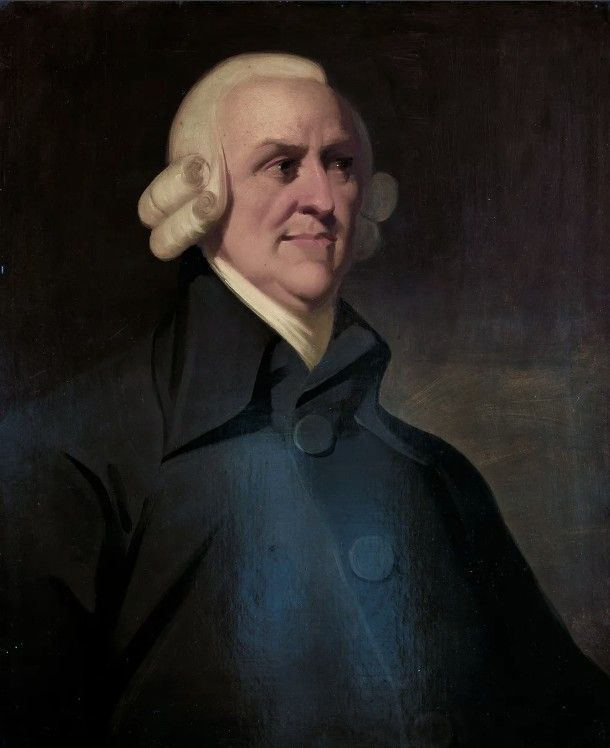 Adam Smith, known as the "Father of Economics." He wrote only two books throughout his life: The Theory of Moral Sentiments and The Wealth of Nations.
The Theory of Moral Sentiments explores not only human nature but also the aspects of human nature that drive the prosperity of society. It suggests that people pursue economic wealth and status to gain the sympathy of others, which in turn leads to the prosperity of society. In this way, the concept of the "invisible hand" also appears in The Theory of Moral Sentiments.
Today, the fact that companies are considering social responsibility and ESG (environmental, social, and governance) issues can be interpreted not as a mere trend, but as a natural consequence. While human self-interest created the market (capitalism), ethical sentiments are necessary to maintain market order.For this reason, among philosophy scholars, The Theory of Moral Sentiments is regarded as the ethics of capitalism.
In particular, The Theory of Moral Sentiments emphasizes the concepts of "justice and benevolence" as the moral pillars that support the social community. "Justice" is the moral means that prevents the collapse of the community due to unrestrained self-interest. The realization of justice is achieved through legal order.
However, a society maintained solely by laws and institutions preserves only the minimum order. The acts that truly advance a community are those of "benevolence." Adam Smith argues that a community lacking moral values such as trust, solidarity, and consideration cannot continue to prosper. In other words, for market logic to function properly and for economic growth to be achieved, ethical consciousness?specifically, empathy and moral restraint?must be present.

The fact that the Financial Services Commission introduced the establishment of a "bad bank"?which would purchase all bonds that have been delinquent for more than seven years since the launch of the Lee Jaemyung administration and write off part of the debt?as its first policy can be interpreted in this context. The creation of a "bad bank" is considered a key element of President Lee's campaign pledge for small business owners.
Vice Chairman Kwon emphasized this point when he told reporters immediately after taking office that he would first implement the new administration's philosophy and tasks, stating, "While upholding financial principles, we will help those in our society who are vulnerable (such as those with overdue debt) to recover."
Since the launch of the new administration, the Financial Services Commission is also expected to emphasize policies such as financial support for small business owners and vulnerable groups. Vice Chairman Kwon has attended on-site meetings to listen to the concerns of small business owners, and another field meeting regarding the management of individual non-performing loans is scheduled for July 25. The Commission's public schedule, which focuses on financial support for vulnerable groups, further supports this direction.
© The Asia Business Daily(www.asiae.co.kr). All rights reserved.
![Clutching a Stolen Dior Bag, Saying "I Hate Being Poor but Real"... The Grotesque Con of a "Human Knockoff" [Slate]](https://cwcontent.asiae.co.kr/asiaresize/183/2026021902243444107_1771435474.jpg)

















