Korea Battery Industry Association Holds Briefing on US Budget Reconciliation Bill
PFE Regulations Applied to Advanced Manufacturing Production Credit
Korean Battery Companies Face Challenge of Excluding China from Supply Chains
"Need to Actively Pioneer New Markets Such as ESS"
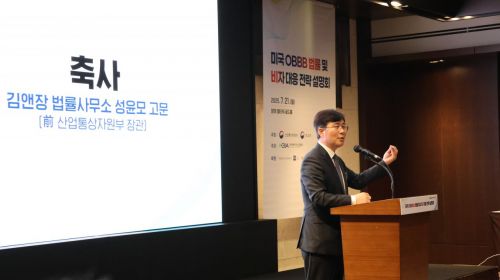 Sung Yoonmo, Advisor at Kim & Chang Law Office (former Minister of Trade, Industry and Energy), is delivering a congratulatory speech at the "US OBBBA Legal and Visa Response Strategy Briefing" held on July 21, 2025. Korea Battery Industry Association
On July 4, US President Donald Trump signed the 2025 budget reconciliation bill, known as the "One Big Beautiful Bill Act (OBBBA)," which has presented another challenge for domestic battery companies. Under this law, the early termination of the electric vehicle subsidy (30D) based on the Inflation Reduction Act (IRA) has been confirmed, but the Advanced Manufacturing Production Credit (AMPC, 45X) remains in place, allowing domestic companies some relief.
However, the addition of a China supply chain exclusion condition to the Advanced Manufacturing Production Credit has made the eligibility requirements more stringent, presenting domestic battery companies with the task of excluding China from their supply chains. Experts have analyzed that this could actually present an opportunity for domestic battery companies that have already established China-free supply chains. There are also calls for companies to actively pioneer new markets beyond electric vehicles, such as drones, robots, and energy storage systems (ESS).
The Korea Battery Industry Association held the "US OBBBA Legal and Visa Response Strategy Briefing" at El Tower in Yangjae-dong, Seoul, on the afternoon of the 21st. At the event, hosted by the Ministry of Trade, Industry and Energy and the Ministry of Foreign Affairs, experts from Kim & Chang Law Office, Yulchon LLC, KOTRA, the Korea Institute for Industrial Economics and Trade, and Daeryun Law LLC gave presentations on the main contents and significance of OBBBA, as well as response strategies for domestic battery companies.
What Are the PFE Standards Applied to the Advanced Manufacturing Production Credit?
With the enactment of OBBBA, the maximum $7,500 tax credit for eco-friendly vehicles (30D, 45W), which was originally scheduled to be maintained until the end of 2032, is set to be abolished after September 30 of this year.
For the Advanced Manufacturing Production Credit (AMPC, 45X), the application period for the tax credit, the direct pay system, and third-party transfers remain as stipulated in the original Inflation Reduction Act. Domestic battery companies will be able to receive tax credits for cells and modules produced in the US until 2032.
However, it is important to note that a Prohibited Foreign Entity (PFE) compliance condition has been added to the Advanced Manufacturing Production Credit. The PFE rule is a stricter version of the Foreign Entity of Concern (FEOC) regulation, which was previously only applied to the electric vehicle subsidy (30D).
According to OBBBA, if a Prohibited Foreign Entity from a specific country (Covered Nation) such as China, North Korea, Russia, or Iran invests in, manufactures, or produces in the US, it will not be eligible for the Advanced Manufacturing Production Credit, the Clean Electricity Investment Tax Credit (ITC), or the Production Tax Credit (PTC). This is essentially a measure to exclude the China supply chain, and domestic companies now face the challenge of decoupling from China.
Prohibited Foreign Entities are regulated in two forms: Specific Foreign Entities (SFE) and Foreign Influenced Entities (FIE).
The first type, Specific Foreign Entity (SFE), is classified into five categories: ▲ Specific foreign entities that may pose a threat to US national security as defined by the National Defense Authorization Act (NDAA) (such as Huawei, DJI) ▲ Chinese military companies operating in the US (such as CATL) ▲ Entities designated under the Uyghur Forced Labor Prevention Act ▲ Entities excluded from Department of Defense battery procurement under the NDAA (such as CATL, BYD) ▲ Foreign-Controlled Entities (FCE).
Among these, a Foreign-Controlled Entity refers to an entity controlled by four types of organizations: ▲ a Covered Nation ▲ an agency or subordinate agency of a Covered Nation government ▲ a national or citizen of a Covered Nation (excluding US citizens or permanent residents) ▲ a corporation established under the laws of a Covered Nation or headquartered in a Covered Nation.
The second type, Foreign Influenced Entity (FIE), has two categories: when a Specific Foreign Entity exerts influence through appointment rights, equity, or debt relationships, or when a Specific Foreign Entity is granted effective control. In such cases, even if the entity is not a Specific Foreign Entity, it is still considered a Prohibited Foreign Entity.
The US government has introduced the "Material Assistance Cost Ratio (MACR)" to quantify the criteria for determining "substantial assistance" from Prohibited Foreign Entities. Companies seeking tax credits must gradually reduce the proportion of materials sourced from Covered Nations in accordance with the annual MACR limits.
For example, in the case of batteries, in 2026, at least 60% of materials must be sourced from entities or organizations that are not Prohibited Foreign Entities in order to qualify for the tax credit. This proportion increases to 65% in 2027, 70% in 2028, 80% in 2029, and 85% from 2030 onward. There is still debate as to whether this proportion includes only first-tier suppliers.
Park Soyeon, a foreign attorney at Kim & Chang Law Office, explained, "With the enactment of OBBBA, domestic battery companies must reduce their reliance on China," adding, "Although the amount of the Advanced Manufacturing Production Credit may decrease, this could be an opportunity for companies with China-free supply chains."
Park advised, "Until the final guidance is released, domestic battery companies should actively engage with the US government to steer the outcome in a favorable direction." In fact, Ford in the US was able to receive the Advanced Manufacturing Production Credit for battery cells for electric vehicles produced under a license agreement with China's CATL through proactive lobbying.
Need to Actively Pioneer New US Markets Such as Drones, Robots, and ESS
Although the Advanced Manufacturing Production Credit remains in place, the abolition of the US electric vehicle subsidy is expected to decrease the production of batteries for electric vehicles, and as a result, the total amount of the Advanced Manufacturing Production Credit that domestic battery companies can receive is expected to decrease. Experts advise that companies should actively develop new markets to compensate for the decline in electric vehicle batteries, with drones, robots, and energy storage systems (ESS) being prime examples.
In particular, ESS remains an area where companies can continue to receive the investment tax credit even after the enactment of OBBBA. ESS is eligible for the tax credit until 2032, as stipulated in the original Inflation Reduction Act. From 2033, the tax credit will be gradually reduced.
ESS is also subject to the new China-origin material restriction (Prohibited Foreign Entity) introduced by OBBBA, which is expected to create new opportunities for Korean companies. In addition, if President Trump's high tariffs are applied, Chinese ESS batteries will lose their price competitiveness.
Hwang Kyungin, Director of External Cooperation at the Korea Institute for Industrial Economics and Trade, stated, "Chinese companies will focus on exporting ESS batteries to the US, but if high US tariffs are imposed, their export competitiveness will decline, and Korean companies are expected to benefit as a result."
© The Asia Business Daily(www.asiae.co.kr). All rights reserved.
![Clutching a Stolen Dior Bag, Saying "I Hate Being Poor but Real"... The Grotesque Con of a "Human Knockoff" [Slate]](https://cwcontent.asiae.co.kr/asiaresize/183/2026021902243444107_1771435474.jpg)















