Record-Breaking Rainfall Hits Chungcheong and Southern Regions
Flooding Damages Watermelon, Chili Pepper, Yeolmu Production Areas
Seasonal Demand and Crop Losses Expected to Drive Continued Price Increases
Major Supermarkets Closely Monitoring Crop Conditions and Market Prices
As record-breaking rainfall of up to 800mm has hit the Chungcheong region and southern areas, the distribution industry responsible for supplying seasonal fruits and vegetables is on high alert. There is a possibility that normal supply volumes may be disrupted due to flooding damage in major production areas for crops such as watermelon and chili peppers. If a heatwave follows the rain, there are growing concerns about the spread of crop diseases and pests. As a result, large supermarkets are closely monitoring the damage in production regions and changes in market prices.
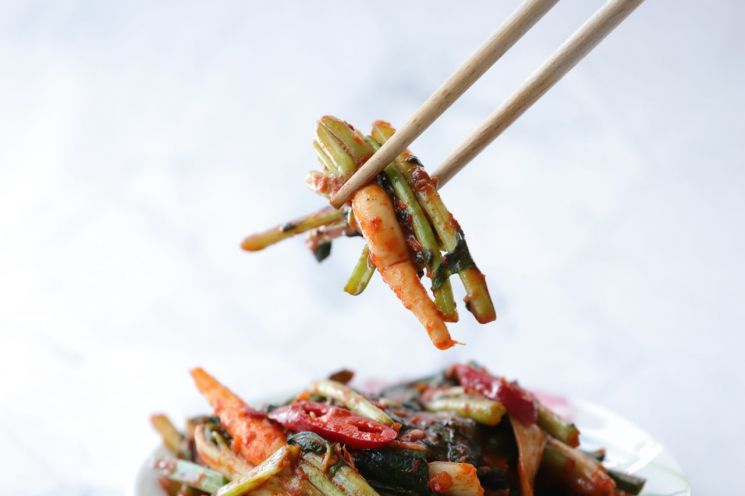
According to the Ministry of Agriculture, Food and Rural Affairs on July 21, a total of 28,491 hectares of farmland were flooded during the five days of heavy rain from July 16 to July 20. This area is equivalent to about 40,000 soccer fields (based on 0.714 hectares per field). The recent rainfall was especially concentrated in the Chungnam, Honam, and Gyeongsang regions, with each area receiving between 300mm and 700mm or more. These regions are key production areas for watermelons, peaches, chili peppers, lettuce, and green onions, resulting in widespread crop flooding.
In particular, in the Chungcheong region, which mainly produces watermelons, chili peppers, and zucchini, greenhouses were damaged by the heavy rain. In Nonsan, Chungnam, a major lettuce-producing area, about 10% of the total supply suffered rain damage. In Sancheong County, Gyeongnam, which received up to 798mm of rain over four days, green onion fields were reported to have been submerged.
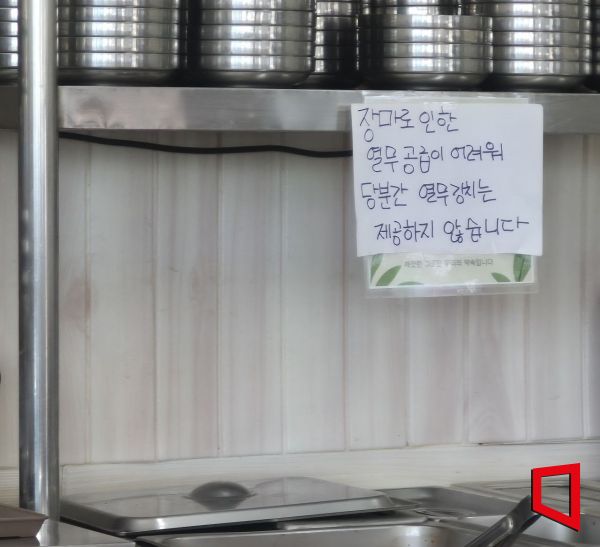 An announcement stating the suspension of Yeolmu Kimchi, which was previously served as a side dish, is posted at a restaurant in the metropolitan area amid heavy rain concentrated in the Chungcheong region and southern areas. Photo by Kim Heungsun
As a result, the surge in prices for certain seasonal agricultural products is expected to continue. Watermelon, whose average retail price exceeded 30,000 won last week, is a prime example. In Buyeo, Chungnam, a major production area, over 300mm of rain fell in just two days starting July 16, causing products to be flooded. According to the Korea Agro-Fisheries & Food Trade Corporation (aT), as of July 17, the average retail price for a single watermelon (premium grade) was 31,280 won, the highest so far this year. This is a 46.61% increase compared to a year ago (21,336 won), and 48.8% higher than the average year (21,021 won).
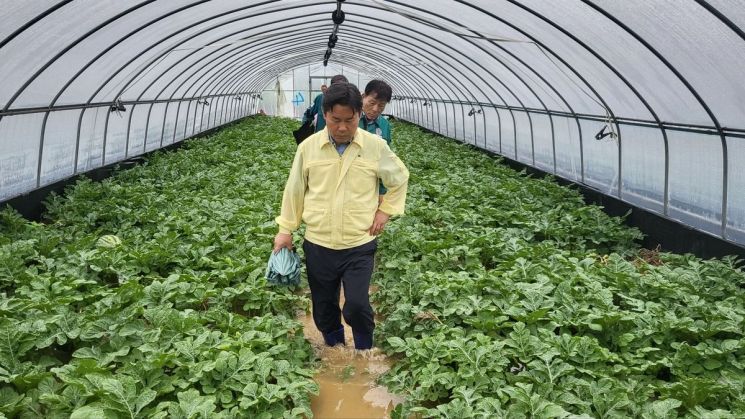 Park Junghyun, the governor of Buyeo County, is inspecting the flooded farmland and watermelon greenhouses caused by heavy rain to assess the damage in the area. Provided by Buyeo County
Yeolmu, a summer staple, also saw its retail price exceed 4,000 won per kilogram during the same period, reaching 4,050 won. This represents a 5.61% increase from a year ago (3,835 won) and a 21.69% increase compared to the average year (3,328 won). Some restaurants have even stopped serving Yeolmu Kimchi as a side dish due to the price hike. In addition, retail prices for green chili peppers and perilla leaves have risen by 48.6% and 24.5%, respectively, compared to the average year, and further increases are possible.
A source in a production area commented, "A significant number of greenhouses have been flooded due to the heavy rain," and predicted, "With the summer vacation season approaching, the supply of leafy vegetables and seasonal fruits, which are in high demand, will not be able to keep up, making price increases inevitable."
Large supermarkets, which had been launching aggressive discount campaigns to stabilize food prices, are now busy monitoring supply trends in production areas. An E-Mart representative stated, "For vegetables, not only flooding but also reduced sunlight and work delays caused by heavy rain could lead to an overall decrease in supply," and added, "We expect prices to rise and are continuously monitoring the situation."
A Homeplus representative said, "For watermelons, we are proactively sourcing from higher-altitude areas such as Bonghwa in Gyeongbuk and Jinan and Muju in Jeonbuk to minimize supply issues in case of additional heavy rain." However, they also noted, "With the weather shifting to a heatwave starting this week, there is a possibility that vegetable prices may rise somewhat depending on production volumes, so we are closely watching the situation."
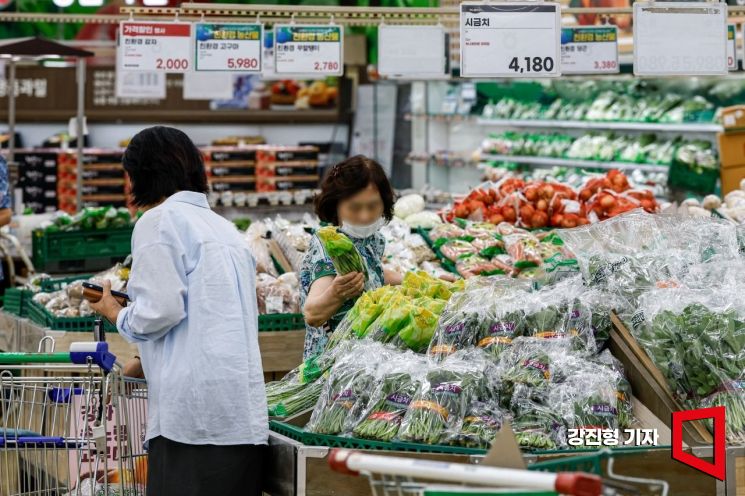 Since early this month, an early heatwave has caused a 'heatflation' phenomenon, driving up agricultural product prices. A single watermelon has exceeded 30,000 won, and prices of heat-sensitive vegetables such as napa cabbage and spinach have risen. On the 14th, spinach was displayed at Hanaro Mart Yangjae branch in Seocho-gu, Seoul. Photo by Kang Jinhyung
Lotte Mart reported, "The main production areas for vegetables currently sold in our stores are in Gyeonggi and Gangwon, so we are not experiencing supply issues due to the heavy rain." However, they added, "As temperatures are rising rapidly right after the rain, there is a possibility of diseases such as soft rot occurring. We plan to closely monitor crop conditions in production areas and respond proactively."
© The Asia Business Daily(www.asiae.co.kr). All rights reserved.
![Clutching a Stolen Dior Bag, Saying "I Hate Being Poor but Real"... The Grotesque Con of a "Human Knockoff" [Slate]](https://cwcontent.asiae.co.kr/asiaresize/183/2026021902243444107_1771435474.jpg)

















