"From Sunlight and Wind to Basic Income"
Yeonggwang County's Vision for Sharing Renewable Energy Profits with All Residents
A new wave of energy transition is sweeping through Yeonggwang County, Jeollanam-do, home to the Hanbit Nuclear Power Plant. The region has been recognized as an optimal location not only for nuclear power, but also for solar and offshore wind energy, thanks to the strong winds of the west coast and abundant sunlight. The large-scale wind farms lining the coastal roads have quickly become popular photo spots. In an interview with Asia Economy, Yeonggwang County Governor Jang Seil emphasized, "Our goal is to distribute the profits generated from sunlight and wind to all residents in the form of a basic income," adding, "Policy support is essential."
Governor Jang explained the background behind his focus on renewable energy policies by stating, "While nuclear power plants will inevitably stop operating one day due to their limited lifespan, the sun and wind will always be with us. I believe that we can transform these natural resources into energy, financial resources, and jobs."
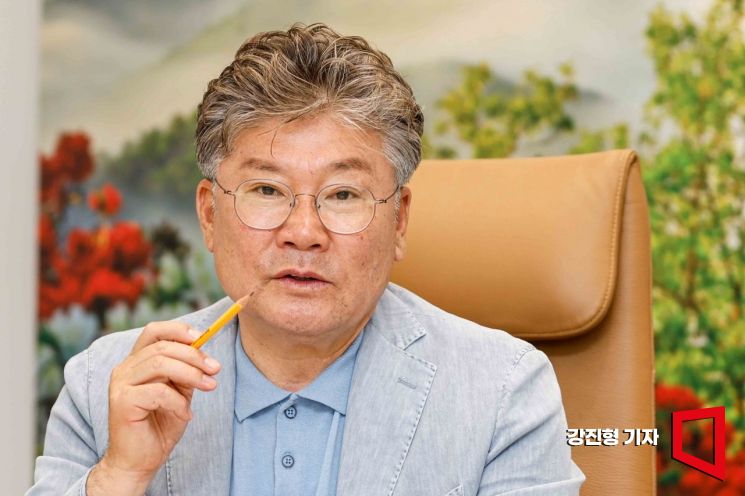 Jang Seil, former governor of Yeonggwang County, Jeonnam, is being interviewed at Yeonggwang County Office, Jeonnam, on the 20th. Photo by Kang Jinhyung
He continued, "Since the introduction of the low-carbon green growth policy in 2008, Yeonggwang County has been recognized as an ideal site for solar and wind power generation. Since then, we have steadily prepared through projects such as establishing wind power demonstration bases, and are now implementing the largest wind power project in Jeonnam." In fact, Yeonggwang County is currently pursuing a project to build a new power complex in the Exclusive Economic Zone (EEZ), following the existing Baeksu Offshore Wind Farm.
Of course, Yeonggwang County also faced opposition from local fishermen during the energy transition process. Governor Jang acknowledged, "There are certainly conflicts between offshore wind power operators and fishermen, who are key stakeholders," and added, "In particular, the county's involvement as a public institution is limited when it comes to compensation."
Governor Jang explained that the county is resolving these conflicts by proposing a profit-sharing model. He said, "We are not simply installing power generation facilities; we will ensure that local businesses and workers can participate in maintenance and operations as well," stressing, "I am confident that this will serve as a catalyst for revitalizing the local economy, going beyond mere compensation." The idea is that as workers and factories involved in renewable energy projects gather in Yeonggwang, inflows of both population and capital will naturally follow.
The ultimate goal of the energy transition is the 'Yeonggwang-style basic income.' This model aims to distribute the profits from renewable energy generation to all residents in the form of a basic income. There are two main ways to fund this initiative: residents can establish solar cooperatives and directly participate in large-scale renewable energy projects to earn profits themselves, or power generation companies can return the profits earned from renewable energy to the local community.
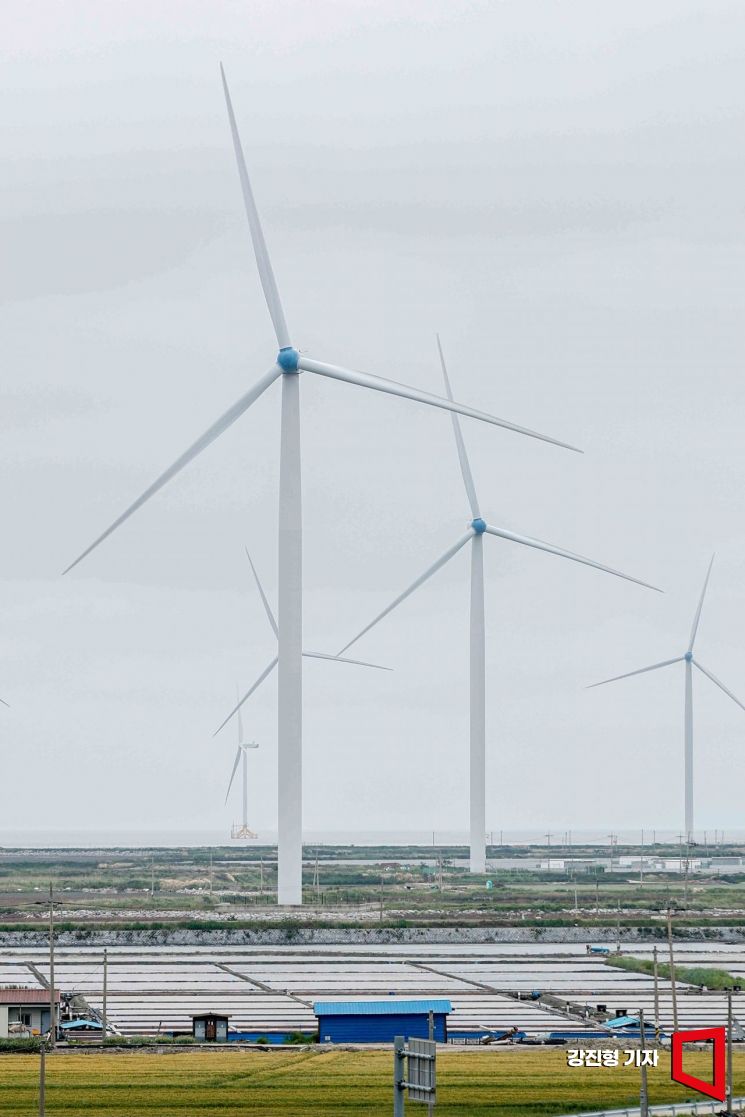 Jeonnam Yeonggwang Yaksu Offshore Wind Power. The Yaksu Offshore Wind Power has a capacity of 4.3MW and is a pilot project implemented by Jeonnam Development Corporation, the first local public enterprise to do so, located 2.5 km offshore near Baeksu-eup, Yeonggwang County. Photo by Kang Jin-hyung
Yeonggwang County has already established a basic income task force (TF) through an organizational restructuring in January of this year, and has formed a collaboration team centered around relevant departments. Thanks to these efforts, Yeonggwang was selected as the site for the 'Jeonnam-style Basic Income Pilot Project' at the provincial level this year, and will receive 20.8 billion won in provincial funding over two years. Governor Jang added, "Even with this provincial-level project, each resident will receive an annual basic income of 500,000 won in local currency." He also stated, "We will continue to pursue policies to ensure that after the two-year pilot project ends, we can provide at least 500,000 won per person per year."
He also emphasized that the central government's attention is crucial for such experiments to be successful. He said, "By 2030, we aim to make Yeonggwang County an energy self-sufficient city," and added, "To establish a basic income policy based on shared resources like renewable energy, it is essential to revise the Local Subsidy Act. If Yeonggwang is designated as a national basic energy income pilot city, beyond the provincial level, these experiments can be promoted even more efficiently."
This feature was supported by the Press Promotion Fund, which is financed by government advertising fees.

© The Asia Business Daily(www.asiae.co.kr). All rights reserved.
![Clutching a Stolen Dior Bag, Saying "I Hate Being Poor but Real"... The Grotesque Con of a "Human Knockoff" [Slate]](https://cwcontent.asiae.co.kr/asiaresize/183/2026021902243444107_1771435474.jpg)

















