"Comprehensive Overhaul of Urban Drainage System Needed"
9.8 Billion KRW Drainage Tunnel Also Proves Ineffective
The Daegu Safety Life Practice Citizens’ Coalition (Daegu Anshilryeon) on July 21 urged a thorough investigation into the causes of the flooding damage in Nogokdong, Bukgu, Daegu, which occurred on July 17 due to the malfunction of a drainage pump. The organization also called for those responsible for the lack of management to be held accountable, and strongly demanded a comprehensive overhaul of the urban drainage system to prepare for extreme rainfall caused by abnormal weather events.
Daegu Anshilryeon stated, "The Nogokdong area in Bukgu, Daegu, already suffered from flooding of homes and vehicles due to heavy rainfall in July and August 2010. At that time, the debris screen installed at the drainage pump inlet did not function properly, causing debris to disrupt drainage. This recent incident has also been confirmed as a man-made disaster caused by repeated debris screen malfunctions. Therefore, a thorough investigation and accountability for poor management and operation are unavoidable."
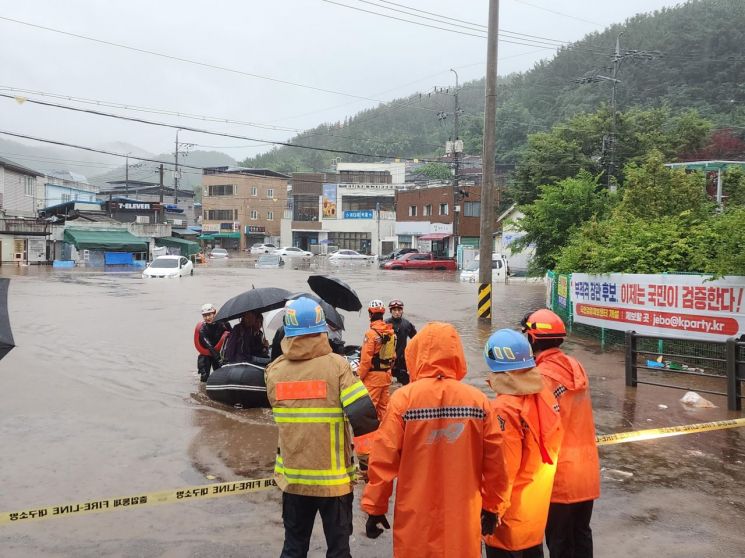
The organization further explained, "This flooding submerged 20 homes and commercial properties and 40 vehicles, and 26 citizens had to be urgently evacuated using rescue boats provided by the fire authorities. Fortunately, there were no casualties. However, public anger is greater because this was a preventable accident. At the entrance to Nogokdong village, both a natural drainage pump and a forced drainage pump are installed, but during this heavy rainfall, the natural drainage pump, which should have operated, did not function. This was because foreign objects such as tree branches became lodged in the debris screen, blocking the inlet. There are also concerns that debris from the Hamji Mountain wildfire may have entered the system. This clearly demonstrates that pre-inspection and management of the drainage facilities were not thoroughly carried out."
Daegu Anshilryeon also stated, "During the investigation into the cause of this incident and the development of countermeasures, it must be clarified whether the high-elevation drainage tunnel, which was installed after the 2010 flooding at a cost of 9.8 billion KRW (length 700m, diameter 3m), was essentially useless. There are questions as to whether the feasibility review for the installation of the high-elevation drainage tunnel was faulty from the beginning, and fundamental measures such as the installation of large rainwater tunnels are required."
The high-elevation drainage tunnel is a facility that channels rainwater collected in a reservoir on the hillside behind Nogokdong to the Geumho River at a maximum rate of 14 tons per second. It was completed and has been in operation since March 2013.
Daegu Anshilryeon criticized, "Despite the repeated occurrence of extreme rainfall due to abnormal weather, Daegu City's safety management measures for flood-prone areas are grossly inadequate. For example, in July last year, the water level of the Geumho River, which has been designated as a flood risk area since 2020, rose rapidly, submerging 12 buildings in the Dongchon Recreation Area in an instant, yet advance preparations remain virtually nonexistent. In particular, the limitations of the aging drainage infrastructure throughout Daegu are at a critical level."
According to Daegu Anshilryeon, the current drainage pump infrastructure, which was installed based on past rainfall amounts and frequency, cannot cope with present conditions and inevitably exacerbates flood damage. On July 17, rainfall exceeded 59.5 mm per hour in the afternoon, causing flooding in various parts of the city. The reason for this was that rainwater could not pass through the drainage facilities and instead backflowed, resulting in flooding.
Daegu City manages 22 drainage pumps, which can collectively drain 37,948 tons per minute. However, 9 of these facilities are over 40 years old (installed before 1982), and according to Daegu Anshilryeon, they are only capable of handling rainfall with a 10-year frequency (54.1 mm per hour).
Only 4 facilities can handle a 20-year frequency rainfall (61.1 mm per hour), 7 facilities can handle a 30-year frequency (65.2 mm per hour), and just 2 locations?Dasa Seojae and Guji National Industrial Complex?can cope with a 50-year frequency rainfall (70.2 mm per hour).
Daegu Anshilryeon emphasized, "Given the recent intensity and frequency of heavy rainfall, the current drainage infrastructure is fundamentally incapable of coping, and the structure inevitably leads to repeated and worsening flood damage. Additionally, the diameter of the sewer pipes is too small, so even water processed by the drainage pumps cannot be smoothly discharged into the streams, causing backflow and a vicious cycle of urban flooding. There is not a single rainwater tunnel or deep drainage channel in Daegu to temporarily store or discharge rainwater that cannot be handled by above-ground sewer pipes or drainage facilities during abnormal weather events with rainfall of about 100 mm per hour."
Daegu Anshilryeon strongly urged that, in light of this incident, Daegu City and the central government must establish and implement practical improvement measures to prevent any further "repeated man-made disasters."
The organization also called for a thorough investigation into the cause of the accident and strict accountability for those involved; comprehensive inspection and regular management of all facilities, including drainage pumps and debris screens; installation of large rainwater tunnels and deep drainage channels and their inclusion in urban planning; complete improvement of flood-vulnerable areas such as small-diameter sewer pipes, old retaining walls, and embankments; reestablishment of a comprehensive urban disaster prevention plan to address the climate crisis; and a request for government budget support.
© The Asia Business Daily(www.asiae.co.kr). All rights reserved.
![Clutching a Stolen Dior Bag, Saying "I Hate Being Poor but Real"... The Grotesque Con of a "Human Knockoff" [Slate]](https://cwcontent.asiae.co.kr/asiaresize/183/2026021902243444107_1771435474.jpg)















