140 Meters from Sex Offenders' Homes to Elementary and Middle Schools
"Let Sex Offenders Live in State-Designated Facilities"
Debate Continues Over Restrictions on Residence and Double Jeopardy
Experts Remain Divided... Further Discussion Needed
As discussions on the Korean version of the Jessica Law, which would restrict the residences of high-risk sex offenders to state-designated facilities, remain stalled, anxiety continues among residents in areas where released sex offenders have moved in.
According to the Seoul Metropolitan Government's Saeol Electronic Civil Service Window on the 19th, a citizen filed a complaint in January stating that a released sex offender had moved near an elementary school and a girls' middle school. The citizen wrote, "Do ordinary citizens and their children have to live in constant worry about whether they will be safe on their way to and from school every day?" and added, "Isn't it common sense that a sex offender should not be allowed to live near a girls' middle school after release?"
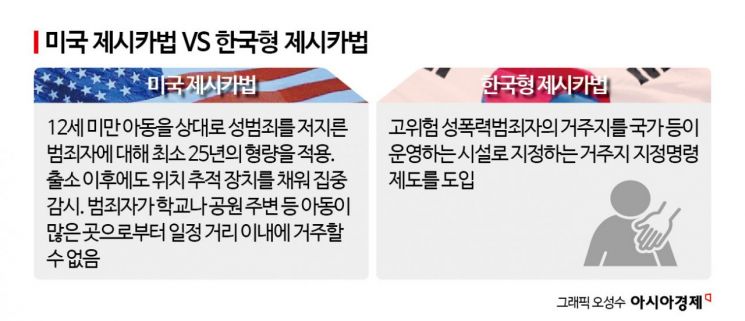
In response, the Ministry of Justice stated, "Under current law, there is no legal basis for the state to intervene in determining the residence of sex offenders," but added, "However, we are pursuing various recidivism prevention measures, taking into account the criminal methods of offenders subject to electronic monitoring." In 2023, the Ministry of Justice attempted to introduce a Korean version of the Jessica Law, which would require sex offenders to reside in specific facilities, instead of the American Jessica Law that restricts released sex offenders from living within 300 to 600 meters of key facilities such as schools. However, there has been no progress on this initiative.
In fact, after visiting the area where the elementary school and girls' middle school are located and searching for the residences of sex offenders, it was found that three sex offenders with publicly disclosed information were living within a 1-kilometer radius. Walking from their residences to the schools revealed that one location was only 140 meters away, taking one minute and forty seconds on foot, while another was 220 meters away, taking just two minutes and thirty seconds, indicating their close proximity.
Discussions on the Korean version of the Jessica Law, which would require sex offenders to live in state-designated facilities, began in December 2020 with the release of Cho Doo-soon and again in October 2022 with the release of Park Byunghwa, as there was strong backlash from local residents each time a sex offender was released. The Ministry of Justice attempted to legislate this in 2023 but failed to pass it in the National Assembly. Even in the 22nd National Assembly, the "Act on the Designation of Residences for High-Risk Sexual Offenders," proposed by lawmakers Kim Youngjin, Park Haecheol, and Jang Donghyuk, remains pending.
 According to the Seoul Metropolitan Government's Saeol Electronic Civil Service Window on the 19th, a citizen filed a complaint in early January stating that a released sex offender had moved near an elementary school and a girls' middle school.
Despite ongoing resident anxiety, the Jessica Law has not been easily passed due to concerns about unconstitutionality, double jeopardy, and the burden of selecting locations for such facilities. Experts remain divided, indicating that further discussion is needed.
Kim Daegeun, a research fellow at the Korea Institute of Criminology and Justice, stated, "The Constitutional Court has already ruled that confining a person who has served their sentence in a facility constitutes double jeopardy." He added, "For sex offenders living with their families, such restrictions could infringe upon the right to family life and, since the impact extends to family members, could violate the constitutional prohibition of guilt by association." He further commented, "While the Ministry of Justice has expressed its intention to pursue the Jessica Law, it has also noted the effectiveness of electronic monitoring devices and chemical castration. If these other measures are already effective, there is no need to implement a law that is highly likely to be unconstitutional."
Kim Dowoo, a professor in the Department of Police Administration at Kyungnam University, said, "In the Seoul metropolitan area, there are schools in every district, which makes it practically difficult to apply the American-style Jessica Law." He continued, "While restricting the residences of sex offenders is the best method for social protection, it is also necessary to establish institutional measures to prevent recidivism among offenders."
Lee Yunho, a distinguished professor in the Department of Police Science at Korea Cyber University, stated, "The public interest outweighs the infringement on individual freedom," and added, "If restricting residence is deemed unconstitutional, increasing the sentence could be an alternative."
© The Asia Business Daily(www.asiae.co.kr). All rights reserved.
![Clutching a Stolen Dior Bag, Saying "I Hate Being Poor but Real"... The Grotesque Con of a "Human Knockoff" [Slate]](https://cwcontent.asiae.co.kr/asiaresize/183/2026021902243444107_1771435474.jpg)
















