Sent to a Children's Detention Facility 55 Years Ago... Beatings and Sexual Assaults Endured
Pain Continues Today... Trauma Triggered by Scars
Compensation Ordered in Appeals Court... Government and Gyeonggi Province Immediately Appeal
Request to Meet President Lee... "What Happens After the Trial Matters Most"
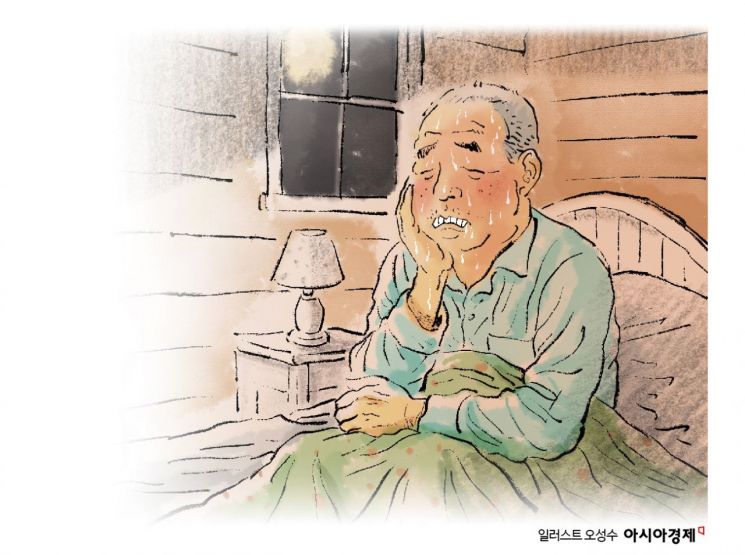
Lee Juseong (66, male) finds himself trapped in a thick fog every night. As he tries to make his way through the mist, people suddenly appear?first a child, then an older teacher?who take turns attacking him with fists or clubs. Although Lee cannot see clearly, he begins to catch and kill them. Once everyone is dead, the fog lifts. What appears next is his own room. When Lee wakes from the dream, his clothes are always soaked in sweat. Even in the early morning, the ever-lit fluorescent light stings his eyes. After waking from a nightmare, it is almost impossible to fall back asleep.
Though Lee is now an elderly man over 60, he remains stuck at age nine. According to an investigation report by the Truth and Reconciliation Commission, Lee was arrested by police in Suwon in 1969 while on his way with his younger brother to meet their eldest brother. The reason given was that they looked like vagrants. Lee explained that he was supposed to meet his grandmother, who worked at the Nammun Market in Suwon, but was instead met with police kicks.
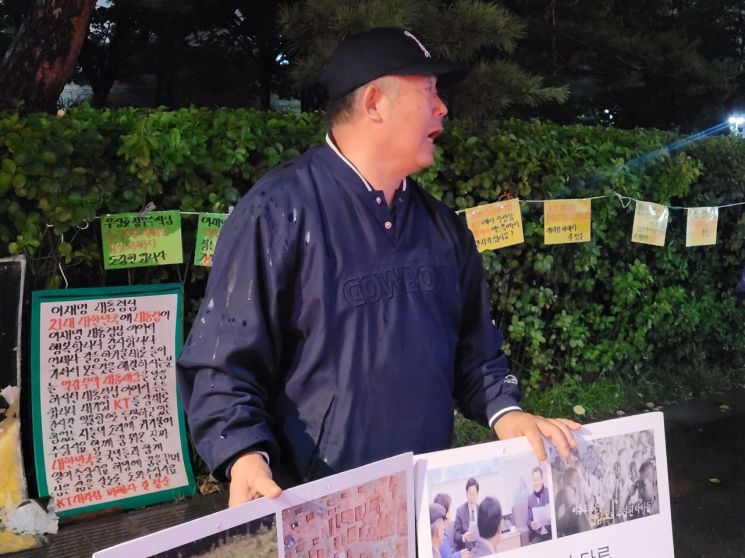 On the 16th, Lee Juseong (66, male) is shouting slogans while protesting in front of the Presidential Office in Yongsan, Seoul. Photo by Gong Byungseon
Lee and his younger brother were immediately taken to Seongam Academy, a children’s detention facility located on Seongamdo Island in Ansan, Gyeonggi Province. Seongam Academy was a facility that forcibly detained children under the pretext of vagrant protection and vocational training during the military regime, operating until 1982. It was so remote that it took an hour by car from Ansan City Hall. Lee was detained at Seongam Academy until 1975. He testified that he was beaten and even sexually assaulted by other youths held there. In 1972, he attempted to escape from Seongam Academy but was caught, severely beaten, and locked in a windowless storage room for several days. "I was sexually assaulted at a young age and the pain was unbearable, so I kept taking medicine, trying to die. I would get medicine saying I had chest pain, or a headache. I collected the medicine and took it all at once, but I didn't die?I woke up."
It has been 50 years since Lee left Seongam Academy, but his suffering continues. He still bears a deep scar on his right arm from being tightly bound with rope in the storage room. Whenever he feels that scar, he is instantly overwhelmed, as if trapped in the storage room again, struggling to breathe. This is why he still takes medication for panic disorder. According to the Truth and Reconciliation Commission's report, Lee developed a trauma related to bowel movements after being locked in the storage room for a long time. He continued to sob as he described his hardships, speaking just like a nine-year-old child. "I still can't overcome the memories of Seongam Academy. The thought that I want to stop now never leaves my mind."
Since this month, Lee has been protesting every day in front of the Presidential Office in Yongsan. After finishing his job managing public rental housing at 6 p.m., he travels from Yongin, Gyeonggi Province, to the Presidential Office in Yongsan. It takes him an hour and a half to get there, where he takes out his picket sign. His wife and daughter tried to dissuade him from protesting for health reasons, but he refused, saying he simply cannot sleep unless he does this. Even on the 16th, when heavy rain poured down, he held up his picket sign. "More than 300 surviving victims still wake up every morning from nightmares, but the perpetrators have not offered a single word of apology!" Lee repeatedly choked up in tears as he shouted toward the Presidential Office.
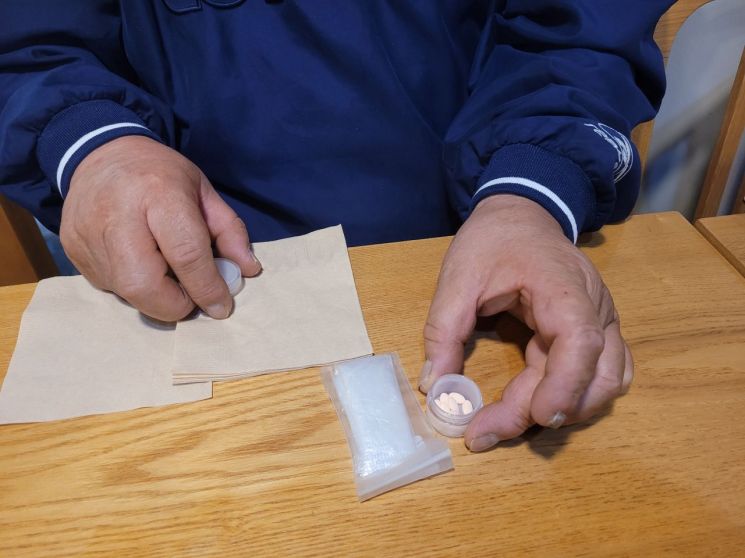 On the 16th, Lee Juseong (66, male) met in front of the Presidential Office in Yongsan, Seoul, showing the medication he is taking for panic disorder. Photo by Byeongseon Gong
The reason he has come all the way to the Presidential Office in Yongsan is because of the government and Gyeonggi Province. On June 4, the Seoul High Court ruled in the appeal trial of a damages lawsuit filed by 13 victims of Seongam Academy that the state and Gyeonggi Province must each pay between 45 million and 650 million won in compensation per person. In court, the government argued that the operation of Seongam Academy was a local administrative matter for Gyeonggi Province, while Gyeonggi Province countered that it was merely carrying out duties delegated by the central government. In other words, the government and Gyeonggi Province tried to shift responsibility onto each other, but the court did not accept this argument.
The court stated, "The plaintiffs were suddenly detained in the facility by police or other authorities inside or near train stations," and explained, "Officials managing Seongam Academy assigned leaders and supervisors to each dormitory, but allowed group discipline and violence to occur, during which sexual assaults also took place." The court further pointed out, "Even if the operation of Seongam Academy was a local administrative matter for Gyeonggi Province, the defendant, the Republic of Korea, is responsible for all damages," and added, "There is room to view the operation of Seongam Academy as a duty delegated to the governor of Gyeonggi Province, but it can also be considered a local administrative matter for the local government."
The government and Gyeonggi Province each filed an appeal on June 24 and 25. Now that the case is headed to the Supreme Court, the victims of Seongam Academy must once again await the court's decision. This lawsuit began in December 2022, meaning more than two years have already passed.
Lee expressed anger that the state is inflicting secondary harm on the victims of Seongam Academy. He said, "Not only I, but many victims still need psychiatric treatment. Yet the government and Gyeonggi Province immediately appeal and file further appeals after every ruling," and added, "When I heard that the government had filed an appeal, I felt like I should do something drastic, even overturn the country. But I can't do anything because it would make things too hard for my family."
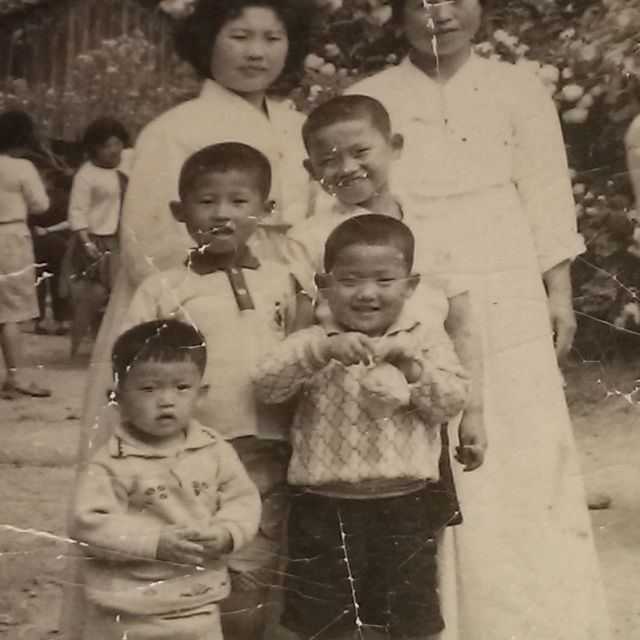 A past family photo of Joo Sung Lee (66, male). Lee is located at the bottom row on the right. Provided by Lee.
Lee wants a sincere apology from the government and Gyeonggi Province. He also hopes the former site of Seongam Academy will be restored, and that the remains of 187 people buried there in mass graves will be reburied in a larger area instead of a cramped 10-pyeong communal grave, so that their honor can be restored. "It doesn't matter how much money each person receives through the lawsuit. What happens after the trial is more important. These days, I keep asking my daughter: Will the Seongam Academy case ever be included in textbooks while I'm still alive? My daughter always replies, 'It will definitely happen.'"
The victims of Seongam Academy are planning to hold a rally in front of the Presidential Office in Yongsan on July 23. They plan to demand an official apology from the government and Gyeonggi Province, as well as the establishment of a permanent recovery institution for victims of state violence. They also intend to request a meeting with President Lee Jaemyung. Lee is hoping to meet President Lee at this event. He remembers that when President Lee was governor of Gyeonggi Province, he met with victims of Seongam Academy and expressed a sense of responsibility through social media. "If I could meet President Lee, this is what I would like to say: 'We are not people who only suffered in the past. We are still in tremendous pain today.'"
© The Asia Business Daily(www.asiae.co.kr). All rights reserved.
![Clutching a Stolen Dior Bag, Saying "I Hate Being Poor but Real"... The Grotesque Con of a "Human Knockoff" [Slate]](https://cwcontent.asiae.co.kr/asiaresize/183/2026021902243444107_1771435474.jpg)

















