Regarding Business Community Demands for Poison Pills and Dual-Class Shares
Special Committee Official Draws a Line: "Restoring Trust in the Capital Market"
The Democratic Party of Korea, which has announced a 'stronger' amendment to the Commercial Act, is drawing a clear line against demands from the business community to introduce new management rights defense measures. The party argues that trust in the capital market must come first.
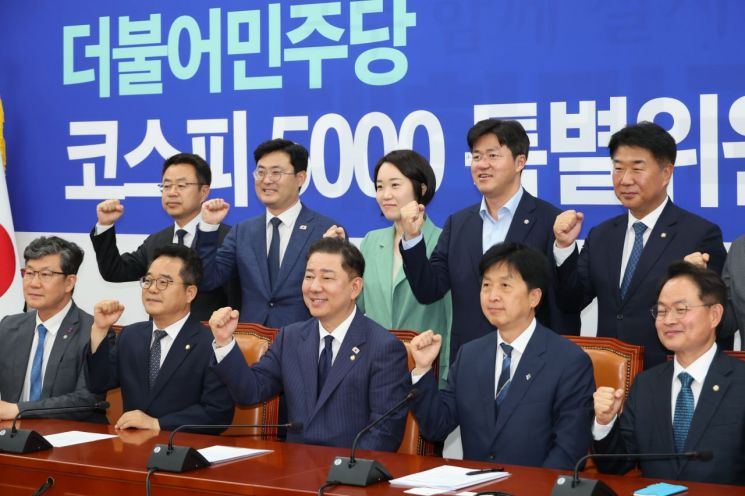
On July 18, a key member of the Democratic Party's KOSPI5000 Special Committee told Asia Economy in a phone interview that, regarding recent calls from the business sector for management rights defense mechanisms in connection with the Commercial Act amendment, "The capital market is in the process of regaining trust," and added, "I don't think this is something to discuss at this time." The business community has been calling for the introduction of management rights protection measures such as poison pills (stock options for existing shareholders) and dual-class voting shares, arguing that amendments to the Commercial Act have made it more difficult to protect management rights or prevent hostile mergers and acquisitions (M&A).
On July 3, when the Commercial Act amendment passed the National Assembly, eight major business organizations released a statement demanding the codification of the business judgment rule, improvement of the breach of trust crime, and the introduction of management rights defense measures. The business sector emphasized the need for supplementary measures based on several points: the large number of domestic companies under attack from global activist funds; the risk that supplementary legislation could intensify interference by external capital; and the fact that over 90% of companies experiencing management disputes due to attacks by activist funds are small and medium-sized enterprises.
Previously, the National Assembly passed an amendment to the Commercial Act that included: ▲ expanding directors' duty of loyalty; ▲ introducing electronic general shareholders' meetings; and ▲ limiting voting rights to a combined 3% for the largest shareholder and related parties when appointing audit committee directors (the so-called "3% rule"). The Democratic Party aims to pass further supplementary legislation during the July extraordinary session of the National Assembly, including: ▲ the introduction of cumulative voting; and ▲ increasing the number of separately elected audit committee members, both of which were not included in the previous amendment.
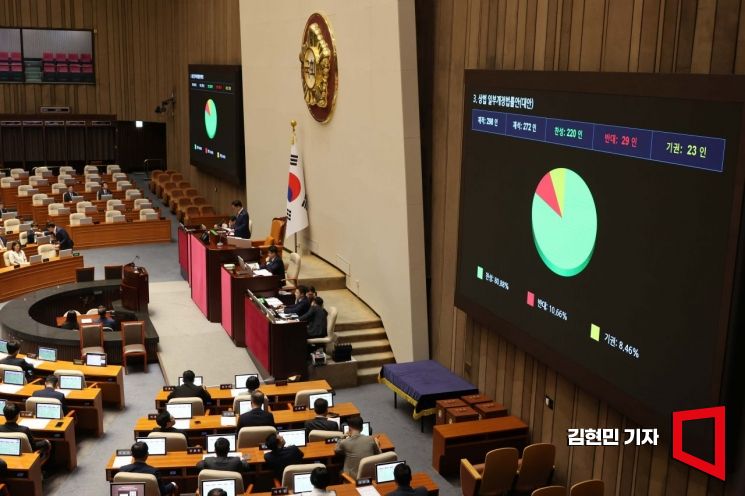 On the 3rd, the partial amendment to the Commercial Act was passed at the plenary session of the National Assembly. 2025.7.3 Photo by Kim Hyunmin
The Democratic Party has remained open to discussions on codifying the business judgment rule and improving the breach of trust crime, but is negative about introducing management rights defense mechanisms. A key member of the special committee stated, "Only companies with a low price-to-book ratio (PBR) become M&A targets in a normal capital market," and added, "If the PBR is at a normal level, there is no room for hostile M&As." They also argued, "Even with the introduction of cumulative voting, shareholders with larger stakes will still retain decision-making authority."
Improvements to the breach of trust crime and the codification of the business judgment rule have been postponed until after the passage of the 'stronger' Commercial Act amendment. According to explanations from Democratic Party officials, related supplementary measures are expected to be addressed after the regular National Assembly session in September. Relevant bills include one proposed by Democratic Party lawmaker Kim Taenyon (deleting the special breach of trust provision from the Commercial Act and codifying the business judgment rule in the Criminal Act), and bills proposed by People Power Party lawmakers Ko Dongjin and Yoo Sangbeom (codifying the business judgment rule in the Criminal Act).
Meanwhile, the Democratic Party has also proposed an amendment to the Commercial Act (sponsored by lawmakers Kim Namgeun and Kim Hyunjung) that would require the mandatory cancellation of treasury shares in principle. Kim Namgeun's bill stipulates cancellation within one year of acquisition, while Kim Hyunjung's bill calls for cancellation within three years. This, too, is targeted for passage during the regular National Assembly session in September.
© The Asia Business Daily(www.asiae.co.kr). All rights reserved.
![Clutching a Stolen Dior Bag, Saying "I Hate Being Poor but Real"... The Grotesque Con of a "Human Knockoff" [Slate]](https://cwcontent.asiae.co.kr/asiaresize/183/2026021902243444107_1771435474.jpg)
















