Forum on AI Transformation and the Future of Work Held
Labor, Management, Government Representatives and Academic Experts Participate
"Concerns Over Worker Competition... Retraining Needed"
The first forum where representatives of labor, management, and government met since the launch of the new administration focused on the topic of 'Artificial Intelligence (AI)'. Given the significant changes in the labor market and employment environment brought by the advent of the AI era, there was a discussion emphasizing that cooperation among labor, management, and government is essential to respond effectively. The Economic, Social and Labor Council, a presidential advisory body for social dialogue, announced that it will release a Green Paper outlining key discussion topics necessary for formulating AI labor policies in October.
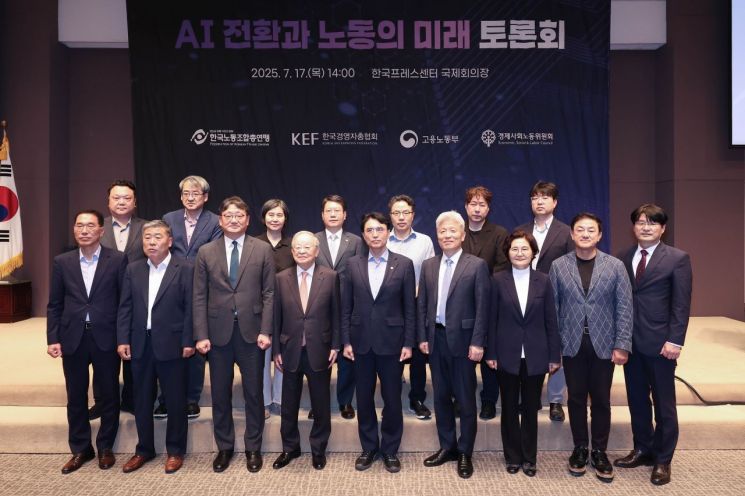 Participants are taking a commemorative photo at the "AI Transformation and the Future of Work Forum" held on the 17th at the Korea Press Center in Jung-gu, Seoul. Photo by Yonhap News
On the 17th, the Economic, Social and Labor Council held the 'AI Transformation and the Future of Work Forum' at the Korea Press Center in Jung-gu, Seoul, together with the Federation of Korean Trade Unions, the Korea Employers Federation, and the Ministry of Employment and Labor. The event was organized to discuss labor policies and legal and institutional reforms for the AI era, building social trust, and strategies for securing future talent.
In addition to representatives from labor, management, and government, academic experts also attended the event. Kim Dongmyeong, President of the Federation of Korean Trade Unions, Sohn Kyungshik, Chairman of the Korea Employers Federation, and Kwon Changjun, Acting Minister (Vice Minister) of the Ministry of Employment and Labor, were present, marking the first event where representatives from all three sides met since the new administration took office.
Vice Minister Kwon stated, "There are conflicting outlooks, such as expectations for the creation of new jobs and concerns about the replacement of existing ones, as well as hopes for increased productivity and worries about widening labor market disparities in the AI era." He continued, "However, if we ignore or try to block these changes, we will not be able to prepare for the future," emphasizing, "This is why labor, management, and government must cooperate and respond proactively to change."
Choi Jaeboong, Professor of Mechanical Engineering at Sungkyunkwan University, who delivered the keynote speech, highlighted the need for active research and development, the establishment of labor-management relations, and education to keep pace with the AI era under the theme 'The Future of Work in the Age of AI Sapiens.' He explained that to become a global AI powerhouse alongside the United States and China, Korea must develop capabilities in semiconductors, manufacturing, and software, and noted that the country's infrastructure is well established, providing a competitive edge.
In Session 1, Kwon Oseong, Professor at Yonsei University Law School, delivered a presentation, followed by a panel discussion with Kim Yucheol, Head of Strategy at LG AI Research, Oh Gyetaek, Head of the Labor-Management Relations Research Division at the Korea Labor Institute, Lee Junhee, Professor of Law at Kwangwoon University, and Jang Jinhui, Senior Research Fellow at the Central Research Institute of the Federation of Korean Trade Unions. The panel discussed the need to establish legal frameworks, ethics, and trust governance in the process of transforming labor policy in the AI era.
Professor Kwon explained in his presentation, "The introduction of AI technology in the workplace is applied across all employment decision-making processes, including recruitment, placement, compensation, and retirement. In this process, there is a high risk of reinforcing discrimination through the use of proxy variables related to sensitive information or discriminatory data learning." He also argued, "Since there is a risk of human bias being embedded in automated decision-making processes, legal intervention is essential."
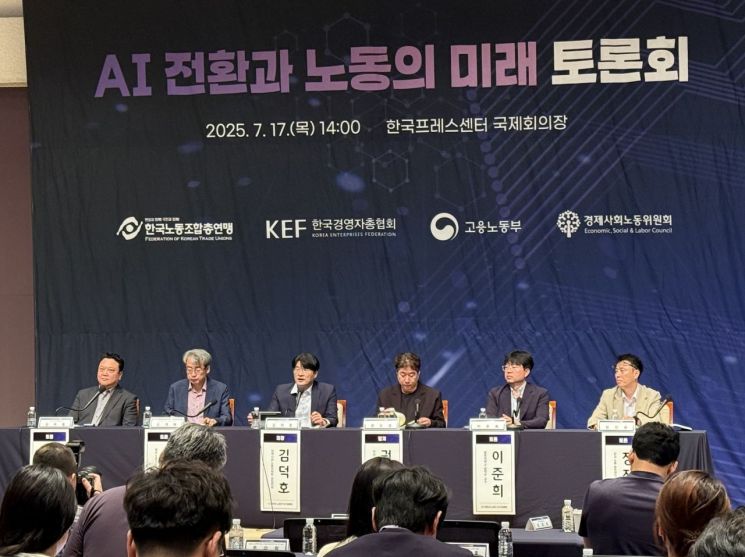 At the 'AI Transformation and the Future of Work Forum' held on the 17th at the Korea Press Center in Jung-gu, Seoul, Kim Deokho, Standing Member of the Economic, Social and Labor Council, who served as the chair of Session 1, is speaking. Photo by Kim Pyeonghwa
During the discussion, Kim Yucheol expressed concern that "in the AI era, relationships among workers, especially competition, may intensify more than the relationship between companies and workers." He added, "As companies strive to reap the benefits of AI, those that fail to implement it properly may be eliminated, and in this process, competition among people will increase." He emphasized, "It is now necessary to provide retraining to foster creative problem-solving abilities and social skills."
Jang Jinhui stressed, "A complete redesign of the social safety net is needed," and added, "A system is required to protect workers who lose their jobs due to layoffs by companies adopting AI." He continued, "As Bill Gates suggested, it may be necessary to introduce a robot tax or AI tax, and use the revenue to support those who lose their jobs because of AI."
Kim Deokho, Standing Member of the Economic, Social and Labor Council and chair of Session 1, said, "We are gathering opinions from 100 experts on various issues regarding the impact of AI," and added, "Once these opinions are collected, we will organize them and publish the Green Paper in October." He further stated, "The Green Paper can serve as a traffic light for AI labor policy," and noted, "It will be the first case in Korea to examine AI labor policy."
The Economic, Social and Labor Council believes it is essential to seek responses to changes in the labor market and working environment brought by the AI era, and for this reason, established the 'AI and Labor Study Group' under its umbrella in January. The study group is co-chaired by Standing Member Kim Deokho and Jang Jiyeon, Senior Research Fellow at the Korea Labor Institute, and will operate until November. The Green Paper, which will reflect the concerns and questions of Korean society, is scheduled to be released.
In his opening remarks at the forum, Kwon Giseop, Chairman of the Economic, Social and Labor Council, emphasized, "To respond proactively to this technological transition, it is more important than ever to establish a policy foundation for systematically securing and nurturing AI talent." He added, "Now, labor, management, and government must work together to accurately diagnose the trends of job changes and jointly design appropriate transition strategies and implementation pathways."
© The Asia Business Daily(www.asiae.co.kr). All rights reserved.
![Clutching a Stolen Dior Bag, Saying "I Hate Being Poor but Real"... The Grotesque Con of a "Human Knockoff" [Slate]](https://cwcontent.asiae.co.kr/asiaresize/183/2026021902243444107_1771435474.jpg)
















