"Recently, a passenger plane from Taiwan made a dangerously close turn near Dottaesan Mountain, bringing Gimhae City once again to the brink of disaster. We must ensure that such a horrific situation never happens again."
Hong Taeyong, mayor of Gimhae City, Gyeongnam, strongly urged the government to establish fundamental measures, citing a recent incident in which a Taiwanese passenger aircraft, while approaching the runway at Gimhae International Airport, made a turn flight extremely close to Dottaesan Mountain.
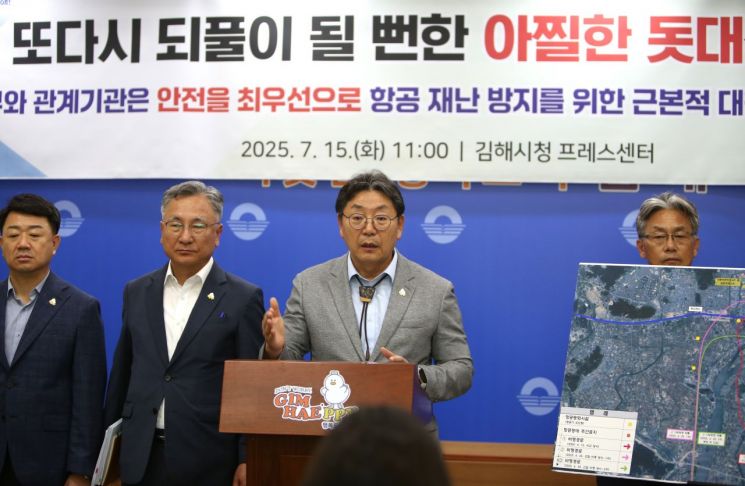 Hong Taeyong, mayor of Gimhae City, Gyeongnam, is urging the government to establish fundamental measures, expressing concerns about the risk of aircraft landing at Gimhae Airport colliding with Dottaesan Mountain. Photo by Lee Seryung
On the 15th, at a press conference held at City Hall's press center, Mayor Hong stated, "There was a harrowing situation in which the 2002 Dottaesan disaster was nearly repeated," and emphasized, "Fundamental safety measures are needed to address the structural risks of turn approaches during takeoff and landing at Gimhae Airport."
He added, "The city has repeatedly proposed measures such as runway extension and flight path changes to prevent noise damage and aviation disasters, but the Air Force has cited reasons such as limited improvement effects, military operation zones, and altitude restrictions for each flight path as grounds for rejection," and raised his voice, "For one reason or another, must our Gimhae citizens continue to live with the risk of aircraft crash accidents?"
Gimhae City revealed that, according to a 2016 survey of 341 pilots operating flights to Gimhae Airport, 72.7% of respondents answered that Gimhae Airport is 'dangerous' in terms of safety, and 80.8% cited mountainous obstacles such as Dottaesan and Sineosan as safety threats.
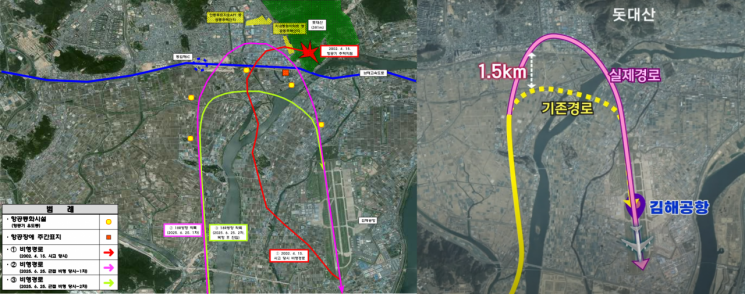 Turn routes of China Airlines flight CI-186 from Taiwan on June 25, 2025, and China International Airlines flight CA-129 during the 2002 Dotaesan disaster. Provided by Gimhae City
Mayor Hong said, "The Ministry of Land, Infrastructure and Transport, the Ministry of National Defense, and airport-related agencies must immediately come together to address public anxiety and devise fundamental measures to eliminate the risks of turn flights near Dottaesan," adding, "This is the reason for the state's existence and the minimum duty the government must fulfill."
He went on to say, "Even if it is rare for aircraft to make turns toward Dottaesan or Sineosan, an incident like the 2002 disaster must never happen again, not even once," and stressed, "The risk of collision with not only Dottaesan but also nearby high-rise apartments cannot be prevented simply by hoping accidents will not occur."
He further stated, "Whether it is by creating a way for aircraft not to deviate from the normal flight path or by improving the runway, only proper measures?not stopgap solutions?will allow both citizens and passengers to feel safe," and added, "It is also necessary to ensure that foreign pilots are well aware of the risks associated with turn approaches at Gimhae Airport."
Previously, on June 25, China Airlines flight CI-186 from Taiwan, while landing at Gimhae Airport, deviated from the normal turn route south of the Namhae Expressway and passed dangerously close to Dottaesan Mountain.
According to the flight tracking site Flightradar24, the route of flight CI-186 at the time brought it within 700 meters of the 180-meter-high peak of Dottaesan and just 160 meters from the ground.
The aircraft, carrying about 150 passengers, turned its nose about 1.5 kilometers later than the normal route for a turn, flew extremely close to Dottaesan, and managed to land at the airport only after two attempts.
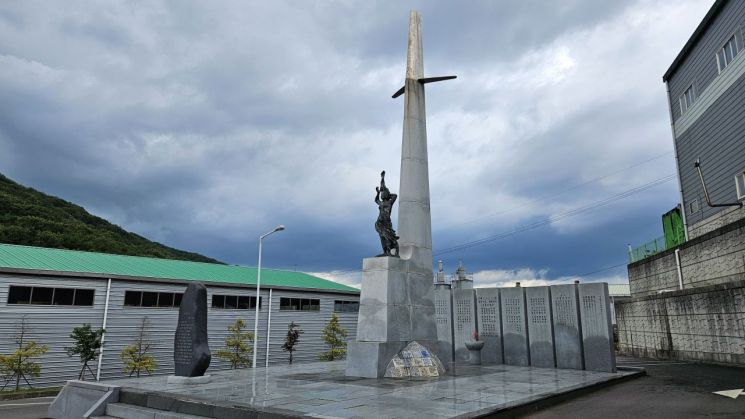 A memorial monument erected near the Shineo Park Memorial Hall at Gyeongnam Yeongmyowon in Sangdong-myeon, Gimhae-si, Gyeongnam. Photo by Lee Seryung
The point where the aircraft made its close approach was only about 1 kilometer from the site of the 2002 'Dottaesan collision disaster.'
The Dottaesan disaster occurred when China International Airlines flight CA-129, attempting to land at Gimhae Airport, missed the normal turn route and collided with the summit of Dottaesan, resulting in the deaths of 129 out of 166 people on board. Of the victims, 111 were Korean, accounting for 86% of the total fatalities.
Gimhae Airport is classified as a 'special airport' because it is surrounded by mountainous terrain such as Dottaesan and Sineosan, and when southerly winds blow, aircraft must make turn flights to avoid the mountains before landing.
Since instrument flight using internal aircraft instruments is not possible, pilots must visually confirm the runway and surrounding terrain, which is said to cause difficulties for foreign pilots unfamiliar with Gimhae Airport's geography when making turn approaches.
Mayor Hong said, "It has been 23 years since the Dottaesan disaster, but the dangers above our city have not disappeared," and added, "Together with our 560,000 citizens, we will watch closely to see what measures the government and relevant agencies will propose."
© The Asia Business Daily(www.asiae.co.kr). All rights reserved.
![Clutching a Stolen Dior Bag, Saying "I Hate Being Poor but Real"... The Grotesque Con of a "Human Knockoff" [Slate]](https://cwcontent.asiae.co.kr/asiaresize/183/2026021902243444107_1771435474.jpg)

















