Trump Announces 30% Tariff on EU, 35% on Mexico
This Week's Stock Market Hinges on Inflation Data and Q2 Earnings
June CPI Expected to Rebound... Will Tariff Effects Become Visible?
The three major indices on the New York Stock Exchange showed mixed movements in a narrow range early in the session on July 14 (local time). As President Donald Trump expanded the list of countries receiving tariff letters last week?starting with South Korea and Japan, and over the weekend adding the European Union (EU) and Mexico?the market's resilience in the face of trade policy uncertainty is being put to the test. In particular, attention is focused on whether the upcoming corporate earnings announcements, which begin in earnest this week, will provide momentum to overcome tariff risks.
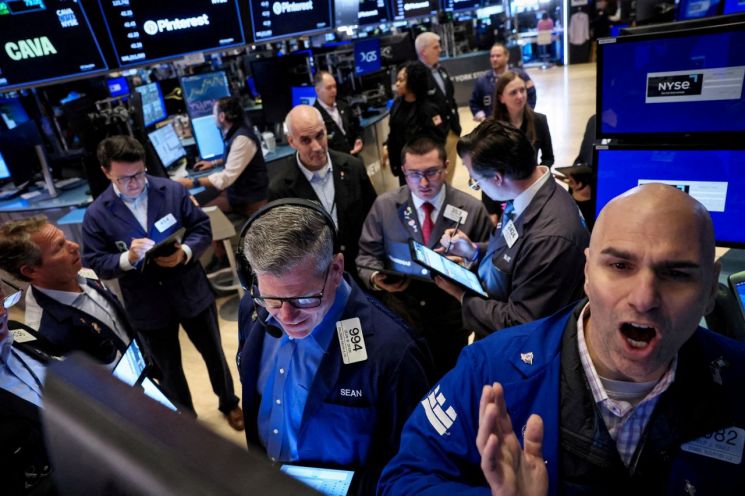
As of 9:31 a.m. on this day at the New York Stock Exchange, the blue-chip Dow Jones Industrial Average was down 118.91 points (0.27%) from the previous trading day, standing at 44,252.6. The large-cap S&P 500 Index had fallen 8.64 points (0.14%) to 6,251.11, while the tech-heavy Nasdaq Index was up 11.56 points (0.06%) at 20,597.08.
Investors are turning their attention to the latest tariff news. On July 12, President Trump sent letters to the EU and Mexico, threatening to impose reciprocal tariffs of 30% and 35%, respectively. Both the EU and Mexico have expressed their intention to negotiate with the United States before the tariffs take effect on August 1 in hopes of reducing the rates.
This week, a series of price and consumption indicators will be released, providing insight into the impact of tariff policies. First, the U.S. Department of Labor will announce the June Consumer Price Index (CPI) on July 15. According to market forecasts compiled by Bloomberg, the core CPI for last month is expected to have risen 2.9% year-on-year. This is a larger increase than May's 2.8%. On a monthly basis, the rise is projected to be 0.3% in June, up from 0.1% in May, marking the largest increase in five months since January (0.4%). The overall CPI is expected to rise 0.3% from the previous month and 2.6% year-on-year, indicating an acceleration in inflation compared to May's figures (0.1% and 2.4%, respectively).
The market is closely watching this CPI release because it marks the point when the effects of tariffs are expected to begin showing up in prices. Until now, companies have absorbed tariff costs by securing inventory in advance, but as these inventories are depleted during the summer, it is likely that the increased tariff burden will be passed on to consumer prices. Federal Reserve Chair Jerome Powell and other monetary authorities have consistently warned about the potential for higher inflation during the summer months. The focus is even greater because this inflation data will be released ahead of the Federal Open Market Committee (FOMC) meeting scheduled for July 29-30.
On July 16, the Producer Price Index (PPI), which measures wholesale prices, will be released. The June PPI is expected to have risen 0.3% from the previous month, indicating a clearer uptrend in prices compared to May's 0.1%. On July 17, the June retail sales figures will be published. Retail sales, which account for about two-thirds of the U.S. economy, are expected to have increased by 0.2% from the previous month in June, suggesting a recovery after a 0.9% decline in May.
The second-quarter earnings season is also kicking off in earnest. Starting with JP Morgan Chase, Citigroup, and Wells Fargo on July 15, companies will begin announcing their second-quarter results this week. According to market research firm FactSet, second-quarter net profit for S&P 500 companies is expected to increase by 4.6% year-on-year. This growth rate is lower than the five-year average of 9.1% and the ten-year average of 6.9%.
Glenn Smith, Chief Investment Officer (CIO) at GDS Asset Management, commented, "Over the next few weeks, the biggest question for the market will be whether the expected solid corporate earnings can offset the persistent issue of tariffs," adding, "So far, the market has endured tariff-related news and is now focusing more on corporate earnings and economic resilience."
In addition, the Federal Reserve's Beige Book, which reports on economic conditions, will be released on July 16. Speeches by Federal Reserve officials?including Susan Collins, President of the Federal Reserve Bank of Boston; Lisa Cook, Federal Reserve Governor; and Christopher Waller, Federal Reserve Governor?are also scheduled throughout the week.
U.S. Treasury yields are steady. The benchmark 10-year U.S. Treasury yield, a global bond market standard, is up 1 basis point (1bp = 0.01 percentage point) from the previous day at 4.44%. The 2-year Treasury yield, which is sensitive to monetary policy, is down 1 basis point from the previous day at 3.89%.
By individual stock, Kenvue, which manufactures Tylenol and Neutrogena, is up 4.28% following news of its CEO's resignation. Electric vehicle company Rivian is down 2.57% after Guggenheim downgraded its investment rating from 'Buy' to 'Neutral,' citing concerns over prolonged weak vehicle sales. Electric vehicle maker Tesla is up 2.78%. Nvidia is down 0.61%. Jensen Huang, Nvidia's CEO, who is visiting China on July 16, said in a CNN interview the previous day that "it is unlikely the Chinese military will rely on U.S. artificial intelligence (AI) chips," criticizing the U.S. government's semiconductor export controls against China.
© The Asia Business Daily(www.asiae.co.kr). All rights reserved.
![Clutching a Stolen Dior Bag, Saying "I Hate Being Poor but Real"... The Grotesque Con of a "Human Knockoff" [Slate]](https://cwcontent.asiae.co.kr/asiaresize/183/2026021902243444107_1771435474.jpg)















