Stray Cat Neutering Project (TNR)
TNR Budget Increased from 19.4 Billion to 26 Billion Won
Neutering the Day After Capture... Release After Recovery
At 7 p.m. in Bangi-dong, Songpa-gu, Seoul, in a villa neighborhood, a stray cat that had been hiding under a car began to cautiously approach the food placed inside a trap cage. Jo Wooram (45), a stray cat trapper who was watching from beyond a wall, waited silently until the cat was fully inside the trap. As soon as the cat ventured deep into the trap and started eating, Jo remotely closed the entrance. After two and a half hours of waiting, he finally caught a cat.
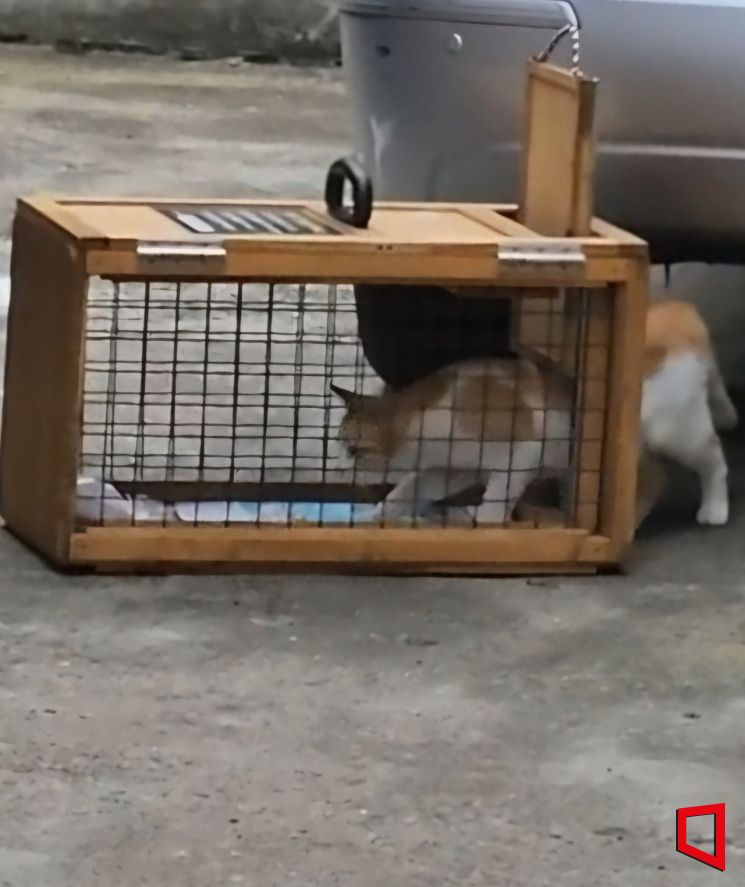
As the startled cat frantically darted around inside the trap, Jo quickly positioned a smaller transport carrier at the entrance of the trap. He then opened the doors of both the trap and the carrier, guided the cat into the carrier, and covered it with a cloth. Jo explained, "From the cat's perspective, being suddenly captured is very stressful, and as it tries to escape by moving around inside the trap, it can get hurt. To prevent injury, I move the cat into a smaller carrier and cover it, since cats prefer dark spaces, to help reduce their stress."
Jo captures stray cats in order to have them neutered. The stray cat neutering program (TNR) is implemented nationwide in accordance with the Animal Protection Act to control the population of stray cats, each of which has its own territory, so that they can survive without invading each other's space and coexist with humans. When a complaint is filed with a local government, a trapper captures stray cats in the designated area, hands them over to a partner animal hospital, and after the cats undergo neutering surgery and recovery, they are returned to their original location.
According to the National Animal Protection Information System on July 22, the number of neutered stray cats increased annually, reaching 129,980 last year, up from 61,673 in 2022 and 99,032 in 2023. As of July 8 this year, a total of 68,739 stray cats had been neutered. Accordingly, the project budget also increased from 19.4 billion won in 2022, to 22.7 billion won in 2023, and 26 billion won last year.
Despite these results, capturing a single stray cat requires considerable time and effort. On this day, Jo used various types of food and even cat toys to catch a stray cat. Jo said, "To attract cats, I have to prepare food that matches their preferences, so I carry around 15 different flavors, such as fish, chicken, and tuna, and I also use toys or laser pointers to get their attention. Still, cats are fundamentally sensitive creatures, so luring them into a trap is like 'plucking a star from the sky,'" he said, emphasizing the difficulty.
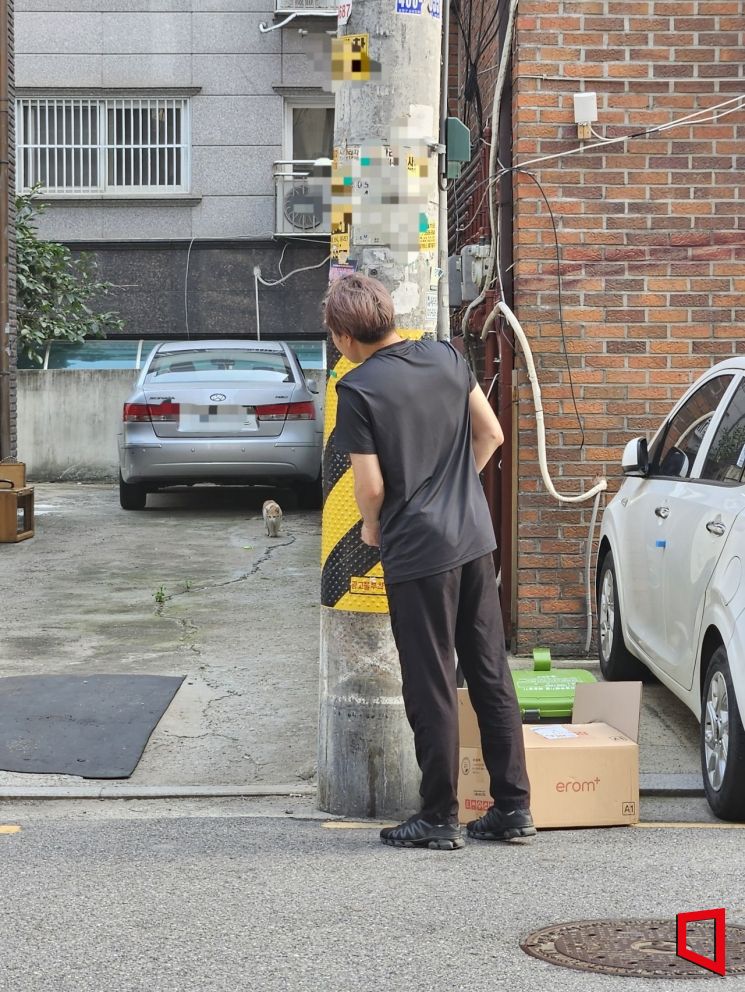
It is not possible to catch cats barehanded or use tranquilizer guns. Cats are too quick to be caught by hand, and using a tranquilizer gun risks serious injury, such as hitting a small cat in the eye. This is why trappers must patiently wait, moving traps around and waiting for the right moment.
It is also a challenge to identify which stray cats need to be neutered among the many roaming the streets. Because cats tend to flee when approached, traps must be set up discreetly near areas where cats move, and trappers must watch from a distance. When a cat lingered near a trap, Jo would zoom in with his phone camera to closely observe its condition. "Some cats are injured, some are pregnant or nursing, and some have already been neutered," he said. "I have to distinguish which cats are eligible for neutering among all these different cats."
As a result, there are many days when trappers go home empty-handed. Jo said, "I've waited up to 10 hours to catch a single cat. In reality, there are more days when I fail to catch any cats than when I succeed." In fact, when the reporter accompanied Jo in May in the Garak-dong area of Songpa-gu, they spotted four cats over four hours but failed to catch any.
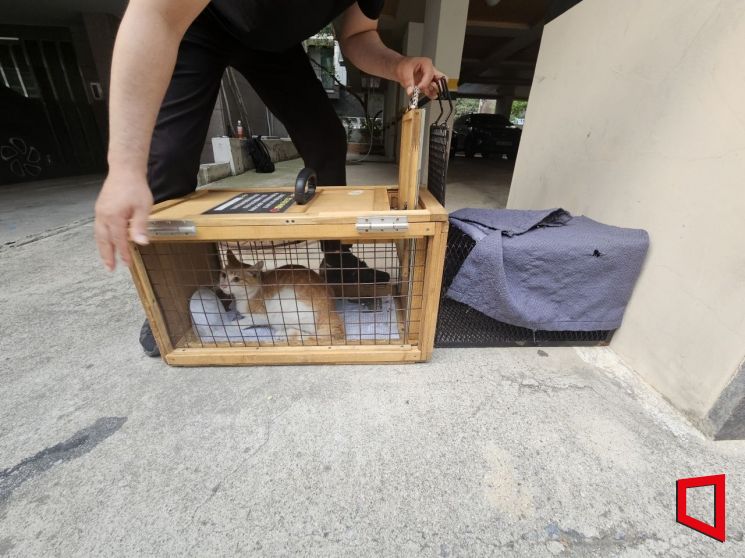 On the 7th, a stray cat catcher is moving a cat from a trap cage to a transport carrier. Photo by Seungwook Park
Once a stray cat is finally caught, it is immediately sent to a partner animal hospital, and if it is found to be healthy the next day, it undergoes surgery. At the hospital, the cat caught the previous day was being weighed before surgery. It weighed 3.6 kilograms and was male. The dosage of anesthesia depends on the cat's weight. Veterinarian Lee Youngguk (63), the hospital director, said, "Just as with humans, it is not good to administer too much anesthesia to cats, so I try to use the minimum amount possible. The most basic criterion for determining the dosage is body weight, and for cats that are docile and accustomed to people, I use about 10% less anesthesia than for other cats of the same weight."
After about five minutes, when the cat was fully anesthetized, Dr. Lee began the neutering surgery. He laid the cat on a pad on the operating table, shaved and disinfected the surgical area, filling the room with the smell of alcohol. After the surgery, the tip of the cat's left ear must be cut off. The Animal Protection Act stipulates that about 1 cm of the left ear tip must be removed after surgery to indicate that the cat has been neutered. Male cats are hospitalized for 24 hours, and females for 72 hours, before being returned to their original locations.
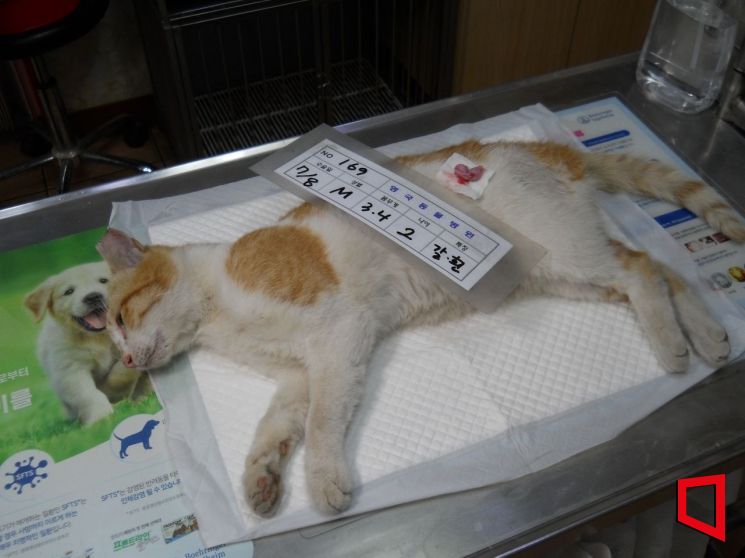 On the 8th, a stray cat was anesthetized and placed on the operating table for a neutering surgery. Photo by Seungwook Park
However, infection prevention and treatment during neutering surgery are the responsibility of individuals. The project budget only covers the costs of neutering surgery, post-surgery hospitalization, and rabies vaccination. Dr. Lee administered heartworm medication that he had prepared separately to the cat. He said, "In reality, there are many cases where we pay out of pocket to treat stray cats for issues other than neutering, since they rarely get to visit a hospital. As a veterinarian, I cannot ignore situations where there are abnormalities or potential problems." He added, "These costs are shared by the hospital or cat caretakers, but if the neutering budget also included basic treatment costs, the cats would be able to live better lives."
Cho Heekyung, president of Animal Liberation Wave, said, "Stray cats are prone to health issues, so there needs to be institutional support to provide some level of infection prevention or treatment when they are brought in for neutering. However, unlike in the metropolitan area, many regions lack sufficient budgets for neutering surgeries, so it is necessary to first secure an overall surgery budget and then discuss additional support for medical care."
© The Asia Business Daily(www.asiae.co.kr). All rights reserved.
![Clutching a Stolen Dior Bag, Saying "I Hate Being Poor but Real"... The Grotesque Con of a "Human Knockoff" [Slate]](https://cwcontent.asiae.co.kr/asiaresize/183/2026021902243444107_1771435474.jpg)

















