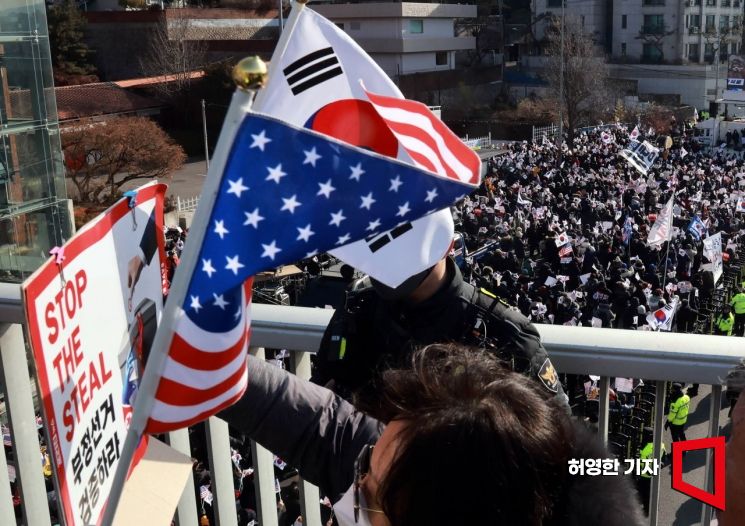
 On the morning of January 3, as officials from the Corruption Investigation Office entered the presidential residence in Hannam-dong, Seoul, to execute an arrest warrant for President Yoon Sukyeol, his supporters gathered near the residence, holding Taegeukgi and US flags, along with signs demanding verification of election fraud, while shouting slogans. Photo by Heo Younghan
Japan is also struggling as unfounded allegations of election fraud continue to spread.
On July 4, Japanese public broadcaster NHK reported, "As the official campaign for the House of Councillors election has begun, unfounded and false information such as 'the voting results will be manipulated' or 'election fraud will occur' is spreading on social networking services (SNS)." According to NHK, during the Tokyo Metropolitan Assembly election, claims that "there was fraud in the ballot counting process" also circulated. However, the Tokyo Metropolitan Election Commission denied these claims, stating, "The ballot counting process is being conducted properly in the presence of observers, and there is no fraud."
Following the Tokyo Metropolitan Assembly election in June and the official announcement of the House of Councillors election on July 3, posts on SNS expressing suspicions of election fraud increased. According to NHK's analysis, since the beginning of 2025, there have been over 500,000 posts (including reposts) related to "there will be election fraud" on the SNS platform X (formerly Twitter). Some politicians even directly raised such suspicions on their own SNS accounts. Especially during the Tokyo Metropolitan Assembly election in June, more than 220,000 posts were made. After the ballot counting day, posts and videos claiming "there was fraud in the ballot counting process" spread, leading to a flood of inquiries to the election commission.
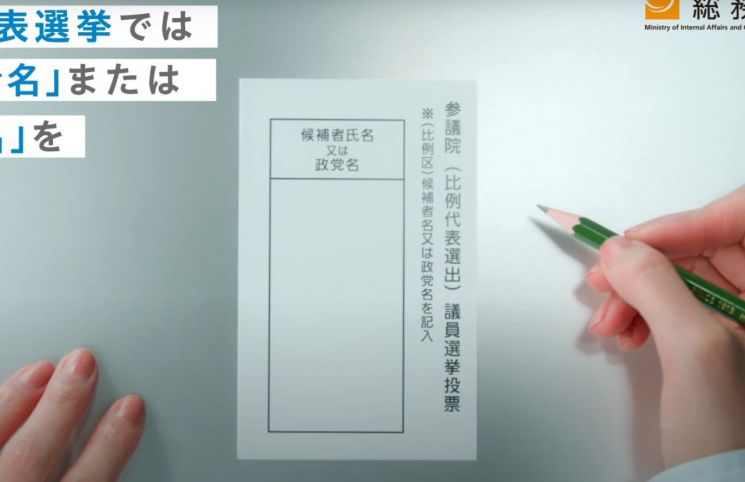 A part of the promotional video by the Japanese Ministry of Internal Affairs and Communications on how to fill out the ballot paper.
One particularly notable case involved reactions to a candidate who was projected to win in NHK's exit polls but ultimately lost. On SNS, suspicions spread such as, "A lower-ranked candidate ended up ranking higher in the actual results, while a projected winner lost, which is strange," "The vote count for a particular candidate hardly changed in the election commission's announcements," and "There are too many invalid ballots. Was there fraud?" Some related videos posted on X, Instagram, and YouTube were viewed more than 1.3 million times. The Tokyo Metropolitan Election Commission refuted these claims, stating, "Each ballot is counted accurately one by one, so there is no room for fraud."
The core of the suspicion centers on the use of pencils. In Japan, voters traditionally write the names of candidates and parties in kanji or hiragana (Japanese characters) during elections. The names must be written correctly, and any mistake results in an invalid ballot. Because of concerns that ballpoint pens may smudge, only pencils are used. Local governments in Japan must prepare pencils for every election.
On X, unfounded claims such as "If you vote with a pencil, the content can be changed later" spread. Many posts suggested "You should bring a ballpoint pen when voting," and some of these posts were viewed more than 3.5 million times. NHK conducted an experiment with the Setagaya Ward Election Commission. Using test paper identical to actual ballots, they compared writing with a pencil and a water-based ballpoint pen. Pencil writing did not smudge. However, when using a water-based ballpoint pen, the ink would show through to the back when the paper was folded, or smudge when rubbed by hand. The Setagaya Ward Election Commission explained, "The ballot paper is made of plastic material that unfolds easily even after being folded, which helps shorten the ballot counting time. Depending on the type of ballpoint pen, smudging can occur, and ink may transfer to other ballots, potentially rendering them invalid." While there are no specific regulations regarding writing instruments, the commission recommends using a quick-drying pen such as an oil-based ballpoint pen if you bring your own.

Nakamura Ken of the Waseda University Democracy Creation Research Institute told NHK, "While there may be clerical errors in the ballot counting process, it is virtually impossible to intentionally manipulate ballots to favor a specific candidate."
NHK also reported, "Unfounded information about election fraud is spreading worldwide, including in South Korea, the United States, Brazil, and Germany." The broadcaster noted, "In South Korea, conservative YouTubers repeatedly raised allegations of election fraud, and former President Yoon Sukyeol also claimed there had been hacking by North Korea. In the United States and Brazil, false information escalated into attacks on legislative bodies."
Professor Taira Kazuhiro of Oberlin University in Japan told NHK, "The spread of false information related to elections raises serious concerns that the democratic process itself could be distorted." He added, "On the internet, information that attracts people's attention spreads more easily. False information is deliberately created with provocative titles or videos to exploit this. If you find yourself drawn to such information, you should calmly examine what kind of information the account has shared and what intentions the account might have."
© The Asia Business Daily(www.asiae.co.kr). All rights reserved.
![Clutching a Stolen Dior Bag, Saying "I Hate Being Poor but Real"... The Grotesque Con of a "Human Knockoff" [Slate]](https://cwcontent.asiae.co.kr/asiaresize/183/2026021902243444107_1771435474.jpg)

















