Strategy Forum on Building a Supply Chain Data Platform
Need for a Data Exchange Environment Rather Than Simple Disclosure
Concerns Over Encryption of Corporate Confidential Information and Small Business Response Capabilities
There has been a suggestion that a "Korean-style platform" is needed to comprehensively manage data from domestic automakers and parts suppliers in order to respond to global automotive supply chain regulations. However, since automotive data is corporate confidential information, it is necessary to establish an operating system that guarantees security. There was also an argument that government support is needed because it is difficult for small businesses to meet requirements such as ESG (Environmental, Social, and Governance) evaluation results or LCA (Life Cycle Assessment)-based carbon emissions.
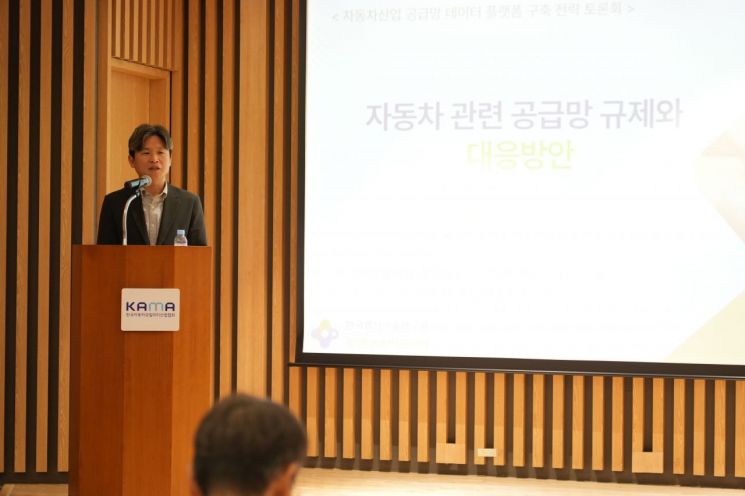 Shin Hojung, Director of the Korea Institute of Industrial Technology, is speaking at the "Automotive Industry Supply Chain Data Platform Construction Strategy Forum" held on the 9th at the Grandeur Ballroom of the Automobile Hall in Seocho-gu, Seoul. Korea Automotive Mobility Industry Association (KAMA)
Shin Hojung, Director of the Korea Institute of Industrial Technology, stated at the "Automotive Industry Supply Chain Data Platform Construction Strategy Forum" held on the 9th at the Automobile Hall in Seocho-gu, Seoul, "Cases where global automakers, such as those in Germany, are demanding supply chain data from their partners, including Scope 3 (indirect emissions such as those from the supply chain), are rapidly increasing." He added, "Given the complex supply chain characteristics of the automotive industry, we need to unify the response system through a digital platform that encompasses the entire industry."
Regarding data sharing methods, some suggested that rather than simply disclosing data as public data, it would be more appropriate to establish a data exchange environment. Lim Heonjeong, Director at the Korea Automotive Technology Institute, said, "The European automotive supply chain data sharing ecosystem, 'Catena-X,' is producing visible results with the participation of overseas automakers. Korea should also adopt this method first to gain practical experience, and then develop a supply chain data platform tailored to the domestic environment that can also be linked with international systems." Since last year, the Korea Automotive Technology Institute has been building a system compatible with Catena-X to enable data exchange with European Union (EU) automotive companies.

However, since most automotive data is confidential, companies may feel uncomfortable providing information to the platform. Jung Sungcheol, Head of R&D Strategy at HL Mando, expressed concern, saying, "There is a worry that confidential information such as production details, process information, or raw material ratios could be inferred from the provided data. Even if only carbon emissions are to be shared on the platform, the very act of uploading confidential information to a data system is burdensome, so encryption and access rights must be clearly defined." Kim Dongsu, Director at Kim & Chang ESG Management Research Institute, added, "Just knowing carbon emissions information in advance could allow estimation of carbon liabilities and even prediction of operating profits."
There were also concerns that small partner companies would find it difficult to utilize the automotive data platform. Kim Jinhyo, Senior Researcher at Hyundai Motor Company, said, "Even first-tier suppliers with large scale and capabilities are struggling to calculate carbon emissions." Kim Younghun, Director at the Korea Automobile Industry Cooperative Association (KAICA), also noted, "Small and medium-sized enterprises lack both the capacity to produce even basic data such as carbon emissions and the necessary specialized personnel." He continued, "If companies lacking capacity use the platform, incorrect information could be entered, making the overall data inaccurate. To meet the standards required by domestic and international automakers, support from the government or public institutions is needed."
Kang Namhoon, President of the Korea Automotive Mobility Industry Association (KAMA), which hosted the forum, emphasized in his opening remarks, "It is most important to accurately identify industry needs during the process of building the data platform, and to ensure that the system is constructed in a way that minimizes the workload and cost burden, especially for small and medium-sized parts suppliers."
© The Asia Business Daily(www.asiae.co.kr). All rights reserved.
![Clutching a Stolen Dior Bag, Saying "I Hate Being Poor but Real"... The Grotesque Con of a "Human Knockoff" [Slate]](https://cwcontent.asiae.co.kr/asiaresize/183/2026021902243444107_1771435474.jpg)
















