KDCA Warns of Salmonella and Campylobacter Infections: Diarrhea and Abdominal Pain May Occur
Thoroughly Wash and Cook Food...
Report to Public Health Center in Case of Group Outbreak
As hot and humid weather continues day after day, the health authorities have issued a warning as there has been a significant increase in cases of enteric infections, which cause symptoms such as diarrhea, abdominal pain, and vomiting after consuming water or food contaminated with pathogenic bacteria.

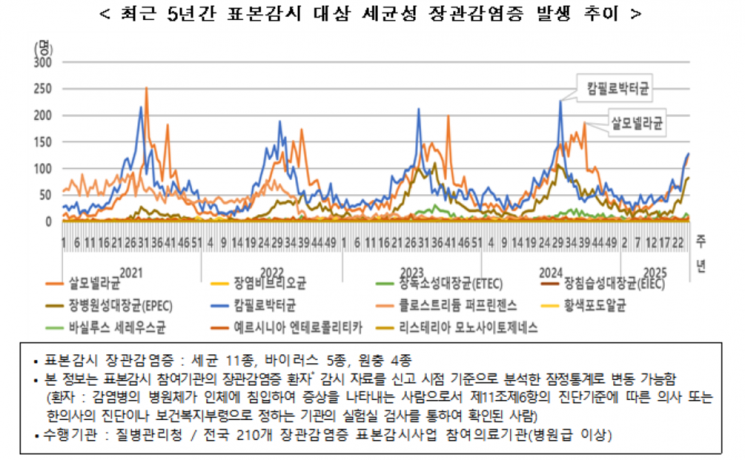
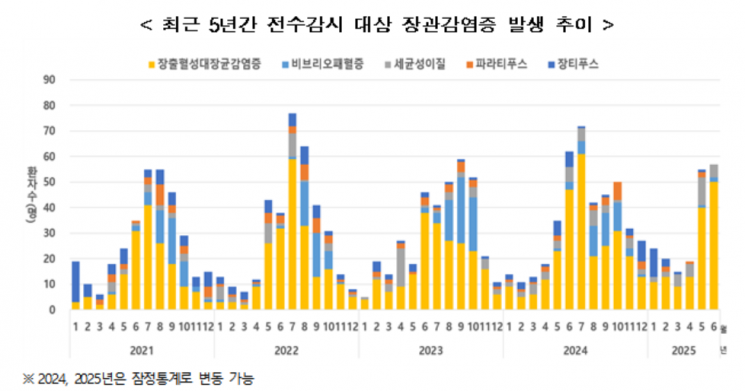
According to the Korea Disease Control and Prevention Agency (KDCA) on July 9, sample surveillance of enteric infections conducted at 210 hospital-level medical institutions nationwide with more than 200 beds has shown that cases of enteric infections have been steadily increasing over the past five years (2021-2025).
During the summer, rising temperatures and humidity promote the proliferation of pathogenic microorganisms, leading to an increase in bacterial enteric infections. In particular, this year, the number of patients infected with Salmonella increased from 66 in the first week of June to 102 in the second week, 109 in the third week, and 127 in the fourth week. Similarly, cases of Campylobacter infection rose from 58, 102, 119, to 128 over the same period.
Salmonella infection can occur through cross-contamination when egg liquid is left at room temperature for a long time or when food is prepared without washing hands after touching eggs contaminated with Salmonella. Since Salmonella often contaminates the surface of eggshells, it is important to purchase eggs with undamaged shells, store them in the refrigerator, cook them thoroughly soon after cracking, and always wash hands after handling eggs.
Campylobacter infection occurs after consuming undercooked poultry or other meats, unpasteurized dairy products, or contaminated water or food. Since Campylobacter can be present on the surface of raw chicken, cross-contamination may occur during food preparation. Therefore, it is best to wash raw chicken last during cooking, and care should be taken to prevent splashing water from contaminating other ingredients. Poultry should be stored in sealed containers on the lowest shelf of the refrigerator to minimize the risk of contaminating other foods.
The KDCA predicted that, given the recent trends in enteric infections, the number of patients will continue to increase for the time being.
Among notifiable enteric infectious diseases, cases of enterohemorrhagic E. coli infection and Vibrio vulnificus septicemia frequently occur during the summer. Notably, this year, cases of enterohemorrhagic E. coli infection increased by 30.4% from 102 last year to 133 between January and June. Since the first case of Vibrio vulnificus septicemia was reported on May 10, two additional cases have occurred, and further cases are expected.
Enterohemorrhagic E. coli infection can be transmitted through contaminated beef, raw vegetables, dairy products, water, or from person to person. Symptoms include severe cramping abdominal pain, nausea, vomiting, low-grade fever, and diarrhea, which can range from watery to bloody. Most symptoms resolve within 5 to 7 days, but if complications such as hemolytic uremic syndrome develop, the fatality rate can reach 3 to 5%. To prevent infection, it is important to practice good hygiene such as handwashing and to cook ingredients like beef and vegetables thoroughly or wash them under running water before eating.
Vibrio vulnificus mainly inhabits coastal marine environments, including seawater, tidal flats, and shellfish, and proliferates when the seawater temperature exceeds 18°C. As a result, the first cases usually occur in May or June each year, with the highest incidence in August and September. Vibrio vulnificus septicemia causes acute fever, chills, low blood pressure, abdominal pain, vomiting, and diarrhea, and within 24 hours of symptom onset, skin lesions such as rashes, swelling, and (hemorrhagic) blisters may appear on the legs. If these symptoms occur, it is important to visit a hospital immediately for appropriate treatment. People with underlying conditions such as chronic liver disease, diabetes, or alcohol dependence are at higher risk of infection and death from Vibrio vulnificus septicemia. They should avoid contact with seawater if they have skin wounds and should only eat shellfish that has been thoroughly cooked.
Ji Youngmi, Commissioner of the KDCA, stated, "As temperatures are expected to be higher than average this summer, extra caution is needed to prevent enteric infections." She added, "Please follow infection prevention guidelines such as safe food consumption and proper handwashing, and if two or more people who ate the same food develop symptoms such as diarrhea or vomiting, report it immediately to the nearest public health center."
© The Asia Business Daily(www.asiae.co.kr). All rights reserved.
![Clutching a Stolen Dior Bag, Saying "I Hate Being Poor but Real"... The Grotesque Con of a "Human Knockoff" [Slate]](https://cwcontent.asiae.co.kr/asiaresize/183/2026021902243444107_1771435474.jpg)

















