First Public Unveiling of LG Science Park's HVAC System
Expanding Business with Solutions Targeting Data Centers
"Order Target for Cooling Solutions Set at Three Times Last Year's Level"
LG Electronics has set an ambitious goal to triple its heating, ventilation, and air conditioning (HVAC) orders for data centers in the era of artificial intelligence (AI). The company is determined to achieve 'compressed growth' at a pace faster than the market. The key lies in solutions based on liquid cooling technology, with plans to begin supplying these as early as next year.
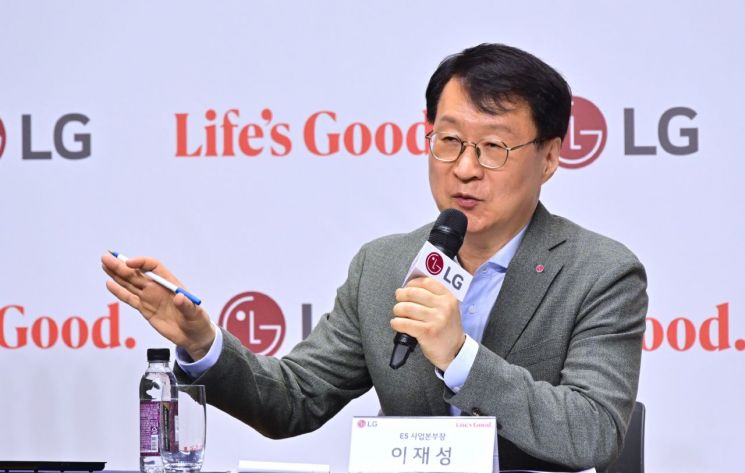 Jaesung Lee, Vice President and Head of LG Electronics ES Business Division, is introducing the HVAC business strategy direction and AI data center solutions at a press conference held on the 8th at LG Science Park in Gangseo-gu, Seoul. LG Electronics
LG Electronics announced this goal at a Media Day event held on the morning of the 8th at LG Science Park in Magok, Gangseo-gu, Seoul. Jaesung Lee, Vice President and Head of the ES Business Division, stated, "HVAC is a core driver in the B2B sector for qualitative growth," and added, "To rapidly secure a leading position in the AI data center cooling solutions market, our goal is to commercialize liquid cooling solutions within this year and begin full-scale supply starting next year."
Specifically, the company presented a target to increase orders for data center-related cooling solutions by more than three times compared to the previous year, aiming for 'compressed growth' at twice the market rate. In particular, LG Electronics has set a sales target of 1 trillion won within two years by expanding the scope of its large-capacity chillers to data centers. Having established the ES Business Division as a separate entity at the end of last year, LG Electronics aims to achieve 20 trillion won in HVAC business sales by 2030.
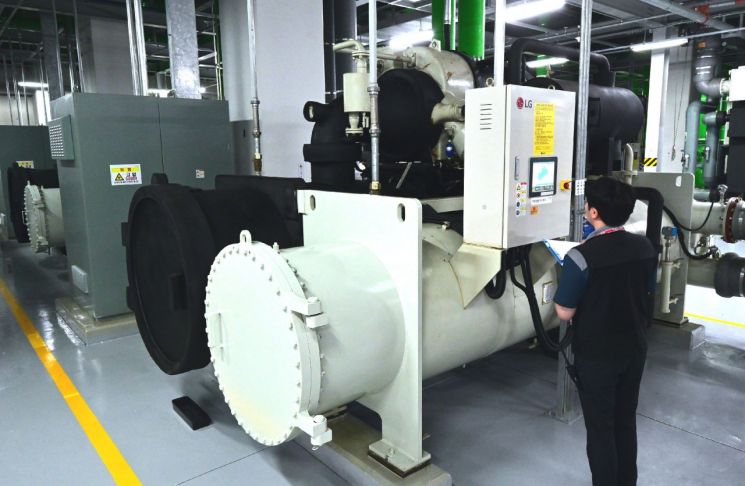 Turbo chiller installed in the main mechanical room of LG Science Park, Gangseo-gu, Seoul. LG Electronics
On this day, LG Electronics unveiled the application site of its HVAC solutions at LG Science Park to the media for the first time. The cooling and heating of this comprehensive research complex, which brings together talents from LG Group's electronics, chemical, bio, and software sectors, is managed by LG Electronics' self-developed chillers and building management systems (BMS), among others.
Upon entering the main mechanical room located on the third basement level of Building W5, the chillers, referred to as the 'lifeline' of the cooling system, came into view. Three types of chillers?turbo, screw, and absorption?were used to supply cooling throughout LG Science Park in a stable and efficient manner, each leveraging its unique strengths.
The chilled water produced by the chillers is delivered through pipes to the air handling units (AHU). These devices manage the indoor air quality by performing functions such as temperature and humidity control and air circulation. Additionally, the cooled air from the chillers is distributed to various spaces within the building, passing through terminal units (ATU) that precisely adjust the volume and temperature of the air according to the characteristics and environment of each space. The AHUs and ATUs installed at LG Science Park are products manufactured by Ace Refrigeration & Air Conditioning, a wholly owned subsidiary of LG Electronics.
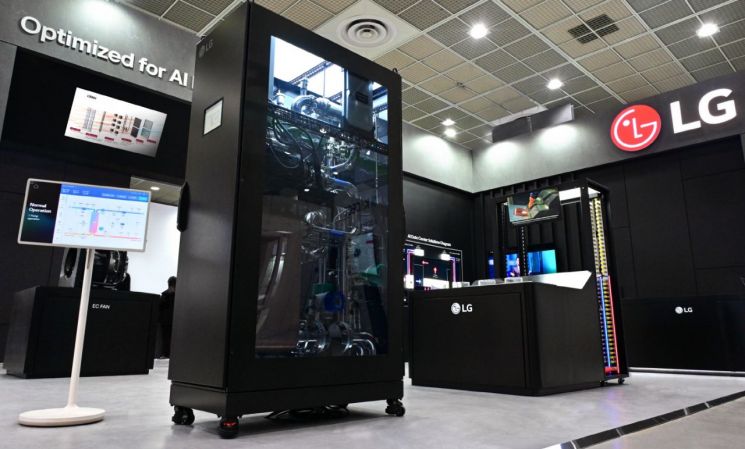
The HVAC system at LG Science Park, showcased on this day, serves as a representative example demonstrating LG Electronics' technological prowess and integrated operational capabilities. In particular, the LG Beacon Cloud Platform, an AI-based smart building solution, has been applied, enabling real-time monitoring and automatic control of HVAC products for temperature, power, and more. This not only reduces unnecessary energy consumption but also uses AI technology to predict potential failures in advance.
LG Electronics holds two solutions targeting data centers: liquid cooling, which uses a cooling distribution unit (CDU) to directly cool chips, and air cooling, which lowers the internal temperature of data centers using chillers. The CDU was unveiled to the media for the first time on this day, boasting technology that allows the system to operate using pump and other sensor data even if key sensors fail, thanks to 'virtual sensors.'
Vice President Jaesung Lee expressed strong confidence in the liquid cooling solution, stating, "Demand is expanding not only for AI data center cooling, but also for semiconductors, displays, nuclear power plants, and smart farms." He continued, "As AI factories become more prevalent, chip heat generation will increase, and the limitations of air cooling will become clear. The liquid cooling CDU, which directly cools chips, is based on LG's core technology and ensures both efficiency and reliability."
He also added, "We are currently conducting proof-of-concept tests with LG Uplus to reach a level where we can supply to customers starting next year," and said, "Our order target is more than three times that of last year, and it is almost achieved."
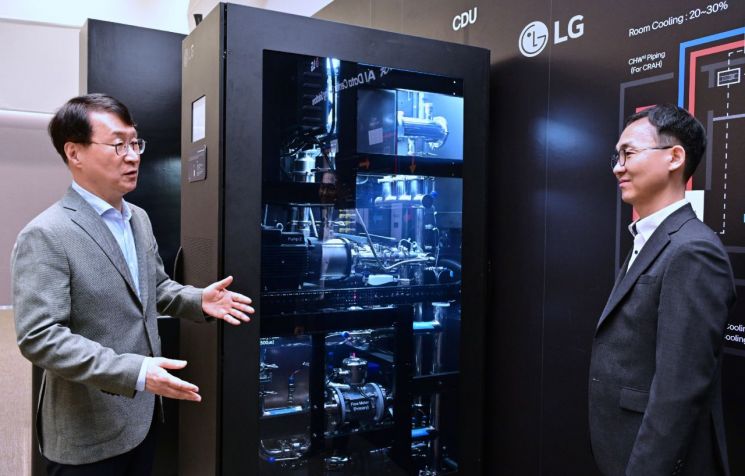 On the 8th, at a press conference held at LG Science Park in Gangseo-gu, Seoul, Jaesung Lee, Vice President and Head of LG Electronics ES Business Division (left), is examining the cooling water distribution unit (CDU), a liquid cooling solution for AI data centers. LG Electronics
LG Electronics plans to advance its HVAC business model through strategies such as establishing a locally complete value chain, expanding into non-hardware (Non-HW) areas, and sequential acquisitions.
In regions such as North America and Europe, LG Electronics is targeting the market with high-efficiency HVAC solutions tailored to local climate and residential environments. In North America, where duct-type air conditioning products are widely used, the company focuses on unitary product lines suitable for residential structures. In Europe, it prioritizes air source heat pumps that align with greenhouse gas reduction policies.
In the Global South, the company aims to become a 'local champion' through locally customized strategies. Last year, LG Electronics supplied high-efficiency chillers capable of cooling a complex the size of 130 soccer fields in Saudi Arabia at once. In April this year, it supplied commercial system air conditioners to a mega logistics center in Singapore.
Furthermore, to enhance its HVAC portfolio, LG Electronics is considering sequential acquisitions in adjacent fields that can create synergy with its existing businesses, based on the 3B (Build, Borrow, Buy) strategy. This means developing its own capabilities, collaborating externally, and pursuing mergers and acquisitions, in that order. Recently, the company acquired OSO, a European hot water solutions company.
© The Asia Business Daily(www.asiae.co.kr). All rights reserved.
![Clutching a Stolen Dior Bag, Saying "I Hate Being Poor but Real"... The Grotesque Con of a "Human Knockoff" [Slate]](https://cwcontent.asiae.co.kr/asiaresize/183/2026021902243444107_1771435474.jpg)

















