Trump's "Tariff Letter" Triggers Sharp Declines
Korean and Japanese Stocks Plunge on New York Exchange
Reciprocal Tariff Announcement Heightens Trade Tensions
On July 7 (local time), U.S. President Donald Trump sent a "tariff letter" specifying country-by-country reciprocal tariff rates to 14 countries, including South Korea and Japan. As a result, the stock prices of South Korean and Japanese companies listed on the New York Stock Exchange were hit hard.
On this day, the New York Stock Exchange closed lower across the board as concerns mounted that global trade tensions could escalate again. The Dow Jones Industrial Average, which is focused on blue-chip stocks, fell by 422.17 points (0.94%) to close at 44,406.36. The S&P 500, representing large-cap stocks, dropped by 49.37 points (0.79%) to 6,229.98. The tech-heavy Nasdaq Composite Index declined by 188.59 points (0.92%) to finish at 20,412.52.
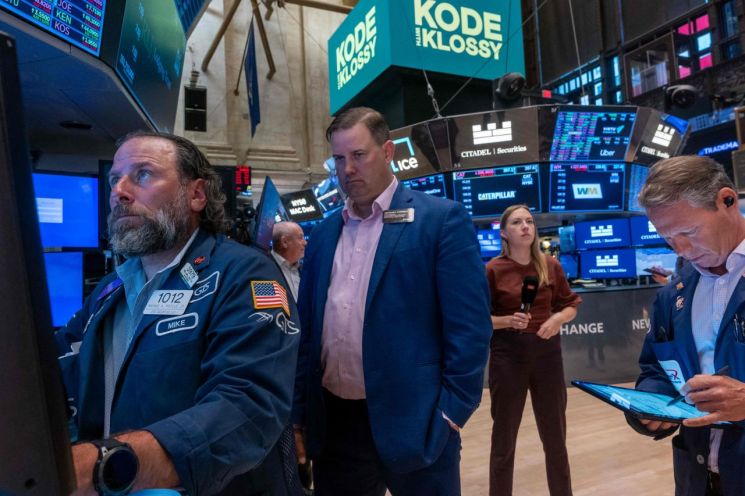
South Korean companies listed on the New York Stock Exchange were no exception. The price of SK Telecom's American Depositary Receipt (ADR) plunged by more than 7.8%, while LG Display's ADR fell by 8.3%. The "iShares MSCI Korea" (EWY) exchange-traded fund (ETF), which invests in the Korean stock market, dropped by 3.62% compared to the previous session. Toyota Motor and Honda Motor ADRs also fell by 4.02% and 3.86%, respectively.
President Trump reignited concerns over tariff risks by sending a letter to 14 countries, including South Korea and Japan, specifying reciprocal tariff rates of 25?40%, and announcing that reciprocal tariffs would be imposed starting August 1. On his self-created social networking service, Truth Social, President Trump stated, "Unfortunately, our relationship has been far from reciprocal," and added, "Starting August 1, 2025, we will impose a mere 25% tariff on all South Korean products sent to the United States, and this tariff is separate from all other item-specific tariffs."
Previously, on April 9, President Trump had postponed the imposition of reciprocal tariffs for 90 days and had been conducting trade negotiations with South Korea while imposing only a basic tariff of 10%. However, he has now warned that unless a new agreement is reached between South Korea and the United States by August 1, the original 25% tariff will be imposed. Japan was also notified of the same 25% reciprocal tariff rate as South Korea. In the letter, President Trump also pressured these countries to lower both tariff and non-tariff trade barriers.
Lee Youngwon, a researcher at Heungkuk Securities, pointed out, "For both South Korea and Japan, the automotive industry is a key target in tariff negotiations." He added, "The fact that President Trump clarified in this letter that reciprocal tariff rate negotiations are separate from item-specific (industry-specific) tariffs means that, for countries such as South Korea and Japan where key industrial issues have been raised, negotiations are likely to become more difficult." In the case of the United Kingdom, it accepted a universal tariff of 10% and applied the current quota level to automobile exports, thereby receiving an exemption from tariffs. This is seen as a differentiating factor compared to the situations in South Korea and Japan.
Meanwhile, as of 9:30 a.m., both Japan's Nikkei 225 Index (+0.27%) and South Korea's KOSPI (+1.28%) were on the rise, indicating that optimism currently prevails in both markets. It is interpreted that some concerns have been alleviated, as President Trump clarified just before the opening of the domestic stock market that the plan to impose reciprocal tariffs on trading partners such as South Korea, as outlined in the letter, could be changed depending on the outcome of trade negotiations.
Park Kihoon, a researcher at Korea Investment & Securities, stated, "This measure could cause a certain level of volatility in the domestic stock market in the short term." However, he also recommended, "Since the effective date of the tariffs has also been postponed to August 1, leaving room for negotiation, investors should see this as a buying opportunity during a correction phase, rather than reacting with excessive concern."
© The Asia Business Daily(www.asiae.co.kr). All rights reserved.
![Clutching a Stolen Dior Bag, Saying "I Hate Being Poor but Real"... The Grotesque Con of a "Human Knockoff" [Slate]](https://cwcontent.asiae.co.kr/asiaresize/183/2026021902243444107_1771435474.jpg)















