37 Cases, Including Perilla Leaves, Crown Daisy, and Green Onions, Found "Non-Compliant"
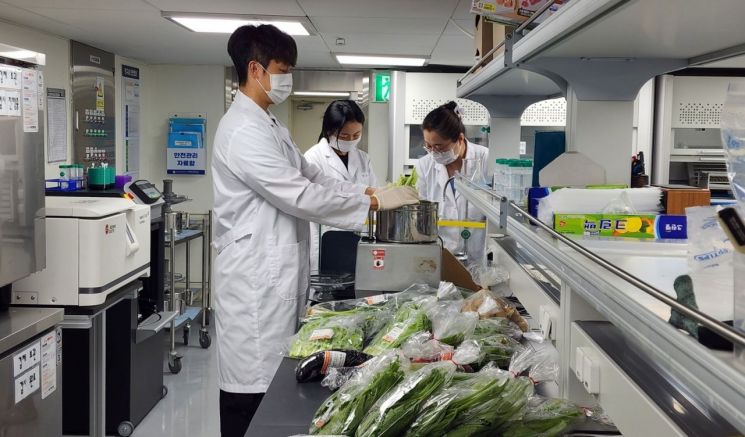 Photo of agricultural product pesticide residue inspection by Gwangju Institute of Health and Environment. Provided by Gwangju Institute of Health and Environment
In the first half of this year, a total of 1,438 kg of 37 types of agricultural products in Gwangju were found to exceed the permitted levels of pesticide residues and were subsequently seized and disposed of.
The Gwangju Institute of Health and Environment announced on July 7 that it conducted pesticide residue tests (covering 345 items) on 2,320 samples of agricultural products distributed at the Seobu and Gakhwa wholesale markets, large supermarkets, and local food stores in the first half of this year. These samples were selected either because they are widely consumed by citizens or have a high frequency of exceeding pesticide residue limits. As a result, 37 cases (1.6%), including perilla leaves and crown daisy, were found to exceed the maximum residue limits and were classified as "non-compliant."
The non-compliant agricultural products included perilla leaves and crown daisy (4 cases each), chives, lettuce, red lettuce, and green onions (3 cases each), as well as shepherd's purse, spring cabbage, canola, spinach, and wild angelica (2 cases each), totaling 37 cases. The pesticide components that exceeded the standards comprised 22 types, including the insecticide terbufos (9 cases), the fungicide diniconazole (5 cases), the herbicide pendimethalin (5 cases), and the insecticide diazinon (3 cases).
In accordance with the Food Sanitation Act and the Agricultural Product Quality Control Act, the Institute promptly seized and disposed of the non-compliant agricultural products to prevent their distribution. Producers of these non-compliant products faced administrative measures such as fines from the relevant authorities and were also restricted from shipping to wholesale markets nationwide for one month.
Director Jung Hyuncheol stated, "With the rainy season and heat wave, the occurrence of crop diseases and pests is expected to increase, which may lead to greater pesticide use. We will continue to conduct thorough pesticide residue inspections both day and night to ensure that citizens can safely purchase agricultural products with confidence."
© The Asia Business Daily(www.asiae.co.kr). All rights reserved.
![Clutching a Stolen Dior Bag, Saying "I Hate Being Poor but Real"... The Grotesque Con of a "Human Knockoff" [Slate]](https://cwcontent.asiae.co.kr/asiaresize/183/2026021902243444107_1771435474.jpg)















