28.6 Trillion Won Allocated for Direct Response
Restructuring Planned for Low-Performing Projects
The budget for responding to the low birth rate and aging society in 2025 has been finalized at a total of 88.5 trillion won. Of this, 28.6 trillion won will be allocated to direct projects addressing the low birth rate, an increase of 3.3 trillion won compared to the previous year. Starting this year, the government will fully implement a policy evaluation system based on performance indicators, and will consider restructuring tasks with low efficiency.
On July 4, the Presidential Committee on Ageing Society and Population Policy and the Ministry of Health and Welfare held the 14th Emergency Population Countermeasures Meeting, where they reviewed and confirmed the "2025 Implementation Plan for the Low Birth Rate and Aging Society." This implementation plan is the final annual plan under the 4th Basic Plan (2021-2025), and includes detailed strategies for existing policies such as the "Low Birth Rate Trend Reversal Measures."
This year, the central government will pursue a total of 300 related projects, with an overall budget of 88.5 trillion won?an increase of 6.4% (5.3 trillion won) from the previous year. In particular, 28.6 trillion won has been allocated solely to direct response projects for the low birth rate, which is 3.3 trillion won more than last year. Efforts at the local government level will also be strengthened. According to the implementation plans established by all 17 metropolitan local governments nationwide, a total of 12.2 trillion won will be invested across 6,741 projects. This represents an increase of 14.1% (1.5 trillion won) compared to the previous year.
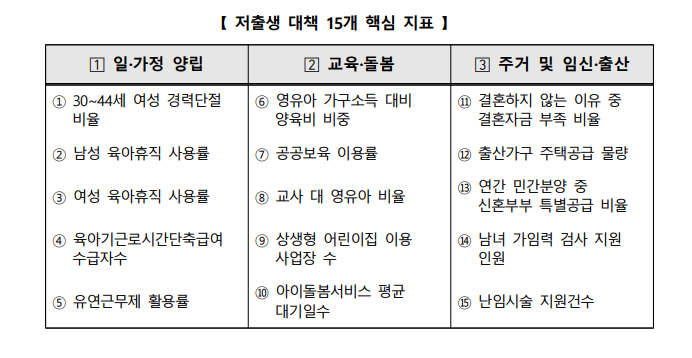
Starting this year, the government will strengthen the evaluation of project performance. The committee, in consultation with relevant ministries, has introduced 15 key indicators for low birth rate countermeasures across three major areas: "work-family balance," "education and care," and "housing, pregnancy, and childbirth." The effectiveness of each direct project will be analyzed in connection with these indicators, and for projects that fall short of targets, the government has announced plans for bold restructuring in consultation with fiscal authorities.
Joo Hyunhwan, Vice Chairperson of the Presidential Committee on Ageing Society and Population Policy, stated, "We will focus on thorough implementation and management so that the public can feel the impact of these policies." He added, "The 5th Basic Plan (2026-2030), which will be established this year and applied from next year, will shift the evaluation system from a focus on total fertility rate to qualitative indicators covering the overall population structure, such as extending healthy life expectancy and reducing elderly poverty and suicide rates."
© The Asia Business Daily(www.asiae.co.kr). All rights reserved.
![Clutching a Stolen Dior Bag, Saying "I Hate Being Poor but Real"... The Grotesque Con of a "Human Knockoff" [Slate]](https://cwcontent.asiae.co.kr/asiaresize/183/2026021902243444107_1771435474.jpg)















