Exploring the Ideal Society Through the Lotus Sutra
A New Academic Perspective on Utopia in Modern Times
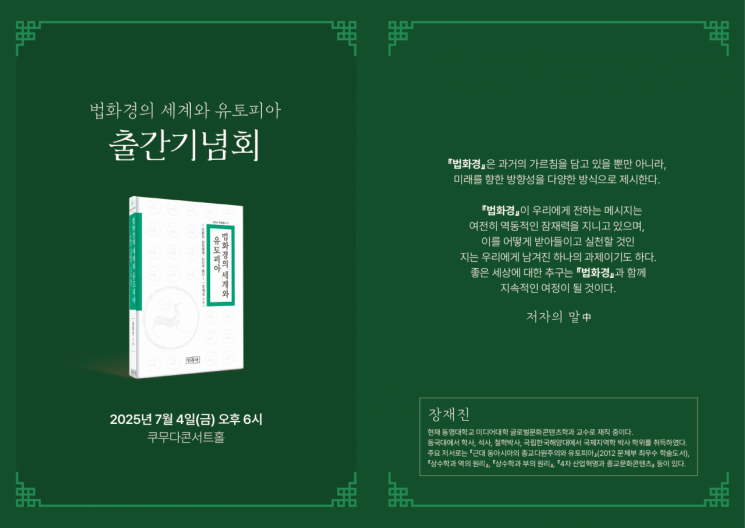
An academic book offering a modern perspective on the ideal society through the Buddhist scripture, the Lotus Sutra, has been published and is attracting attention. This book goes beyond a simple religious text, providing insights that are accessible to general readers as well.
Jang Jaejin, a professor in the Department of Global Cultural Contents at Dongmyung University, will hold a publication event for "The World and Utopia of the Lotus Sutra" at 6 p.m. on July 4 at the Songjeong Kumuda Concert Hall. Monk Munkwang will also participate in the event, where they will discuss, in a talk show format, the implications of Buddhism’s ideal society for the present day.
This book compares the Buddhist concept of the Pure Land with the Western idea of utopia, exploring the intersections between Eastern and Western philosophical thinking on ideal societies. Professor Jang particularly reinterprets "Pure Land" not as a concept limited to the afterlife, but as an ideal society that can be realized in the present world.
Through "Ekayana" (One Buddha Vehicle), a core tenet of Buddhist thought, the book emphasizes the equality of all humans and the potential for everyone to attain Buddhahood. It also analyzes the cosmology of the Lotus Sutra from both philosophical and mathematical perspectives. For example, it quantifies the time unit of "kalpa" and concretely converts it to analyze the periods of Buddha’s training and enlightenment as presented in the Lotus Sutra. The book notably attempts to connect religious expressions with scientific interpretations by explaining the immense number of kalpas and the timing of Shakyamuni Buddha’s enlightenment in numerical terms.
Regarding the spatial concept of the "Ten Directions World," the book interprets it not merely as a physical dimension, but as a symbolic space where significant events occur-namely, the entire universe where the Buddha’s teachings are delivered.
By comparing the world of Pure Land with the Peach Blossom Spring, the Confucian Great Unity, and Western utopian thought, the book underscores that the Lotus Sutra is not simply oriented toward the afterlife, but is a philosophy calling for practical action in the present.
Professor Jang holds a Ph.D. in Philosophy from Dongguk University and a Ph.D. in International Area Studies from Korea Maritime and Ocean University. His publications include "Religious Pluralism and Utopia in Modern East Asia," "The Principles of Sangsu and the Book of Changes," "The Principles of Sangsu and Wealth," and "The Fourth Industrial Revolution and Religious Cultural Contents." He has also been active in various policy fields, serving as an expert member of the Presidential National Education Council, a member of the Busan City Transition Committee, and chairman of the Regional Broadcasting Development Committee.
© The Asia Business Daily(www.asiae.co.kr). All rights reserved.
![Clutching a Stolen Dior Bag, Saying "I Hate Being Poor but Real"... The Grotesque Con of a "Human Knockoff" [Slate]](https://cwcontent.asiae.co.kr/asiaresize/183/2026021902243444107_1771435474.jpg)















