Focusing EU Capabilities to Foster the Quantum Sector
Announcing Stronger Quantum Act Legislation and Funding Support
Setting the Goal to Lead the Quantum Field by 2030
The European Union (EU) Commission has unveiled a blueprint aimed at securing leadership in the quantum sector and fostering related industries by 2030. By outlining the enactment of a Quantum Act, funding support, and concrete development goals, the plan emphasizes a unified approach to nurturing the quantum industry across member states, rather than individual national efforts, and demonstrates the EU’s determination not to fall behind the United States and China in this field.
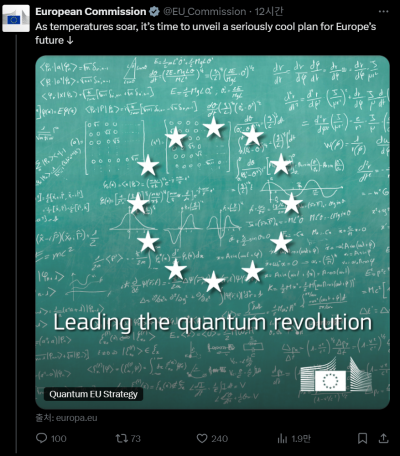
According to the scientific community on July 4, the EU Commission announced the ‘Quantum Europe Strategy’ on July 2. This comprehensive plan aims to transform scientific achievements into industrial outcomes through investments in research, infrastructure, talent development, and commercialization across the quantum technology sector.
The strategy sets out specific development targets for each area. The core challenge is the development of error-corrected qubits, which are essential for quantum computers. The plan aims to secure quantum computers equipped with approximately 100 error-corrected qubits per system by 2030, and thousands by 2035. The development of hybrid systems with high-performance computing (HPC) will also proceed in parallel. Through these efforts, the EU intends to accelerate industrial use cases for quantum computers and support Europe’s artificial intelligence (AI) strategy.
Under the Chips Joint Undertaking, six new quantum pilot production lines will be established to support initial prototyping, process development, and industrial validation of quantum chips. In 2026, the EU will announce a ‘Quantum Chip Industrialization Roadmap’ to further accelerate industrialization.
In the field of quantum communications, the EU aims to build a secure satellite-to-ground communication network across the region by 2030, and will launch the ‘European Quantum Internet Pilot Facility’ next year. For quantum sensing, a quantum gravimeter network will be deployed from 2026, and a European Q-MRI pilot infrastructure will be established from 2025 to apply quantum technology to a wide range of areas including medical diagnostics and security.
The EU Commission also plans to collaborate with the European Space Agency (ESA) to develop a quantum technology roadmap for space and contribute to the European defense technology roadmap.
To avoid competition among EU member states and to consolidate policy support and research capabilities, the Commission plans to enact the ‘Quantum Act’ next year. This legislation will formalize the governance structure and funding mechanisms for quantum technologies, providing a foundation for effectively integrating and coordinating the efforts of each member state.
The Commission will launch the ‘Quantum Europe Research and Innovation Initiative,’ a joint undertaking to support basic research and application development across member states. Through this initiative, public and private research will receive funding and coordination throughout the EU. The European Innovation Council (EIC), the European Investment Bank (EIB), and the Scaleup Europe Fund will also strengthen strategic investments in the quantum sector.
To address the shortage of talent in quantum technology, the EU will establish the ‘European Quantum Skills Academy’ by 2026 to foster experts and attract overseas talent.
Although Europe has invested approximately 11 billion euros in quantum technology over the past five years, it has lagged behind the United States and China in patent applications, private investment, and quantum hardware manufacturing. For example, EU companies currently attract only 5% of global private investment, while the United States attracts 50%.
Henna Virkkunen, EU Commissioner for Technology Autonomy, Security, and Democracy, and First Vice-President, stated, “We have launched the Quantum Europe Strategy to bring together member states, industry, academia, and society as one to fully realize the potential of quantum technology.”
A domestic quantum sector official commented, “The large participation of European countries in the recently held Quantum Korea event indicates growing interest in fostering the quantum sector.”
© The Asia Business Daily(www.asiae.co.kr). All rights reserved.
![Clutching a Stolen Dior Bag, Saying "I Hate Being Poor but Real"... The Grotesque Con of a "Human Knockoff" [Slate]](https://cwcontent.asiae.co.kr/asiaresize/183/2026021902243444107_1771435474.jpg)















