Latest Experience with Barakah Nuclear Power Plant in the UAE
Lower Unit Costs and Better Deadline Compliance Compared to the US and France
Since the end of March, expectations for nuclear power have begun to be fully reflected in the stock prices of domestic construction companies. Subsequently, news that U.S. President Trump signed an executive order to accelerate nuclear development, Sweden's decision to build a new nuclear power plant for the first time in 45 years, and Belgium's abandonment of its nuclear phase-out policy after 22 years, among other nuclear-friendly policies in major countries, have driven up the stock prices of Korean construction companies.
Global Nuclear Power Market Activates, Korean Companies in the Spotlight
In the short term, the global nuclear power market is expected to be led by large-scale nuclear power plants, while small modular reactors (SMRs) are projected to drive growth in the future. According to scenarios from the International Energy Agency (IEA), 129GW of new large-scale nuclear power capacity is expected to be installed by 2030, 242GW from 2031 to 2040, and 143GW from 2041 to 2050. Globally, SMRs are expected to be installed in earnest from 2035, with approximately 800 units projected worldwide by 2050.
In the mid- to long-term, the nuclear decommissioning market must also be considered. There are currently 189 nuclear power plants that have been permanently shut down but not yet decommissioned, and 282 nuclear power plants that have been in operation for over 30 years. Considering that the design lifespan of large-scale nuclear power plants is about 40 to 60 years and that decommissioning costs about KRW 1 trillion per plant, a KRW 500 trillion market is expected to open in the future.
According to an analysis by Bloomberg Businessweek of 400 nuclear power plants currently planned or proposed, Korea is in a position to win contracts for about 43% of them. In fact, global companies such as Westinghouse and Holtec are reaching out to domestic construction companies like Hyundai Engineering & Construction and Daewoo Engineering & Construction.
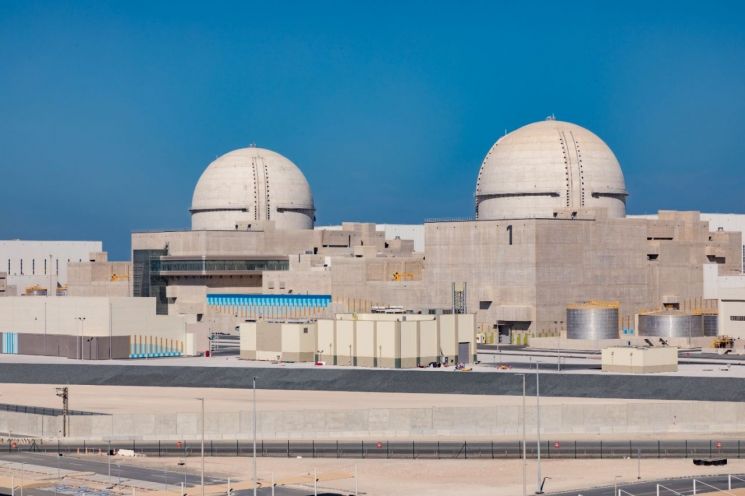
The first reason Korean construction companies are gaining attention in the global nuclear power market is their most recent track record, exemplified by the completion in 2024 of the Barakah nuclear power plant (Barakah·photo) in the UAE. This demonstrates not only their possession of the latest construction technology but also their major infrastructure, including manpower and equipment. The second reason is their superior price competitiveness compared to global competitors. The cost per MW for Barakah (KRW 7.5 billion/MW), Shin Hanul in Korea (KRW 4.5 billion/MW), and Shin Kori (KRW 4.4 billion/MW) is lower than that of major nuclear power projects built in other countries. The third reason is adherence to deadlines. While major competitors such as the United States and France have a track record of significant project cost overruns due to construction delays, Korea has met both deadlines and budgets at the Barakah and Saeul nuclear power plants.
Hyundai and Daewoo Lead... DL E&C Ventures into SMRs
The listed Korean nuclear power plant builders include Hyundai Engineering & Construction, Daewoo Engineering & Construction, and DL E&C. Hyundai Engineering & Construction has the most experience, having built a total of 24 Korean-type nuclear power plants, including 20 in Korea and 4 in the UAE. Starting with the Kozloduy nuclear power plant in Bulgaria (main EPC contract expected by the end of this year, with a contract amount estimated at about KRW 10 trillion) and the Palisades SMR in the United States, nuclear power orders are expected to ramp up. As the decommissioning of Kori Unit 1, built by Hyundai Engineering & Construction in 1971, was recently approved, its nuclear decommissioning technology is also expected to advance. Nuclear power revenue is projected to take off in earnest from 2028, when revenue from the Bulgarian plant is recognized. Samsung Securities expects Hyundai Engineering & Construction’s nuclear power revenue to grow from about KRW 200 billion this year (Shin Hanul Units 3 and 4) to KRW 3 to 4 trillion by 2030.
On June 4, Daewoo Engineering & Construction was selected as the builder for the Dukovany nuclear power plant, a project worth about KRW 25 trillion (CZK 400 billion), signed by the Czech government and Korea Hydro & Nuclear Power. Korea Power Engineering Company (design), Doosan Enerbility (main equipment, construction), Korea Nuclear Fuel (nuclear fuel), and Korea Plant Service & Engineering (commissioning, maintenance) will participate alongside Daewoo Engineering & Construction. The contract amount allocated to Daewoo Engineering & Construction as the lead contractor is expected to be about KRW 4 to 6 trillion. Since Daewoo Engineering & Construction signed a cooperation agreement with Korea Plant Service & Engineering in March for SMR and nuclear decommissioning, it is expected to grow in the domestic nuclear power market as well.
In August last year, DL E&C and DL Energy signed a memorandum of understanding (MOU) with Norwegian nuclear company NorskKjernekraft to cooperate on SMR development. On June 24, NorskKjernekraft announced the establishment of FensfjordenKjernekraftAS, an SMR development company. The company plans to complete an SMR power plant in Mongstad, near Bergen, Norway, by 2035. Meanwhile, DL E&C has invested USD 20 million in convertible bonds in U.S. SMR developer X-Energy, and is expected to participate in the growth of the SMR market.
However, it should be noted that it takes time for nuclear power orders to translate into actual revenue, and that recent stock prices have already reflected much of the anticipated growth. For example, the main construction of the UAE Barakah nuclear power plant, ordered in 2009, began in 2012, with the highest revenue recorded in 2016. Revenue was concentrated over the seven years from 2012 to 2018. For Daewoo Engineering & Construction’s Czech nuclear power plant, scheduled to break ground in 2029, revenue is expected to ramp up from 2029 and peak in 2033. For Hyundai Engineering & Construction’s Bulgarian nuclear power plant, expected to be ordered in the second half of this year, revenue could begin in earnest from 2027 to 2028.
Heo Jaejun, an analyst at Samsung Securities, said, "Investors should be cautious about stocks that have risen too quickly in the short term." However, he also analyzed, "Given that the construction industry’s P/B ratio traded between a minimum of 0.93 times and a maximum of 1.70 times during the 2010-2011 period when expectations for overseas construction orders were high, the recent rapid rise (P/B ratio of 0.61 times as of the closing price on July 1) still leaves room for further growth in the long-term time series."
© The Asia Business Daily(www.asiae.co.kr). All rights reserved.
![Clutching a Stolen Dior Bag, Saying "I Hate Being Poor but Real"... The Grotesque Con of a "Human Knockoff" [Slate]](https://cwcontent.asiae.co.kr/asiaresize/183/2026021902243444107_1771435474.jpg)















