June Consumer Price Trends
Processed Foods See Largest Increase in 19 Months
Ramyeon Up 6.9%, Eggs Up 6.0%
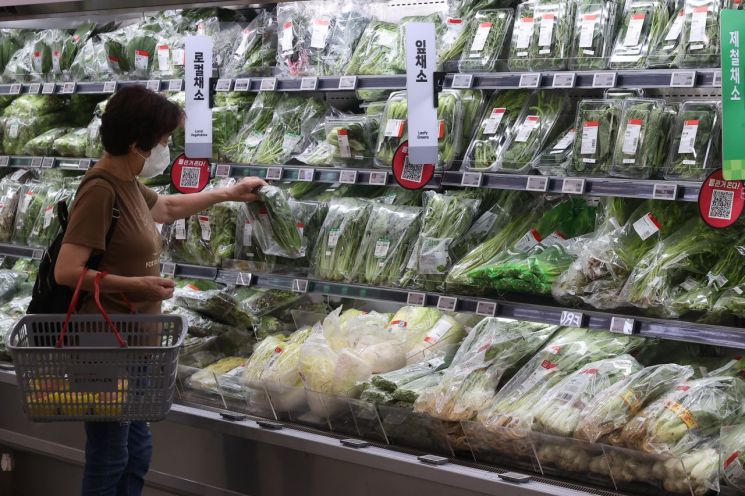
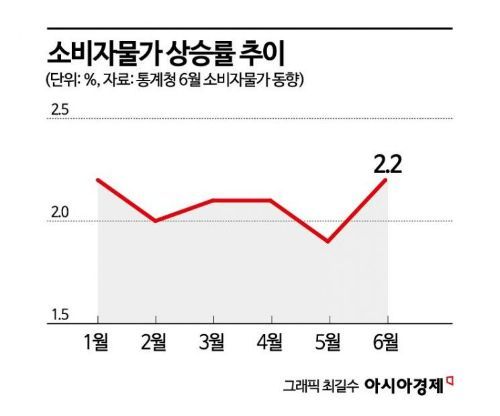
Last month, the consumer price inflation rate returned to the 2% range for the first time in two months. While overall prices remained stable, the prices of key food items such as processed foods and seafood rose, resulting in the largest increase in five months. Petroleum prices also shifted upward due to the impact of the Middle East conflict.
According to the “June Consumer Price Trends” released by Statistics Korea on July 2, the consumer price index last month rose 2.2% compared to a year earlier. The consumer price inflation rate had dropped to 1.9% last month, marking the first time in five months since December 2024 (1.9%) that it fell to the 1% range, but it has now returned to the 2% range. This is the largest increase in five months since January 2025 (2.2%). Park Byungseon, Director of Price Trends at Statistics Korea, explained, “Petroleum prices shifted upward, and the increase in prices of processed foods and non-dining-out food items expanded, resulting in a larger increase compared to the previous month.”
The upward trend in processed food prices led the rise in consumer prices. Processed food prices jumped 4.6% year-on-year, marking the largest increase in 19 months since November 2023 (5.1%). This contributed 0.39 percentage points to the overall inflation rate. In particular, instant noodles (ramyeon) rose 6.9% compared to the same month last year, the highest in 21 months since September 2023, when the increase was 7.2%.
Director Park explained, “Processed foods, including instant noodles, reflected the sequential increase in factory prices due to higher raw material costs.” Lim Hyeyoung, Director of Price Policy at the Ministry of Economy and Finance, also stated, “The increases in raw material costs and exchange rates since last year accumulated, and companies concentrated their price hikes in the first half of this year.” However, she added, “Since the prices of raw materials such as sugar and palm oil are stable, further price increases by companies are likely to be limited for the time being.” Last month, petroleum prices also rose by 0.3%, shifting upward due to the Middle East situation.
Last month, agricultural product prices fell 1.8% year-on-year, but livestock and seafood prices rose by 4.3% and 7.4%, respectively.
In particular, seafood prices saw a larger increase than last month (6.0%), rising by 7.4%, the highest in 27 months since March 2023. Statistics Korea analyzed that this was due to reduced catches and higher import prices caused by the high sea surface temperatures last year. Mackerel (16.1%) and croaker (10.6%) recorded significant increases. The government expects seafood supply to decrease for the time being. Director Lim explained, “From April to June, catches tend to decrease,” and added, “We will continue to provide seafood discount support and implement quota tariffs for mackerel (10,000 tons).”
The increase in livestock product prices slowed compared to the previous month (6.2%). Egg prices rose by 6.0%, the highest in three years and five months since January 2022 (15.8%).
The decline in agricultural product prices narrowed compared to the previous month (-4.7%). By item, carrots (-30.6%), pears (-25.2%), green onions (-18.5%), and apples (-12.6%) saw significant drops.
Service prices rose 2.4% year-on-year. Personal services increased by 3.3%, contributing 1.13 percentage points to overall inflation. In particular, the cost of home appliance repairs rose by 25.8% compared to the previous year. Statistics Korea attributed this to a tendency to raise call-out fees as demand for installation and repair of air conditioners and other cooling equipment increases during the summer peak season. Dining-out personal services rose by 3.1%, and non-dining-out personal services rose by 3.5%, contributing 0.44 percentage points and 0.69 percentage points, respectively, to overall inflation.
Excluding the volatile prices of food and energy, the core inflation index, which shows the overall price level, rose by 2.0%, the same as the previous month (2.0%).
The government plans to focus all efforts on stabilizing perceived inflation, given uncertainties such as weather conditions and international oil price volatility. In particular, to stabilize food prices closely related to people’s livelihoods, the government will continue to provide discount support for agricultural, livestock, and seafood products, maintain quota tariffs on key food ingredients, and respond swiftly to changes in prices and supply-demand factors for major items.
Meanwhile, Kim Woong, Deputy Governor of the Bank of Korea, presided over a meeting to review the inflation situation on the same day and stated, “If the current stability in international oil prices and exchange rates continues, the rate of consumer price increases will slow in July.” He added, “Although the inflation rate is expected to fluctuate around 2% going forward, uncertainties remain high due to U.S. tariff policy, the situation in the Middle East, and summer weather conditions, and living costs are still high, so we will continue to closely monitor the inflation situation.”
© The Asia Business Daily(www.asiae.co.kr). All rights reserved.
![Clutching a Stolen Dior Bag, Saying "I Hate Being Poor but Real"... The Grotesque Con of a "Human Knockoff" [Slate]](https://cwcontent.asiae.co.kr/asiaresize/183/2026021902243444107_1771435474.jpg)
















