Remarks at the CSIS Webinar
Sid Seiler, Senior Advisor: "Trump is not an isolationist"
Iran, pursuing nuclear development, likely referenced the North Korean case
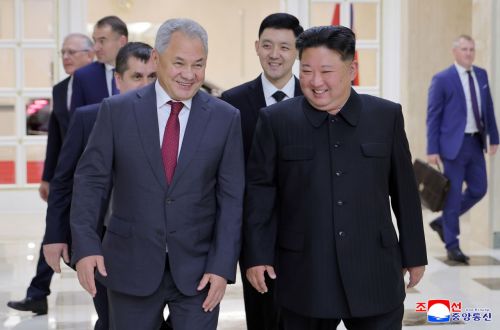 North Korean State Affairs Commission Chairman Kim Jongun (right) and Sergey Shoigu, Secretary of the Russian Security Council, who visited North Korea, are walking together on the 17th of last month. / Pyongyang=EPA·Yonhap Photo by EPA Yonhap
An analysis by a U.S. think tank suggests that President Donald Trump's decision to strike Iranian nuclear facilities will serve to deter North Korean military provocations.
Sid Seiler, Senior Advisor at the Center for Strategic and International Studies (CSIS), stated during a CSIS webinar on the 1st (local time), "President Donald Trump demonstrated through the bombing of Iran that he is prepared to intervene in international affairs," adding, "He is not an isolationist, and this operation proved that he is not afraid to use military force."
Seiler noted, "Regardless of the validity of the decision, the bombing of Iran was an event that publicly showcased President Trump's resolve," and predicted, "While this will not immediately bring North Korea back to the denuclearization negotiating table, it will at least have the effect of deterring the possibility of all-out war."
He particularly highlighted the scene where U.S. B-2 stealth bombers flew long distances and dropped 14 GBU-57 bunker buster bombs to destroy Iran's underground nuclear facility in Fordow, calling it a symbol of America's overwhelming military capability. Seiler assessed, "This will serve as a factor that makes it difficult for North Korea to easily plan for war," and estimated that the deterrent effect would persist for a considerable period.
Some have raised the possibility that North Korea's case may have influenced Iran's decision to pursue nuclear development to some extent. Daniel Shapiro, Senior Fellow at the Atlantic Council, who previously served as Deputy Assistant Secretary of Defense for the Middle East and as U.S. Ambassador to Israel during the Obama administration, pointed out, "Iranian leaders are well aware of the nuclear development histories of North Korea and Libya, and they have drawn clear lessons from both cases."
He continued, "North Korea, by advancing its nuclear program to a mature stage, secured deterrence and a shield for regime survival, whereas Libya, after giving up its nuclear program through negotiations, found that this decision did not protect the Gaddafi regime when it faced crisis. Iran is acutely aware of this," he emphasized. Dictator Muammar al-Gaddafi declared nuclear abandonment through negotiations with the United States in 2003, but only eight years later, in 2011, after the 'Arab Spring' revolution, he was killed by rebels backed by the United States and the North Atlantic Treaty Organization (NATO).
Shapiro also suggested that the U.S. failure to resolve the North Korean nuclear issue at an early stage may have influenced Israel's decision to strike Iran. He said, "Israel is likely aware of the price the United States paid for hesitating to intervene militarily during the early stages of North Korea's nuclear weapons development in the 1990s," and added, "They may have applied the lesson that timing should not be missed in this case."
© The Asia Business Daily(www.asiae.co.kr). All rights reserved.
![Clutching a Stolen Dior Bag, Saying "I Hate Being Poor but Real"... The Grotesque Con of a "Human Knockoff" [Slate]](https://cwcontent.asiae.co.kr/asiaresize/183/2026021902243444107_1771435474.jpg)















