The 'Law School Nepotism System' Debate Reignites
Weight Given to Possibility of Parallel Bar and Law School Exams
Focus Remains on Annual Number of New Lawyers
With President Lee Jaemyung's recent remarks expressing sympathy for the "revival of the bar exam," heated debates have erupted within the legal community. Among lawyers who graduated from law schools (referred to as "Robeon"), the prevailing opinion is that "regardless of how the system changes, the most important issue is reducing the annual number of new lawyers."
According to the legal community on July 2, the "Roiners+" board?an exclusive space for lawyers within the online community "Roiners," which is used by law school applicants, current students, and graduates?has seen a steady stream of posts and comments sharing news articles and columns related to the revival of the bar exam and the so-called "law school nepotism system" since President Lee's remarks.
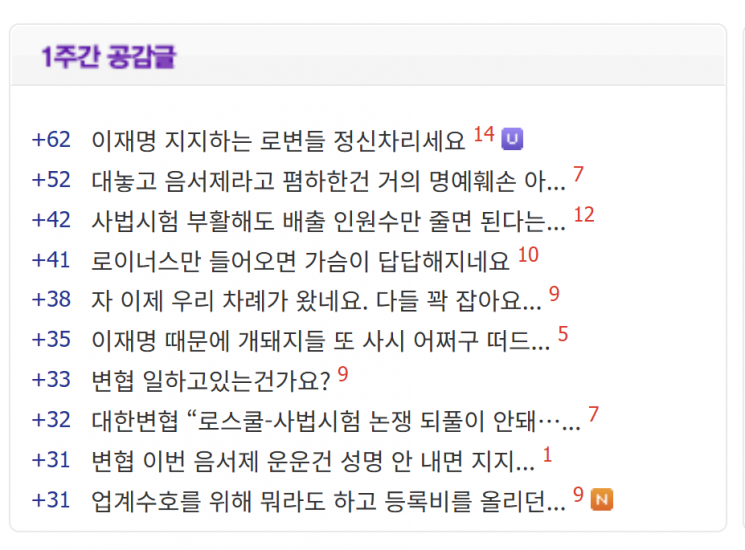 In the past week, most of the posts that received significant sympathy on the 'Roiners+' board, an exclusive community for law school graduates, were related to the 'revival of the bar exam' or the 'law school nepotism system.' Roiners homepage
Renewed Debate Over the 'Law School Nepotism System'
Robeon lawyers have expressed strong dissatisfaction with those advocating for the revival of the bar exam who characterize the law school system as a "nepotism system."
On June 25, during a town hall meeting in Gwangju, President Lee responded to a related question by saying, "It seems there are issues with the law school system as a pathway for training legal professionals," and added, "For a moment, I was concerned that it might be turning into a nepotism system rather than a merit-based one."
On the board, posts expressed frustration over such criticisms, with comments such as, "Why call it a nepotism system when 10% are admitted through special admissions and scholarships are provided?" and "If even Cho Kuk's son can't get into law school, it's not a nepotism system?it's the medical school, which Cho Kuk's daughter got into, that is a nepotism system." Some posts even suggested that "openly denigrating it as a nepotism system is almost defamation," and proposed reviewing Supreme Court precedents on "defamation against a group."
On the other hand, some posts expressed agreement, stating, "The essence of the criticism isn't whether poor people can become lawyers, but that the system should allow anyone to pass the exam purely on their own merit. No matter how much money or power one's family has, that shouldn't guarantee success, but law schools don't provide that. ... From the perspective of fairness, there is room for criticism," or "By requiring law school graduation to take the bar exam, the system creates a barrier that limits equal opportunities for all citizens to become lawyers," and "What matters is not whether it is actually a nepotism system, but that policymakers and the majority of the public perceive it as one."
Concerns Over Hierarchy and Proposals for Compromise
Robeon lawyers, acknowledging President Lee's clear intent, see a real possibility that the bar exam could be revived. They also expressed concerns that the hierarchy and discrimination between bar exam and law school graduates, which emerged in the early days of the bar exam's abolition, could resurface.
Posts on the board included comments such as, "There will be another tier above Seoul National University's law school, pushing all other law schools further down," and "If the law school system is abolished and the bar exam revived, that's one thing, but if both systems coexist, law school graduates without special experience or prior judicial office will be at a disadvantage."
Various alternative proposals were also suggested, such as, "How about running one or two national university law schools with full scholarships for students who maintain a minimum GPA?" "Only allow current special admission candidates to take the bar exam and implement a five-attempt limit," "For basic livelihood recipients under 30 with no criminal record, allow one attempt at the first stage and two at the second, for a total of two attempts," and "Introduce a Korea National Open University law school."
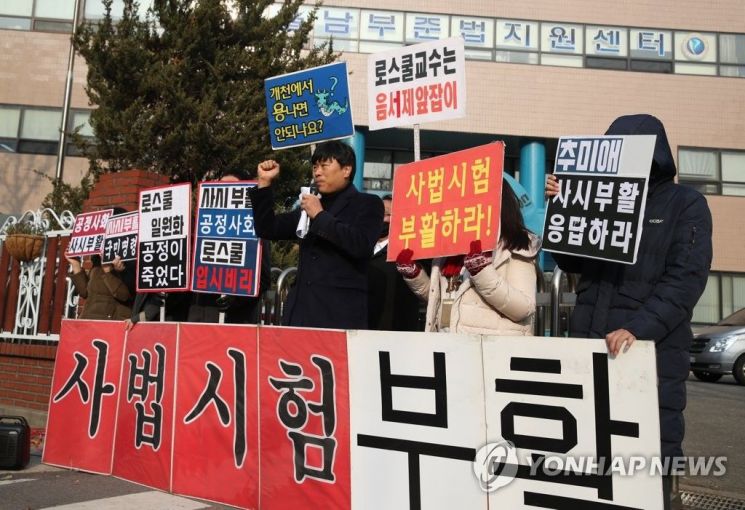 On December 9, 2019, members of the "Association of Bar Exam Candidates for the Preservation of the Judicial Examination" held a press conference in front of the Seoul Southern Compliance Support Center, where the preparation office for the confirmation hearing of Choo Mi Ae, then Minister of Justice nominee, was set up in Mokdong, Yangcheon-gu, Seoul, urging the revival of the judicial examination or the introduction of a preliminary lawyer exam. Photo by Yonhap News
Main Concern Is Number of Successful Candidates, Not the System
While Robeon lawyers have pushed back against efforts to revive the bar exam by labeling law schools as a "nepotism system," their primary concern has focused on the total number of lawyers admitted each year. Given the practical difficulty of abolishing law schools, there is a strong consensus that if the bar exam is revived and both systems operate in parallel, the annual number of new lawyers should not increase.
Posts on the board predicted, "Since universities with law schools are unlikely to give them up, the combined total of bar exam and law school admissions is almost certain," "If law schools are abolished, 1,000 lawyers will be admitted, but if both systems coexist, it will be 3,000," "Like the transition period between the bar exam and law schools, for about 10 years both will run in parallel, admitting 2,800 lawyers per year," and "With 1,750 from law schools and 1,500 from the bar exam, the annual total could reach 3,000." Many posts anticipated that reviving the bar exam would increase the current annual output of about 1,700 lawyers.
Other posts stated, "There would be an uproar if law schools were abolished, but the key issue is the number of lawyers, not the system," "It's fine if the bar exam is revived, just please reduce the number of lawyers admitted," "If the bar exam produces 200 and law schools 800 or fewer, that's acceptable," "Abolish law schools and admit 500 to 700 lawyers," "Just get rid of everything and admit only 1,000," and "Whether it's the law school or bar exam system, if the number of lawyers is not ultimately reduced, none of it matters." The majority of posts emphasized the need to reduce the number of new lawyers.
© The Asia Business Daily(www.asiae.co.kr). All rights reserved.
![Clutching a Stolen Dior Bag, Saying "I Hate Being Poor but Real"... The Grotesque Con of a "Human Knockoff" [Slate]](https://cwcontent.asiae.co.kr/asiaresize/183/2026021902243444107_1771435474.jpg)
















