Pet Playgrounds in Seoul Surge Eightfold in a Decade
Around 3 p.m. on the 1st, at a pet playground in Mapo-gu, Seoul. Despite the sweltering weather with temperatures exceeding 30 degrees Celsius, about ten citizens were leisurely spending time with dogs of various breeds. Dogs off their leashes chased toy balls and tumbled around together. Lee (42), who came with a Maltese, said, "In the past, I always felt self-conscious when walking my dog, but here I don't have to worry about that, so I come often." "My dog can run around freely without a leash, so I can really feel that its stress has decreased," she added.
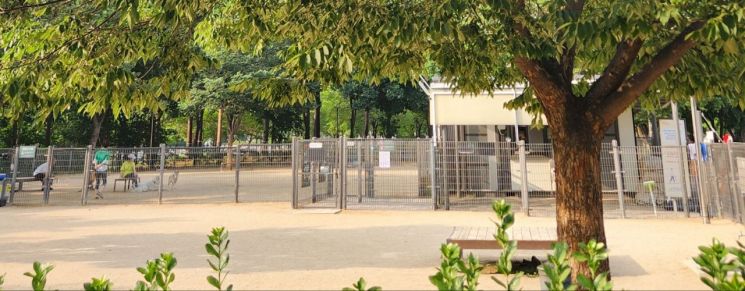 A dog park in Mapo-gu, Seoul, visited on the 26th of last month. Despite the hot weather, several residents were walking their dogs. Photo by Byun Seonjin
As the number of households raising pets increases, local governments are rapidly expanding related public facilities. However, a range of problems, such as poor management and conflicts over location, have also emerged, leading to ongoing disputes over the expansion of pet facilities. Some point out that simply increasing the number of facilities is not always the best solution.
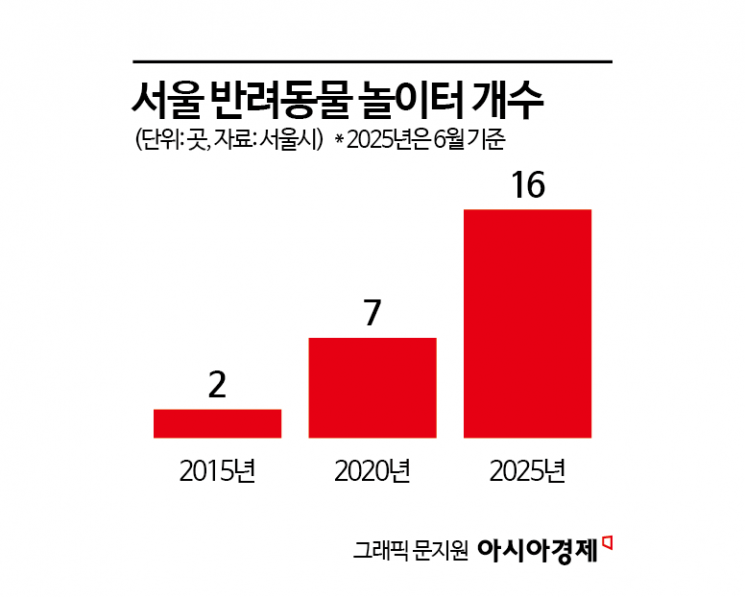
According to the Seoul Metropolitan Government, the number of pet playgrounds in Seoul grew from two in 2015, to seven in 2020, and to sixteen as of June this year, marking a significant increase over the past ten years. The Architecture and Urban Research Institute counted a total of 123 pet playgrounds nationwide as of 2023. The first pet playground was established in 2012, and their numbers have surged as more households began raising pets. The Ministry of Agriculture, Food and Rural Affairs estimated that the proportion of the population raising pets in Korea reached a record high of 28.6% last year.
There is an assessment that pet playgrounds help ease conflicts between pet owners and non-pet owners. These spaces are said to have the effect of safely separating the two groups. Yoon (41) said, "Even though I have a small dog, I was often criticized in parks for not keeping the leash within two meters," adding, "With dedicated spaces now available, there are far fewer conflicts between pet owners and non-pet owners, and I feel much more at ease."
Pet owners also give high marks to these playgrounds as places for animal welfare and socialization education for dogs. Kim (36) said, "When my dog only stayed at home, it would bark or get scared whenever it saw strangers or other animals, but after going to the playground, it has become much calmer."
Pet playgrounds also serve as spaces for communication and bonding among pet owners. Jung (28) said, "Thanks to the pet playground, I've had opportunities to interact with other pet owners," and added, "I was lonely after moving to a new area, but it was a great comfort to be able to naturally strike up conversations with residents who share the same interests."
However, some residents complain not only about noise, odors, and waste issues but also about infringements on their living environment. As pet playgrounds are increasingly seen as undesirable facilities, NIMBY (Not In My Back Yard) phenomena are occurring. In fact, since January, Gangnam-gu has been pushing to build a pet playground in Daemosan, but this has faced strong opposition from residents. Seocho-gu also had to dismantle a dog playground built in Banpo Park in 2017 without ever opening it due to resident opposition. Resident Lee (70) said, "I can't accept the idea of turning a space used by people of all ages into a pet-only area," and added, "Crowds will gather day and night, leading to littering and noise problems."
Given these circumstances, some local governments choose to locate pet facilities in outlying areas to avoid resident backlash. The first public pet playground in Daegu, which opened last year, is adjacent to the Seongseo Industrial Complex and the Daegu City Cemetery. The Chojon Park dog playground in Jinju is next to a sewage treatment plant. Some local governments first install temporary dog playgrounds. Gangdong-gu created a mobile dog playground at Amsa History Park in April, and Eunpyeong-gu reopened a pet playground at Mulpure Park in March.
Poor management is also an issue. When visiting a dog playground in Dobong-gu recently, notices such as "Only registered dogs allowed" and "Unvaccinated dogs prohibited" were posted, but there was no manager to check compliance. Resident Shin (39) said, "I've hardly ever seen anyone come out to manage the place."
On the evening of the 16th of last month, around 9 p.m., a dog bite incident occurred at a dog playground managed by the Seoul Metropolitan Government. It was reported that there was no manager present at the time. A Seoul city official said, "The accident happened at night when the facility was operating autonomously," and added, "If such incidents are repeated, we will reconsider the operating method."
Bae Ungyu, a professor of urban engineering at Chung-Ang University, said, "Rather than blindly increasing the number of pet facilities, it is essential to design a layout that suits local conditions, along with an operating system that can minimize conflicts among users." He added, "Comprehensive standards are needed, including securing management personnel, establishing location criteria, and conducting prior consultations with residents."
© The Asia Business Daily(www.asiae.co.kr). All rights reserved.
![Clutching a Stolen Dior Bag, Saying "I Hate Being Poor but Real"... The Grotesque Con of a "Human Knockoff" [Slate]](https://cwcontent.asiae.co.kr/asiaresize/183/2026021902243444107_1771435474.jpg)
















