Maintaining Predecessor's Issuance Strategy
Short- and Long-Term Bond Yields Expected to Fall if Inflation Slows
U.S. Treasury Secretary Scott Besant has stated that he will not increase the issuance of long-term bonds, citing the current level of interest rates and the possibility of easing inflation.
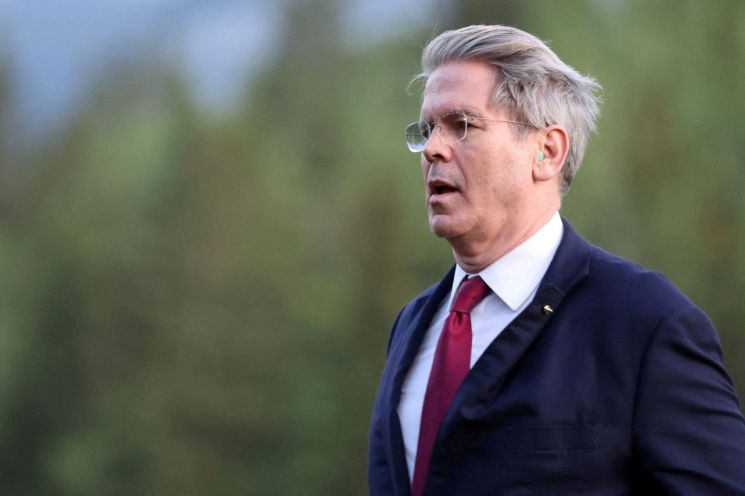
In an interview with Bloomberg TV on June 30 (local time), Secretary Besant was asked whether he would raise the proportion of long-term bond issuance. He responded, "Why would I do that at these interest rates? Why should we do that when rates are more than one standard deviation above the long-term average?" He added, "The time to do that would have been in 2021 and 2022."
Long-term bonds have fixed interest rates, so if the rate is high at the time of issuance, the government's future fiscal burden increases. This is because even if rates fall later, the government must continue to pay the higher interest rate until maturity.
Last year, Secretary Besant repeatedly criticized then-Treasury Secretary Janet Yellen for relying too heavily on short-term bonds in government debt issuance. He argued that the aim was to lower long-term borrowing costs to stimulate the economy ahead of the election, saying, "There are too many short-term bonds and not enough preparation for long-term refinancing."
However, after taking over the position, Besant has continued his predecessor's strategy for government bond issuance.
He predicted that if inflation slows, interest rates on both short- and long-term bonds will fall. When asked about the outlook for the 10-year Treasury yield by the end of the year, Secretary Besant replied, "It depends on several factors, but if inflation decreases, the entire yield curve could decline in parallel."
If inflation slows, the likelihood of a Federal Reserve (Fed) policy rate cut increases, and the market reflects this by lowering short-term bond yields. Over the long term, as expectations for price stability grow, yields on long-term bonds such as the 10-year Treasury could also come under downward pressure.
Regarding the Fed's policy rate decisions, he said, "It seems like they are driving with the wheel slightly frozen," and added, "Because they disappointed the American people in 2022, I am concerned that the Fed is only looking at its feet instead of looking ahead."
When the Fed raised rates in March 2022, it faced criticism for acting too late. After all prices surged from April 2021, the Fed judged the inflation as "temporary" and missed the right timing to respond.
He dismissed the possibility of inflation caused by tariffs. He emphasized, "There was absolutely no inflation caused by tariffs, and in terms of impact on consumer prices, nothing is more temporary than tariffs."
Regarding the succession plan for Fed Chair Jerome Powell, whose term ends in May next year, he mentioned two possibilities: appointing a new Fed governor in January who could become the next chair, or nominating one of the current Fed governors as chair.
Secretary Besant said, "In January next year, a 14-year term governor position will become vacant. So, I've considered the idea that this person could become chair when Chair Powell retires in May. Alternatively, a new chair could be appointed in May. Unfortunately, that position would only have a two-year term."
As for the candidates for the next Fed chair, Secretary Besant said only, "There are certainly people among the current Fed officials being considered (for the next chair)," without giving any specific names.
© The Asia Business Daily(www.asiae.co.kr). All rights reserved.
![Clutching a Stolen Dior Bag, Saying "I Hate Being Poor but Real"... The Grotesque Con of a "Human Knockoff" [Slate]](https://cwcontent.asiae.co.kr/asiaresize/183/2026021902243444107_1771435474.jpg)















