June Manufacturing PMI Remains Below 50 for Third Consecutive Month
WSJ: "Chinese Authorities Seem Unconcerned About Economic Indicators"
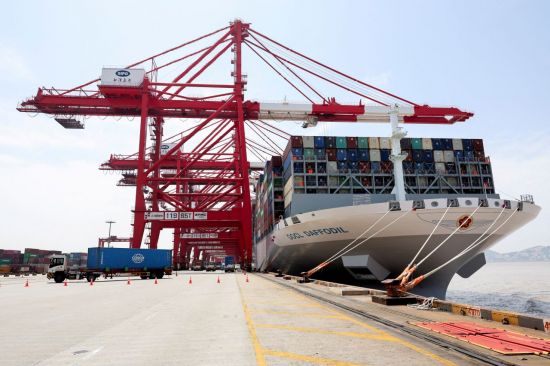
The Manufacturing Purchasing Managers' Index (PMI), which reflects trends in China's manufacturing sector, has continued to decline for the third consecutive month. Despite the decision to pause the US-China tariff war, it appears that the Chinese economy remains sluggish.
June Manufacturing PMI Remains Below 50 for Third Consecutive Month
On June 30, China's National Bureau of Statistics announced that the June manufacturing PMI was recorded at 49.7, up 0.2 points from the previous month's 49.5. While this figure met market expectations and showed a slight increase from the previous month, it remained below the baseline of 50 for the third consecutive month.
The PMI, compiled based on surveys of corporate purchasing managers, is an indicator that shows trends in the relevant sector. A reading above 50 indicates expansion, while a reading below 50 signals contraction.
Bloomberg News pointed out, "The June PMI is the first figure to fully reflect the monthly trend after the US and China agreed to a 90-day truce in their trade war," adding, "With the outlook for future trade agreements still uncertain, it remains questionable whether China's manufacturing sector will regain strength within this year."
The non-manufacturing PMI, which covers the construction and service sectors, stood at 50.5 in June, up 0.2 points from the previous month's 50.3, maintaining an expansionary phase. By sector, the construction industry index rose by 1.8 points to 52.8 from the previous month's 51.0, while the service industry index dropped by 0.1 point to 50.1 from 50.2. The composite PMI for China in June, which combines manufacturing and non-manufacturing, rose by 0.3 points to 50.7 from 50.4 in the previous month.
WSJ: "Chinese Authorities Seem Unconcerned About Economic Indicators"
Chinese authorities appear unconcerned about the slowdown in the country's manufacturing sector. In fact, the National Bureau of Statistics stated, "The manufacturing PMI, non-manufacturing PMI, and composite PMI for June all rose compared to the previous month," evaluating that "the rise in all three major indices indicates that China's economy is generally maintaining an expansionary trend."
The Wall Street Journal (WSJ) also reported that Chinese authorities appear generally satisfied with economic performance since the beginning of the year. Li Qiang, China's Premier and widely referred to as the country's "number two," stated in his keynote speech at last week's Asian Infrastructure Investment Bank (AIIB) annual meeting that key economic indicators continued to improve in the second quarter despite the US-China tariff war. In fact, China's retail sales in May increased by 6.4% year-on-year, marking the highest growth since December 2023 (7.8%).
Global investment bank Goldman Sachs also noted in its latest report that the People's Bank of China has recently shown a policy stance that is somewhat less dovish (less accommodative). In the report, the bank's economists stated, "We believe the likelihood of a large-scale stimulus package or additional easing measures being announced at the July Politburo meeting is low," and added, "If additional measures are taken, they are expected to focus on selective areas such as the labor market and the real estate sector."
However, the WSJ added that some maintain a cautious outlook on the Chinese economy. Huang Zichun, an economist at Capital Economics, pointed out that slowing export growth and weakening fiscal stimulus effects could cause economic activity to slow again in the second half of the year.
© The Asia Business Daily(www.asiae.co.kr). All rights reserved.
![Clutching a Stolen Dior Bag, Saying "I Hate Being Poor but Real"... The Grotesque Con of a "Human Knockoff" [Slate]](https://cwcontent.asiae.co.kr/asiaresize/183/2026021902243444107_1771435474.jpg)















