Ministry of Health and Welfare to Fully Launch 'Essential Specialized Function Enhancement Support Project' in July
Strengthened Compensation and Performance Support for 24-Hour Care Availability
Government support will be strengthened for secondary hospitals that provide 24-hour care in the fields of burns, digit replantation, childbirth, pediatrics, and cerebrovascular diseases. The goal is to enhance the capacity to address essential medical needs within local communities and to ensure that patients requiring care during nights or holidays can receive adequate medical services.
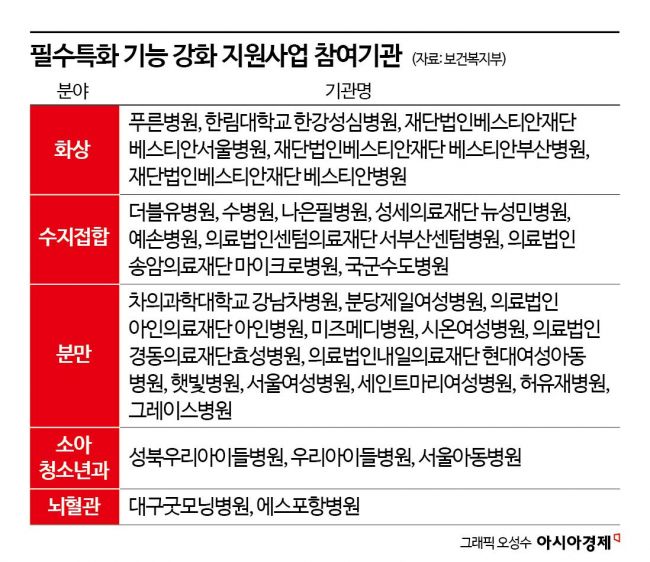
The Ministry of Health and Welfare announced on the 30th that it has selected five hospitals specializing in burns, eight in digit replantation, fifteen in childbirth and pediatrics, and two in cerebrovascular diseases to participate in the 'Essential Specialized Function Enhancement Support Project,' which will be implemented starting July 1.
Secondary hospitals, which are key to strengthening regional healthcare, number about 1,700 nationwide (including 330 general hospitals and 1,400 hospitals). However, there have been ongoing concerns that patients do not know which hospital to visit in emergencies or sudden illnesses, as each hospital varies in its functions and capabilities. The Ministry explained that, rather than encouraging all hospitals to expand their capacity for higher compensation, it is necessary to foster small but highly specialized hospitals with expertise in specific diseases to establish a desirable healthcare supply and utilization system.
Accordingly, the Ministry prioritized five fields?burns, digit replantation, childbirth, pediatrics, and cerebrovascular diseases?by comprehensively considering the following: areas with insufficient supply or demand, those requiring treatment within the golden hour, and fields where secondary hospitals in the region mainly handle or need to handle the medical demand. The selection criteria include hospitals whose treatment volume in the relevant field ranks in the top 30 percent among all medical institutions, those with more than 10 percent of claims for night and holiday cases for each disease, or those with over 1,000 claims for the disease and at least 100 claims for night and holiday cases.
Hospitals selected for the Essential Specialized Function Enhancement Support Project must maintain a 24-hour care system, including night and holiday clinics, in the designated field. They are also required to establish patient referral and cooperation systems with nearby tertiary hospitals, comprehensive secondary hospitals, and local clinics and hospitals.
The government will provide financial support to participating hospitals for 24-hour operations and offer incentives (performance-based rewards) for outstanding performance in essential specialized functions. Performance will be evaluated based on night and holiday care records in the relevant field, the number of patients accepted via the regional control center (emergency response), the number and proportion of patients referred by tertiary or comprehensive secondary hospitals (care coordination), and patient satisfaction. In addition, these hospitals will be included in the emergency transport system, allowing the regional control center to refer patients to participating hospitals when necessary. Each participating hospital will clearly indicate its care hours and specialties so that patients can easily identify available services.
The support project will undergo a preparation period in the second half of 2025, followed by a three-year pilot phase from 2026 to 2028, before being fully implemented. Additional participating institutions will be selected each year to expand the number of hospitals equipped to provide essential medical care.
Lee Jungkyu, Director of the National Health Insurance Policy Division, stated, "The Essential Specialized Function Enhancement Support Project aims to foster hospital-level institutions that serve as the backbone of regional healthcare," adding, "We expect that by enabling immediate response in emergencies and providing appropriate 24-hour care to patients, the quality of regional healthcare will be significantly improved."
© The Asia Business Daily(www.asiae.co.kr). All rights reserved.
![Clutching a Stolen Dior Bag, Saying "I Hate Being Poor but Real"... The Grotesque Con of a "Human Knockoff" [Slate]](https://cwcontent.asiae.co.kr/asiaresize/183/2026021902243444107_1771435474.jpg)
















