SEMAS Commissions Study on Legal and Institutional Reforms
Examining Consistency Across Dispersed Laws
Comprehensive Overhaul Centered on the Framework Act
The government is set to review the entire legal and institutional framework for small business owners. This initiative stems from concerns that small business owners are still classified as a subcategory of small and medium-sized enterprises (SMEs), and that policy support is scattered across various individual laws, resulting in limited effectiveness. Through this review, the government plans to reorganize small business policies into a single, coherent system and to establish clearer and more effective support criteria.
According to industry sources on June 30, the Small Enterprise and Market Service (SEMAS) recently commissioned a research project titled "Analysis of the Effectiveness of Laws and Systems Related to Small Business Owners and Self-Employed Persons and Measures for Improvement." The purpose of this project is to comprehensively analyze current laws and systems and, based on this analysis, to propose improvements that can enhance the effectiveness of policy implementation. SEMAS plans to use the "Framework Act on Small Enterprises," as the central reference point in this study to examine the overall consistency of the legal system.
 Empty storefronts are scattered throughout the commercial area near Ewha Womans University in Seodaemun-gu, Seoul. Photo by Kang Jinhyung
The Framework Act on Small Enterprises, enacted in 2020, is highly symbolic in that it recognizes small business owners as independent policy targets, distinct from SMEs. However, most policy design and implementation still rely on the "Framework Act on Small and Medium Enterprises," so small business owners continue to be classified as a subcategory of "small enterprises." As a result, there are concerns that the unique characteristics of small business owners are not sufficiently reflected in the actual policy benefits or in the operation of the system.
Although each small business may be modest in scale, small business owners account for a significant portion of the national economy in terms of the total number of businesses and employment. According to the Ministry of SMEs and Startups' "2023 Small Business Survey," there were 5.96 million small businesses nationwide in 2023, employing 9.55 million people. This represents more than half of all businesses and employment in the country. Nevertheless, there have been ongoing criticisms that protection and support for small business owners have been either marginalized or overly simplified within the framework of SME policies.
The relevant legal system is also entangled in complexity. Laws targeting small business owners are dispersed across several individual statutes, such as the "Act on the Protection and Support of Small Enterprises," the "Traditional Market Act," and the "Local Commercial District Act." Because each law operates independently according to its own policy objectives, there is analysis that policy efficiency is diminished and confusion arises in the field due to overlaps between programs and inconsistencies in application criteria.
The foundation for ensuring effective policy implementation is also lacking. Article 3 of the Framework Act on Small Enterprises stipulates that the government and local governments must establish and support policies to protect small business owners and help them grow autonomously. However, in practice, it is often difficult for local governments to secure the necessary budgets to implement small business policies in their regions. This is because a concrete system for financial support from the central government is not clearly established in law.
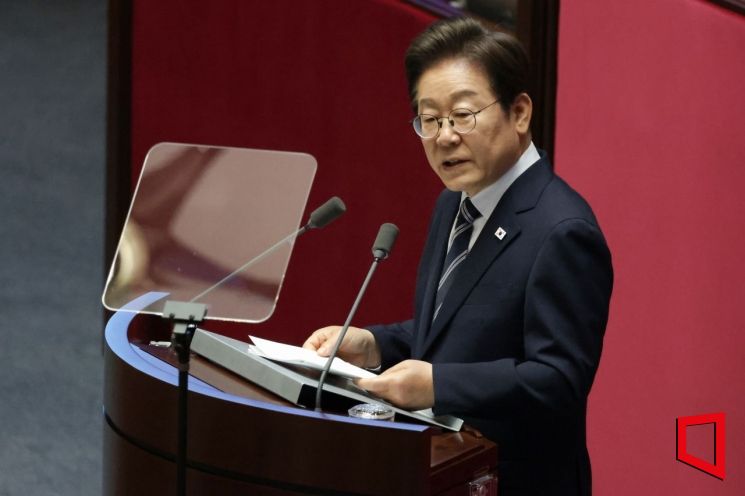 President Lee Jae Myung is delivering a policy speech on the supplementary budget at the National Assembly plenary session on the morning of the 26th. Photo by National Assembly Press Photographers Group
Jang Eunjung, Associate Research Fellow at the SEMAS Policy Research Institute, stated, "One way to improve the tangible impact of policies is to enhance the legal and institutional framework," and added, "It is necessary to continuously expand major small business initiatives with high implementation effectiveness by increasing legal consistency in line with the framework act."
The small business community hopes that this research will lead to substantial institutional reform. The industry has consistently called for the establishment of a control tower dedicated to small business support policies, such as appointing a deputy minister for small business within the Ministry of SMEs and Startups and creating a Civil Affairs Secretariat within the Office of the President. The argument is that a dedicated organization for small business owners is necessary to ensure rapid implementation and policy consistency that meets on-the-ground needs.
The government also continues to view small business owners as a key pillar of the people's economy and maintains its stance of strengthening related policies. The first supplementary budget proposal under the Lee Jae Myung administration included comprehensive support measures such as revitalizing the small business economy through nationwide consumer coupons and a large-scale debt relief policy for small business owners worth 16 trillion won. Given the clear policy commitment, this institutional overhaul is expected to further enhance the consistency and effectiveness of small business policies.
© The Asia Business Daily(www.asiae.co.kr). All rights reserved.
![Clutching a Stolen Dior Bag, Saying "I Hate Being Poor but Real"... The Grotesque Con of a "Human Knockoff" [Slate]](https://cwcontent.asiae.co.kr/asiaresize/183/2026021902243444107_1771435474.jpg)
















