Hebrew Practice Notes of Franz Kafka, Pioneer of 20th-Century Existential Literature
Sold at a High Price at Paris Fair
The notebook that Czech-born Jewish writer Franz Kafka, a pioneer of 20th-century existential literature, used to practice Hebrew while preparing to immigrate to Palestine 100 years ago, has been sold for 90,000 euros (approximately 142 million won). Yonhap News reported on June 24 (local time), citing Czech media outlet Radio Prague, that "a book containing traces of Kafka's Hebrew practice was sold at a high price at the Rare Book and Graphic Art Fair held in Paris, France, from the 13th to the 15th of this month." This book is originally a printed copy of the short story "A Report to an Academy," published in 1919.
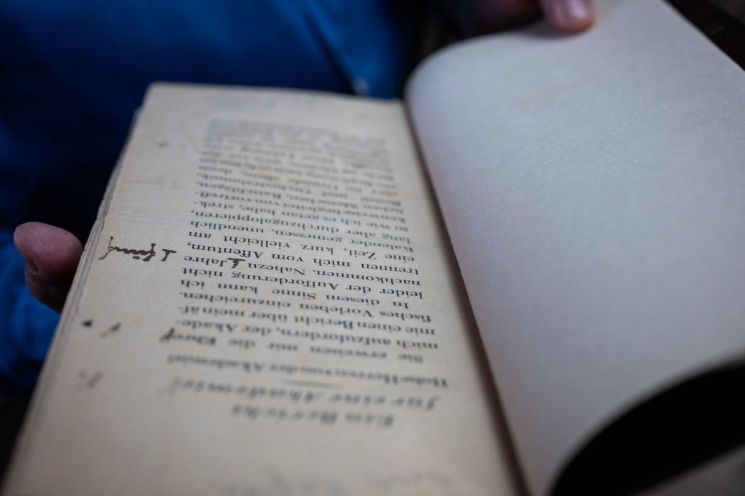
Hebrew is the official language of Israel used by Jewish people today. At that time, before the establishment of the Jewish state of Israel, Britain was administering the land that is now Israel and Palestine under a mandate. Kafka practiced Hebrew by writing in the blank spaces of the book.
Kafka was born and raised in Prague, Czech Republic, and wrote in German. After World War I, he took Hebrew classes for several years and contemplated immigrating to Palestine, but he died of tuberculosis in 1924. Kafka, who died at the relatively young age of 40, left masterpieces such as "The Metamorphosis" while struggling with anxiety, despair, and isolation throughout his short life, but little is known about his creative process. This notebook was owned by Thierry Bouchet, a French doctor who had been collecting Kafka rarities since the 1970s. He put up for sale 427 items, including first editions of "The Metamorphosis" and "In the Penal Colony," as well as letters Kafka sent to acquaintances. Books containing the author's handwriting sold for as much as 200,000 euros (approximately 316 million won).
Kakfa's unpublished works changed hands many times over about 100 years
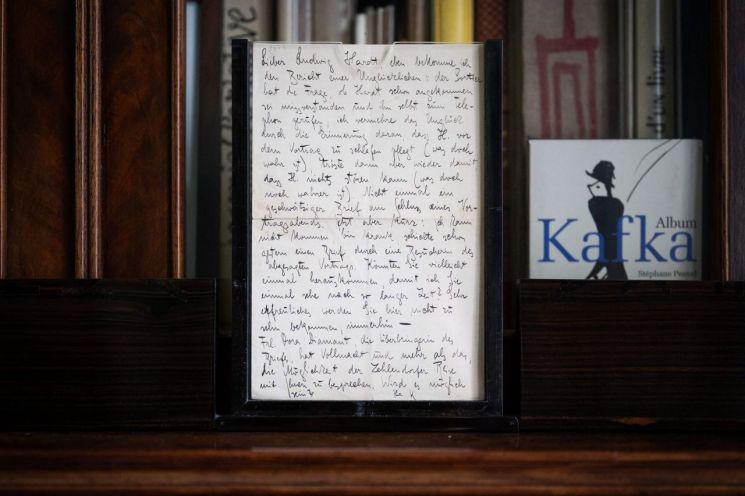 Kafka was born and raised in Prague, Czech Republic, and wrote in German. After World War I, he took Hebrew classes for several years and contemplated immigrating to Palestine, but he died of tuberculosis in 1924. AFP·Yonhap News
In 1924, shortly before his death from tuberculosis at age 40, Kafka entrusted his writings to his friend and publisher Max Brod. Kafka asked Brod not to read his works and to burn them all. However, Brod ignored Kafka's last wishes and published many of the works he received, including "The Trial," "The Castle," and "America." The ownership of Kafka's manuscripts passed from his friend to his friend's secretary, and then to the secretary's daughter. After that, Kafka's unpublished works changed hands among various people for about 100 years.
In 1968, when Brod died, he instructed his secretary, Esther Hoffe, to transfer the remaining manuscripts to an institution. However, Hoffe also ignored Brod's will, kept the items herself, and sold some of them. When Hoffe died in 2008, she left her collection to her two daughters. Both daughters, Eva Hoffe and Ruth Wiesler, as well as their mother Hoffe, were Holocaust survivors, and Brod had fled to what was then British-controlled Israel in 1939 when Nazi Germany invaded Czechoslovakia.
The two daughters considered Brod their father and regarded Brod's collection as their inheritance, keeping it in their possession. However, in 2008, after both Brod and Hoffe had died, the National Library of Israel filed a lawsuit. At first, the legal dispute over the publication of Kafka's unpublished works was simply a matter of ownership. However, the situation became complicated when it was revealed that Hoffe's daughters, who claimed ownership of Kafka's works, had attempted to sell them and had contacted German parties.
As a result, the Israeli government ultimately filed a lawsuit to determine the rightful heirs to Kafka's unpublished works. The Israeli government argued that since Kafka was Jewish, his works should also belong to the Jewish people, and by extension, should be state property. In 2019, after a decade-long legal battle, an Israeli court accepted the government's argument and recently ruled that Kafka's unpublished works should be made public and become state property.
© The Asia Business Daily(www.asiae.co.kr). All rights reserved.
![Clutching a Stolen Dior Bag, Saying "I Hate Being Poor but Real"... The Grotesque Con of a "Human Knockoff" [Slate]](https://cwcontent.asiae.co.kr/asiaresize/183/2026021902243444107_1771435474.jpg)
















