International Journal "Nature" Stresses the Need to Change Perceptions of Sharks
Unscientific Fear Sparked by "Jaws" Depicting Sharks as Monsters
"Shark Population Declined for 50 Years... Risk of Ecosystem Collapse"
There has been a call to reconsider the unscientific fear of sharks depicted in the movie "Jaws." It is argued that the portrayal of sharks as monsters in the film has contributed to the acceleration of population decline and the risk of extinction. According to Dongascience, on June 21 (local time), the international journal "Nature" highlighted the need for shark conservation and the importance of changing public perception to mark the 50th anniversary of the release of "Jaws." Experts warned that "the extinction of sharks, which have served as apex predators in marine ecosystems for over 400 million years, could lead to the collapse of the entire marine ecosystem."
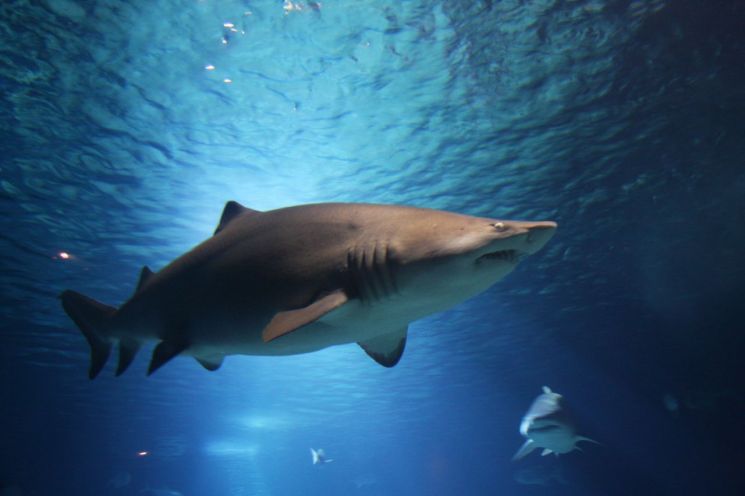
The movie "Jaws," released in 1975, depicted events unfolding as a shark appeared near the shore and threatened humans. The film opened a new chapter in the blockbuster genre and had a significant impact worldwide. Beyond its box office success, it also dramatically changed public perception of sharks, drawing attention from the scientific community. David Shiffman, a researcher at Simon Fraser University in Canada, said, "At the time, people were so afraid that they hesitated to enter even ankle-deep seawater, and some even avoided swimming pools."
This phenomenon is known as the "Jaws effect." It is a concept that explains how fictional depictions influence real-world public perception and policy directions. According to Shiffman, baseless fear of sharks remains widespread and sometimes spreads as pseudoscientific claims. The problem is that sharks have experienced the worst population decline in human history over the past 50 years. As apex predators, sharks play a crucial role in regulating the populations of other fish species and maintaining the balance of the marine food chain.
Shiffman emphasized, "If apex predators disappear, the entire ecosystem can collapse, which will ultimately have a direct impact on humans. Billions of people around the world rely on the ocean as a primary food source, and tens of millions work in the marine industry, so a healthy ocean is the foundation of human survival." The direct cause of population decline is attributed to fishing practices. Shiffman stressed, "The greatest threat to marine biodiversity is overfishing," and underscored the necessity of sustainable fisheries policies not only to save sharks but to preserve the entire marine environment. He also stated, "Consumer choices are essential for shark conservation," and advocated for choosing "sustainable seafood."
Shiffman further noted, "Most of the public encounters sharks only through sensational media reports or unfounded rumors," and emphasized, "If the media focuses on the ecological importance and scientific facts about sharks, conservation efforts based on understanding rather than fear would be possible." He added, "Sharks are not a threat to humans but partners in protecting the marine ecosystem," and concluded, "It is not too late."
 UN Ocean Goodwill Ambassador Luis Fu (55) swam around Martha's Vineyard Island, the filming location of "Jaws," over 12 days to break the terrifying image of sharks depicted in the movie.
Meanwhile, a man who recently swam 97 kilometers in the sea over 12 days to break the fearful image of sharks has drawn attention. Luis Pugh (55), UN Ocean Goodwill Ambassador and an experienced swimmer in challenging environments such as polar regions and glacial lakes, swam around Martha's Vineyard Island, the filming location of "Jaws," over 12 days last month to mark the 50th anniversary of the film's release. He stated, "For the past 50 years, 'Jaws' has depicted sharks as cold-blooded killers targeting humans, instilling a culture of fear worldwide," and added, "I thought this was a perfect opportunity to change this misconception."
© The Asia Business Daily(www.asiae.co.kr). All rights reserved.
![Clutching a Stolen Dior Bag, Saying "I Hate Being Poor but Real"... The Grotesque Con of a "Human Knockoff" [Slate]](https://cwcontent.asiae.co.kr/asiaresize/183/2026021902243444107_1771435474.jpg)
















