Korea Consumer Agency Investigates 10 Types of Ready-to-Eat Naengmyeon
Mul-naengmyeon Contains More Sodium Than Bibim-naengmyeon
As dining-out prices have risen significantly, demand for convenient naengmyeon meal kits that can be prepared at home has increased. However, it was found that 9 out of 10 naengmyeon products sold on the market contain more than half of the recommended daily sodium intake per serving. In particular, sodium content was found to be especially high in the broth or bibim sauce compared to the noodles themselves.
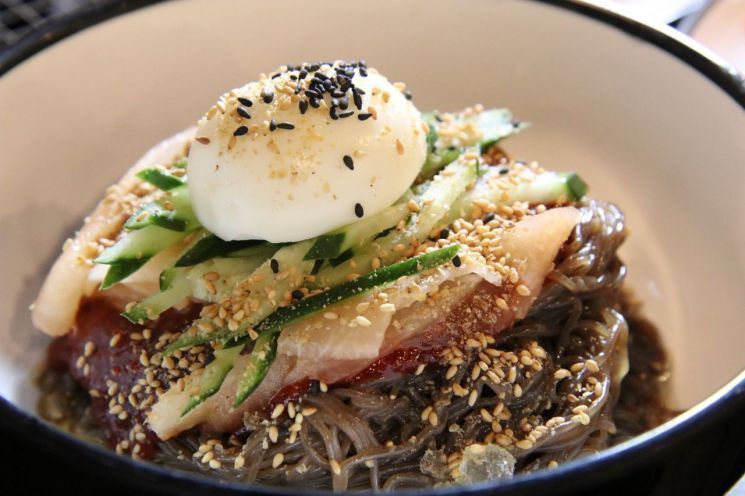
On June 19, the Korea Consumer Agency announced that, after examining the quality and safety of five types each of ready-to-eat mul-naengmyeon and bibim-naengmyeon available on the market, most products were found to have excessively high levels of sodium and calories.
According to the Korea Consumer Agency, 9 out of 10 naengmyeon products had sodium content exceeding 1,000mg per serving. This amount is more than 50% of the daily recommended sodium intake of 2,000mg.
By product, Chilgabsanong's "Eoreumchan Mulnaengmyeon" had the highest sodium content at 2,969mg. This was followed by Emart's "No Brand Mulnaengmyeon" at 1,833mg, which is close to 90% of the recommended daily intake. Among bibim-naengmyeon products, Chilgabsanong's "Eoreumchan Bibimnaengmyeon" recorded the highest sodium content at 1,790mg. The only product among the 10 surveyed with sodium content below half of the daily standard was Pulmuone Foods' "Hamheung Bibimnaengmyeon" at 803mg.
It was also found that mul-naengmyeon generally contained more sodium than bibim-naengmyeon. The average sodium content of the five mul-naengmyeon products was 1,999mg, which is higher than the average of 1,270mg for the five bibim-naengmyeon products.
Broth and bibim sauce accounted for 83% and 66% of the total sodium content per serving of naengmyeon, respectively. The Korea Consumer Agency advised that, since broth and bibim sauce contain relatively more sodium than the noodles themselves, consumers should consider adjusting the amount they add when eating.
The calorie content of ready-to-eat naengmyeon was also considerable. Per serving, the calorie content accounted for 23% to 29% of the estimated daily energy requirement. In a survey of 1,000 people conducted by the Korea Consumer Agency, 47% of respondents said they eat two servings of naengmyeon in a single meal, which is nearly half. In such cases, more than half of the daily energy requirement would be consumed at once. The Korea Consumer Agency explained that if one serving of naengmyeon feels insufficient, instead of increasing the portion size, adding toppings such as boiled eggs, meat, or cucumber can help reduce calorie intake while supplementing protein and minerals, thereby contributing to nutritional balance.
All 10 products passed hygiene and preservative tests. However, a foreign substance presumed to be fiber was detected in Chilgabsanong's "Eoreumchan Mulnaengmyeon," prompting the company to announce plans to prevent recurrence. In addition, the price per serving of ready-to-eat naengmyeon ranged from 1,708 won to 3,600 won, showing a price difference of up to 2.1 times between products.
© The Asia Business Daily(www.asiae.co.kr). All rights reserved.
![Clutching a Stolen Dior Bag, Saying "I Hate Being Poor but Real"... The Grotesque Con of a "Human Knockoff" [Slate]](https://cwcontent.asiae.co.kr/asiaresize/183/2026021902243444107_1771435474.jpg)















